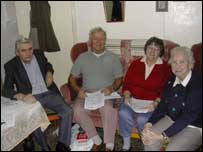
The Forest of Dean in Gloucestershire was home to one of the smaller coalfields in Great Britain. The collieries and small coal workings in the area some were home to close-knit communities, communities which developed remarkable series of local dialects - words in one town would have a meaning that would be lost on someone from a town just two miles down the road. Keith Morgan explains:  | Keith Morgan
Keith believes that mining had a strong influence on the Forest dialect. |
 You got totally different words, and that mean the same thing two miles down the road. Just the way you were talking to somebody. You got totally different words, and that mean the same thing two miles down the road. Just the way you were talking to somebody.
'How bist thee old butty, how's the acker cutting?' Well that's just a greeting to your friend, how you feeling sort of thing, but it also referred to pit life, where your butty was a system of payment, it went to the Butty Man.  Of course, Keith has his own theory as to the origins of the Forest dialect. He explains: Our dialect goes right back to Celtic times, that's when it started. A lot of the words we use come from that time. Then you got a lot of it which is pure old English - the use of the pronouns thee and thou is pure Old English. But a lot of words came out of the mines and the pits during the forties, fifties and so on. From listening to Keith, mining comes across as the strong influence on the Forest dialect. Keith reveals his thoughts on why this unique regional variant developed, he says: Because they were such isolated communities years ago, and people that worked in the pit, ne'er went far really, it was such an insular life. This belief is reinforced by Charles, who remembers life at the pit. He revealed:  | Charles Harvey
Charles remembers life in the Forest of Dean |
Back in them days we worked in the pits, you go out at night playing darts, or skittles, or crib, or whatever it was and it was such a friendly atmosphere. Charles also remembers how this atmosphere changed when mining died out in the area and other industries moved in, he says: When Northern [a colliery] closed - that was Christmas 1965 - a lot of the men were employed as nylon spinners at Gloucester. Rank Zerox [also] came to Mitcheldean. They [miners] knew their job, they dressed and talked according to the mining and the situation they were in. Now then, they had to go into work in the factory, with a collar and tie on and [it was] a totally different environment altogether. A lot of them just couldn't adapt to this new way of life. I mean men, maybe 50 or 55 [years of age], worked the mines all their life, now all of a sudden they gotta go and work in a factory, where maybe this whatever is coming down the line is gotta have a hole drilled exactly there, and there's another one, and another one, there's millions of 'em. Because life in the mines, there was never ever two days the same. There was a variety, the work was always different. You were doing the same job, but every day was different to the other one. This is possibly one reason why the old dialect of the Forest is not as strong as it once was. As modern technology makes communication on a wider scale easier, these old dialects are becoming less well known to today's generation and the worry is that they'll all but die out with maybe just one or two phrases lingering on. Keith and Charles talk about life in the Forest of Dean and reveal some of the fabled Forest dialect:  Listen to the Keith Morgan clip in 56k Listen to the Keith Morgan clip in 56k
Listen to the Keith Morgan clip in broadband
Listen to the Charles Harvey clip in 56k
Listen to the Charles Harvey clip in broadband To listen to audio content on the BBC you will need to have a program called RealPlayer installed on your computer. Download it for FREE by clicking here |