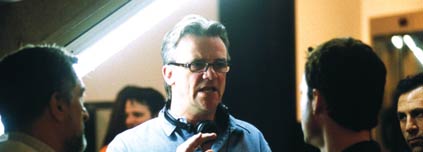

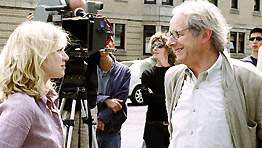
I went to Leicester a few days ago for Cinema Days. It's a well organised junket aimed specifically at the regional press. They'd pitched a small marquee next to a multiplex on the outskirts of the town and for three days the journalists were subjected to an onslaught of film activity: screenings, press conferences, interviews, presentations, etc. Everything from Spider-Man 2 footage to the recent Ken Loach film [Ae Fond Kiss]. I was due to do a press conference and as I walked into the marquee, there was Ken being interviewed in one corner. All the journalists who'd previously watched his film were now inside watching Godsend.
So there we were, sitting in a windy marquee both trying to promote our films. He's always been a hero of mine, but instead of introducing myself I got buried into conversation with some publicists and decided to take a walk into the multiplex.
Then it hit me.... swarms - yes, swarms - of people around the box office, queuing for the latest blockbuster. The place was alive, popcorn popping like it was going out of fashion. Popular entertainment at its most popular. The multiplex had truly arrived and this is what it has become.
You might ask what's wrong? It's working, people are going to the cinema - and you'd be right. But I couldn't help feeling incredibly depressed. Are we all just kidding ourselves? One of the greatest filmmakers this country has ever produced was sitting 20 yards away in an empty marquee, being interviewed by a solitary Scottish journalist. People were piling in next door oblivious to his presence and to his movies.
 So what, you say? He makes films that only appeal to a small minority of people. Why should the enormous marketing machine that is cinema now give him attention? Because it should, that's why!
There's no right or wrong in cinema, just what is and what should be.
So what, you say? He makes films that only appeal to a small minority of people. Why should the enormous marketing machine that is cinema now give him attention? Because it should, that's why!
There's no right or wrong in cinema, just what is and what should be.
When it first started, the multiplex was hailed by people in the film business as a salvation. The initial idea was that commercial movies would sit side by side with art-house. There would be no artistic apartheid; rather there would be a flow of audience from one to the other. That was a short-lived dream. There is no flow. Cinema owners forced by market pressure simply put the popular movies on more screens and don't even bother to show the others... it is a brave manager who will save a few screens for the more esoteric product.
Some films educate, make you believe in a better world and the possibility of creating one. Unfortunately, the access people have to these films is limited. Even those lauded at festivals rarely get to breathe in some kind of open market. Our cinemas are corporate institutions, catering almost exclusively for the mass market. The marketing machine pumps the new opening every week and every week people go. Sometimes it's like eating fast food: the anticipation is greater then the reality. The moment you've eaten it you regret it.
You're probably thinking: What's Hamm banging on about? You've just made a Hollywood movie, how can you talk? I know, I know, and I hope Godsend reaches as wide an audience as possible.
Kees Kasander said recently: "The cinema is dead, long live the DVD." What he means is that it's too expensive to put some movies 'out there' anymore. Digital distribution has come of age... and the way it is used provides us as filmmakers with many exciting possibilities. It's cheap, easy to screen, print costs are low, you could show a different movie every night, even give away a free DVD. Releases could take place on different platforms, special screening rooms could be set up. The running of this needs to be controlled and managed.
How many of us now think we can change anything by what we make? It's a rare movie that changes lives. When I first started as a theatre director working on the fringe in London, I put on plays for the social messages - which I believed were essential for the common experience. Now I try and disguise that message and just try and tell the stories in as clever and intricate a way as I can.
My reasoning is that it's hard enough to reveal the complexity of human emotion and the contradiction of behaviour and that any 'message' about how we should behave is made redundant because it's so obvious. Does cultural awareness make you a better person? Are people better off in a society, with a complex matrix of art on offer - are they better people?
It's a funny contradiction that in the film business, or maybe just in the entertainment business in general, this is often not the case. The proximity to the product does not necessarily create greater awareness, and it's often the case that choice is made from a position of fear - and the higher up individuals are on the food chain, the worse they allow themselves to behave.
Anyway, I went back to the marquee. Ken had gone and I did a lively press conference with about 50 journalists, who were great. Long live Leicester.
"CAMERA DISAPPEAR... PEOPLE DISAPPEAR..."
On another note, I had a word with my Italian producer friend this week, about funding for the development of the "mafia film". A few months ago I bought the rights to a short novella, the first part of which I read in the International Herald Tribune. It's a great story and a completely original way into the whole mafia thing. However, it takes place in Sicily. I sent him the short story a while back saying our company needed development money to commission the script. Every few months I bug him about whether he's going to give me any money. I'm forced to do this by the writer who, in turn, periodically bugs me about whether or not I've secured him a commission.
And around it goes. As this was one of those days and the writer had just called, I picked up the phone and dialled Milan. I got straight to the point: "Francesco, are you going to give me the money?" He inhaled, spoke in Italian, checked himself, then in stalling English explained to me that it is very difficult to shoot movies in Italy which talk about the mafia. No surprise there then. He told me that he'd been working with a very respected Italian director - no names please - who'd now been waiting patiently for the last six months for permission to shoot in Sicily. "It's very difficult," he sighed. "You see, without permission, camera disappear, people disappear..."
He went on for a few more minutes. My heart sank. Not only did this project have all the common problems associated with getting any movie going - you could also get shot. It's going to be difficult to convince my brother we should carry on with this one.
So there we are. With all this I'm still in the middle of Three. Intense work on the script has improved it; we've set the inner emotional story in a political context now and have started serious research into where we might shoot. It is one of the most powerful movies I have ever been involved with, and will take all my energy to get it going.
While Nick was in America, he shot footage of the Godsend US junket:
Watch it here