|  | Peter Pan, the boy who refused to grow up, is one of the greatest stories in children's literature.
The year 2004 marks the 100th anniversary of the first performance of J.M. Barrie's classic play.
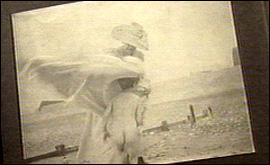
In a timely discovery a unique photograph album has been unearthed in Exeter, which shows the real-life subjects who were the inspiration for the play and later the book.
The album, from the pioneering days of photography, was uncovered in the vaults at Exeter University where the papers of novelist Daphne du Maurier are stored. 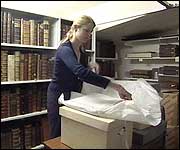 | | Dr Jessica Gardner with the newly discovered album. |
It contains a series of beautiful late 19th and early 20th century photographs taken by Barrie of the family which inspired him to write Peter Pan.
Two boys featured in the photographs are of particular significance - because it was they who provided the inspiration for the so-called ‘Lost Boys’ in Peter Pan.
The children were those of Arthur and Sylvia Llewelyn Davies - the aunt of Daphne Du Maurier.
The family was befriended by Barrie and when Sylvia Llewelyn Davies died in 1910, the author became the boys' unofficial guardian.
It's taken a year of hard work to find out exactly how important the photographs are.
"It was immediately obvious that they were something special," explained Dr Jessica Gardner, Exeter University librarian.
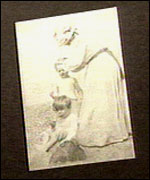 | | The Llewelyn Davies family as seen through J.M. Barrie's camera. |
"But it was only when we began doing some research into the pictures that we identified it actually was a photograph album relating to J.M. Barrie and Peter Pan.
"They are quite unique, we think the photographs were taken by J.M. Barrie himself and they really show the relationship he had with this family.
"They capture something of the lost innocence of this era in the late 19th Century."
Peter Pan, or the Boy Who Would Not Grow Up, was first performed on December 27th 1904 at the Duke of York Theatre, in London
Ever since, Barrie's classic adventure story has thrilled and delighted generations of children.
The album was found among a treasure trove of family and literary papers which once belonged to the Cornish writer Daphne du Maurier.
Also tucked away in the vaults were original illustrations by du Maurier’s grandfather, the novelist and illustrator George du Maurier (1834-1896), theatre scrap books of Daphne’s father, Gerald du Maurier (1873-1934), and original handwritten manuscripts of Rebecca, one of the nation’s favourite novels.
First published: December 2003
|