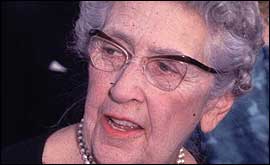
|  | Agatha Mary Clarissa Miller was born in Barton Road, Torquay, Devon, in September 1890...and would go on to change the art of crime-writing forever.
Agatha Miller would, of course, become Agatha Christie - and when you look at how the self-taught woman started as a novelist, it's all the more amazing that she later became the biggest selling whodunnit writer the world has ever seen.
Her father, Frederick Miller, was from New York, but died when Agatha was a child, so she was brought up - and educated - by her mother in Torquay.
It was her mother who first suggested she tried her hand at writing, when Agatha was stuck indoors because of a cold.
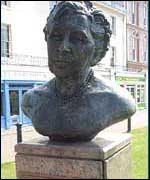 | | The bust of Dame Agatha in Torquay |
Agatha was also said to be rather disappointed about the mystery books on the market, as you could always guess "whodunnit."
A key time for her was during the First World War. She married Archibald Christie - an officer in the air force - shortly after the outbreak of the war, and they had a very short honeymoon at the Grand Hotel Torquay.
The hotel is featured in the Agatha Christie trail - a mystery walk in Torquay which takes you to places associated with the writer.
Agatha then did her bit for the war effort by working in a hospital in Torquay. This, apparently, is where she learnt about drugs and poisons - knowledge she would use in her books.
Agatha's first big success was in 1920, with "The Mysterious Affair at Styles" - where the Belgian detective Hercule Poirot made his debut. The script was rejected six times by publishers (who must have regretted their decision later).
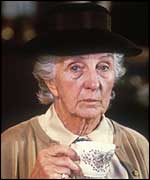 | | Actress Joan Hickson as Miss Marple |
Her other famous character, elderly spinster Miss Marple, made her first appearance in "Murder in the Vicarage" in 1930.
She used places in Torquay and South Devon in her books - such as the cliffs at St Marychurch, the Imperial Hotel, Torquay, and Burgh Island.
In December 1926, Agatha was herself at the centre of a mystery, when she disappeared from her home in Sunningdale. It followed the revelation that Archie was having an affair with a younger woman, Nancy Neele.
Newspapers offered rewards for information about her whereabouts, and for a brief time, Archie was suspected of murdering her!
In the end, she was found at a hotel in Harrogate, Yorkshire, and the claim was that she was suffering from amnesia.
No real explanation has ever been forthcoming, but it's known that she cheekily booked herself into the hotel as "Teresa Neele."
She and Archie were divorced, and Agatha married her second husband, archaeologist Max Mallowan, in 1930.
Among the Queen of Crime's best loved works are "The Murder of Roger Ackroyd," "Why Didn't They Ask Evans," "Witness for the Prosecution," "Death on the Nile," "Murder on the Orient Express," and "The Mousetrap" - which was first staged in London in 1952 and became the longest running play in the world.
Agatha was made a Dame of the British Empire in 1971, and died in January 1976 at the age of 85.
Her family home, Greenway, overlooks the River Dart near Galmpton in South Devon.
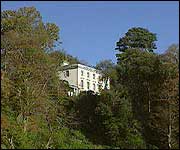 | | Greenway House and gardens |
Although she never wrote any of her books there, it became a holiday home and a retreat for her until her death in 1976.
The house was gifted to the National Trust in 2000 by Dame Agatha's daughter, Rosalind Hicks, and her husband, Anthony.
The gardens are open to the public - and there's even a mystery whodunnit over who designed the gardens - was it the acclaimed architect Thomas Repton?- read our feature and see what you think.
It's incredible to think that more than a quarter of a century after Dame Agatha's death, her books are still among the most read in the world, and that her stories are still popular on TV and on film.
Her legacy lives on in Torquay, where the museum has an Agatha Christie section, and there's also a bronze bust of the writer near the harbourside.
Her mother's suggestion that she should make use of her time while confined with a cold must go down as one of the best pieces of motherly advice ever!
|