|  | The village detective goes to Ravenglass
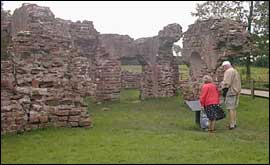
| | Walls Roman Bath House dating from the 1st Century |
Roman Bath House:
These very fine remains of roman masonry date from the 1st Century and lie close to a very important Roman Fort at the southern end of the Hadrian's Wall fortifications. They are the tallest Roman remains in Northern England and are open to the public free of charge. The site is protected as a scheduled ancient monument.
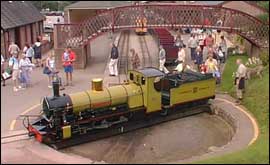 | | Ravenglass and Eskdale Railway terminus |
Ravenglass and Eskdale Railway:
This narrow gauge railway was constructed in 1875 as a mineral line to carry Iron ore from Boot in Eskdale to the coastal railway. It was re-laid to a 15" gauge in 1915 and is now one of the most scenically attractive railways in Britain and a very popular tourist attraction.
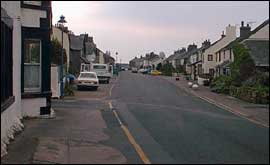 | Ravenglass Main street - view south |
Main Street:
When King John granted a Market Charter to Ravenglass in 1208, the Main Street Market Place was laid out with gently curving building frontages. The early clay and thatch buildings have gone and the street is no longer the main coastal road. However, there are still many clues and pieces of evidence to show the former importance of Ravenglass as a busy port.
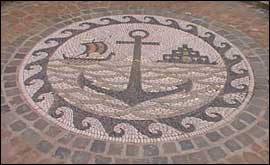 | Millennium Garden new cobble mosaic |
Millennium Garden Cobble Mosaic:
A part of a scheme to improve a piece of land just off the Main Street, a cobble mosaic was designed with help from local school children and laid by Maggy Howarth (a cobble artist). The mosaic uses local cobblestone to pick out features of local history - the sea, a castle, a Viking longboat and an anchor. |