|  | The village detective explores Broughton in Furness.
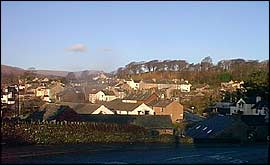
| View over Broughton in Furness |
| Andy Lowe, village detective |
View over Broughton-in-Furness from the eastern approach road:
This compact market town dates from the 18th and 19th centuries and was once a busy centre of woodland craft industries, with a railway link to Coniston (1859-1962).
Today, the traditional industries and railway have gone, but the town still has a strong identity as a thriving rural community with a small weekly market and a busy livestock mart. 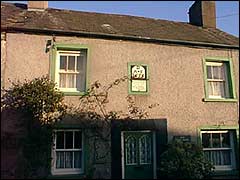 | Syke House |
Syke House:
Syke House on the western approach is an attractive listed building with datestones of 1655 and 1740.
Before the mid-18th century, Broughton-in-Furness was a loose group of buildings, strung out along this ancient coastal route .
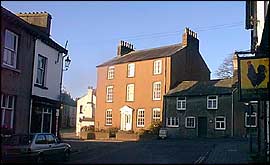 | Broughton House |
Broughton House:
Broughton House is a fine mid-18th century town house indicating the growing prosperity of this market town. Its formal elegance contrasts with the adjacent earlier small cottages.
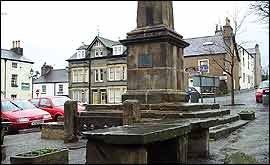
 | Market Square |
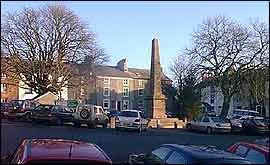
Market Square:
Broughton-in-Furness Market Square was formally laid out in 1760 by John Gilpin Sawrey, the Lord of the Manor, who lived at Broughton Tower,a large mansion just a short distance from the Square.
In the centre of the Square is an obelisk commemorating the Golden Jubilee of George III in 1810, two slate fish market slabs, old stocks, together with the surrounding three storey merchants houses and Town Hall, creates a unique feeling to this historic market town. 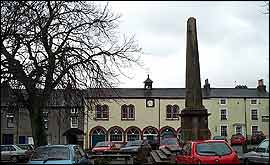 | The Town Hall and obelisk |
|