Dublin to Derry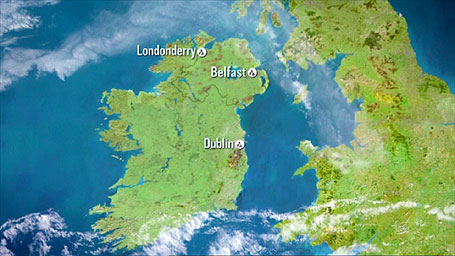
This captivating and ancient coastline is a magical place. Besides its charm and warm hospitality, it has much more to offer. This remarkable stretch of coast has three great Cities that have been shaped over the centuries by the sea. This idyllic setting of rugged coast and secluded beaches has drawn, influenced and inspired many people and still does today.
Dublin
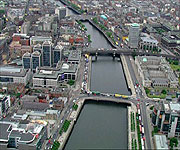 Dublin's history is one of invaders from the Vikings in the 9th Century to the Normans and British after that, they have all left their mark. Dublin's history is one of invaders from the Vikings in the 9th Century to the Normans and British after that, they have all left their mark. Centred around the Liffey, the river and the Irish Sea beyond, have brought prosperity to the City. Dublin's Bull wall and Great South wall, begun 300 years ago, are vital in keeping the shipping channel open at all tides, allowing two thirds of Ireland's sea trade to come through. 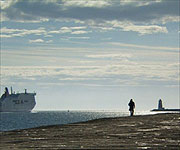 Dublin has now been transformed to a modern vibrant capital city that is home to a quarter of the Republic's population. One of its best kept secrets are the beaches. Dublin has now been transformed to a modern vibrant capital city that is home to a quarter of the Republic's population. One of its best kept secrets are the beaches.
Neil Oliver meets up with Fionn Davenport to find out about Dublin's past and discovers that its name translates to Black Pool! 'Dublin' comes from the Irish for Black "Dubh" and Pool "Linn" - not quite the romantic, mystical Gaelic meaning Neil had hoped for. Laytown Races
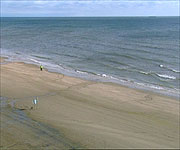 There's something quite spectacular about seeing horses racing on the beach. There's something quite spectacular about seeing horses racing on the beach. Racing horses is an old tradition and in Laytown there has been a race since 1867. Once a year people flock here for the last remaining beach race under Jockey Club rules.
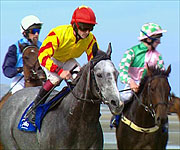 Miranda Krestovnikoff meets local trainer and racer Marcus Callaghan and has a bit of a flutter on last year's winner Paris Sue. But the odds are hard to calculate as the horses are used to performing on turf and not sand. So outsiders are in with a chance. Miranda Krestovnikoff meets local trainer and racer Marcus Callaghan and has a bit of a flutter on last year's winner Paris Sue. But the odds are hard to calculate as the horses are used to performing on turf and not sand. So outsiders are in with a chance. But horses aren't the only thing being gambled on. Each year the course is built from scratch on Laytown's huge beach, will the organisers win their race against the tide? Dundrum Bay - Salvaging the SS Great Britain
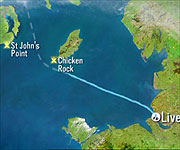 The SS Great Britain was designed by Isambard Kingdom Brunel. It was the world's first propeller driven steam passenger ship and now rests in Bristol Harbour. But one hundred and sixty years ago the story could have been very different, its resting place could have been Dundrum Bay of the Northern Irish Coast. The SS Great Britain was designed by Isambard Kingdom Brunel. It was the world's first propeller driven steam passenger ship and now rests in Bristol Harbour. But one hundred and sixty years ago the story could have been very different, its resting place could have been Dundrum Bay of the Northern Irish Coast. 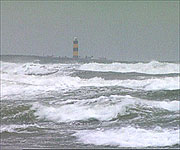 In 1846 the ship left Liverpool destined for New York. Rather than turning right at the Chicken Rock lighthouse on the Isle of Man, it went straight on to St Johns Point in Northern Ireland and ran aground on Dundrum Bay. In 1846 the ship left Liverpool destined for New York. Rather than turning right at the Chicken Rock lighthouse on the Isle of Man, it went straight on to St Johns Point in Northern Ireland and ran aground on Dundrum Bay.
Captain James Hosken claimed that his chart was out of date and mistook the light house at St Johns Point for the one on the Isle of Man. St Johns Point lighthouse was built 2 years earlier in 1844. 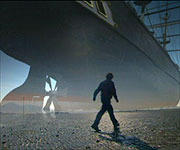 The sands are very dangerous in these parts and with the ship weighing more than 3,000 tonnes, it seemed there was no chance of refloating her. Determined to convince the public that iron ships were reliable, Isambard Kingdom Brunel went to Dundrum Bay to work out a solution and salvage the ship, but his first concern was to protect her. The sands are very dangerous in these parts and with the ship weighing more than 3,000 tonnes, it seemed there was no chance of refloating her. Determined to convince the public that iron ships were reliable, Isambard Kingdom Brunel went to Dundrum Bay to work out a solution and salvage the ship, but his first concern was to protect her.
With the help of Marine Archaeologist Shane Casey, Mark Horton Investigates how Isambard Kingdom Brunel managed to salvaged the Great Britain from disaster. Harbour Seals
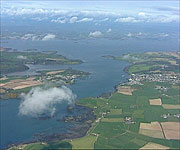 Strangford Lough is the largest sea lough in the British Isles protected as one the most important marine environments in Europe. Every year Harbour Seals (also known as Common Seals) return to the area to give birth on the rocks. Strangford Lough is the largest sea lough in the British Isles protected as one the most important marine environments in Europe. Every year Harbour Seals (also known as Common Seals) return to the area to give birth on the rocks. But with Belfast being only thirty miles away there are many visitors to this tranquil coast. 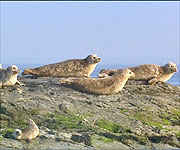 At the slightest sign of threat during pupping time the seals can panic. Mothers and pups are easily separated and each season abandoned pups are left on the rocks, vulnerable and unable to fend for themselves. At the slightest sign of threat during pupping time the seals can panic. Mothers and pups are easily separated and each season abandoned pups are left on the rocks, vulnerable and unable to fend for themselves.
Miranda Krestovnikoff meets with seal expert Sue Wilson. Sue is helping pups abandoned by their mothers to survive by nurturing them for a few weeks until they can feed themselves. Belfast - The Floating City
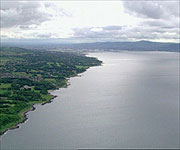 Belfast has developed around the tidal river The Lagan. Scottish and English entrepreneurs were determined on developing the place and helped make it what it is today, Ireland's most industrial city. Belfast has developed around the tidal river The Lagan. Scottish and English entrepreneurs were determined on developing the place and helped make it what it is today, Ireland's most industrial city. Neil Oliver is on a mission to find out about Belfast's history and discovers that this City defies nature. He joins engineer Kerry Greeves who is drilling for foundations and learns that most of the city is built on mud and salt water. The bedrock is sandstone which is 50 metres down - a problem builders past and present have had to contend with. Much of the land that the city is built on is man made, reclaimed from the sea by those who saw the potential of a seemingly unpromising place. 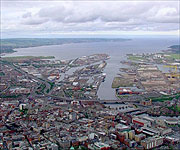 But what about the entrepreneurs who came here. What attracted them to Belfast? To find out more, Neil meets up with local author Glenn Patterson who wrote:- But what about the entrepreneurs who came here. What attracted them to Belfast? To find out more, Neil meets up with local author Glenn Patterson who wrote:-
Belfast is a triumph over mud and water, the dream of successive generations of merchants, engineers and entrepreneurs. Their names driven like screw-piles into the city's sense of itself. Dargan, Dunbar, Workman, Harland. The thing is they're all Scottish or English names. Protestant merchants attracted here from the beginning of the 17th century by the promise of land at the water's edge. Salt Mine
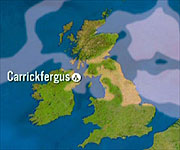 The beautiful landscape just outside Carrickfergus hides a strange and eerie sight. It is the site of an industry that is crucial to all of us especially during the winter months. The beautiful landscape just outside Carrickfergus hides a strange and eerie sight. It is the site of an industry that is crucial to all of us especially during the winter months. Half a million tonnes of salt are shipped from the Irish Salt Mining & Exploration Company in Kilroot every year, some going to England, Scotland and as far as the USA. It's used for gritting icy roads in winter.  But how was it formed and why is it here? It is basically old land locked sea that has evaporated. This area sits on huge deposits of subterranean salt and has several evaporated sea beds layered down on top of each other. But how was it formed and why is it here? It is basically old land locked sea that has evaporated. This area sits on huge deposits of subterranean salt and has several evaporated sea beds layered down on top of each other.
Alice Roberts meets Mine Surveyor Jason Hopps and descends over 1,000 feet underground to discover a labyrinth of tunnels over 30 miles long.
 Island of Carrick-a-Rede Island of Carrick-a-Rede
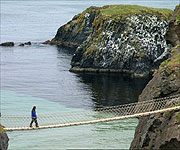
For five hundred years local fishermen have used a rope bridge to get from the mainland to the island of Carrick-a-Rede.
But at 96 feet above the water, will vertigo set in as Neil stumbles across to the other side? Bendhu House
Perched on top of a cliff at Ballintoy is Bendhu House, a listed building designed by Newton Penprase in 1936.
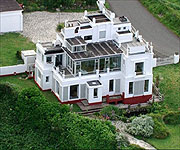 This unconventional design by this eccentric Cornish man was built from materials around him on the coast. Bendhu House is on a perfect site to view this beautiful coastline and has no fewer than fifty windows so the view can be appreciated at all times. Unfortunately Newton Penprase didn't finish building his dream home before he died in 1978. This unconventional design by this eccentric Cornish man was built from materials around him on the coast. Bendhu House is on a perfect site to view this beautiful coastline and has no fewer than fifty windows so the view can be appreciated at all times. Unfortunately Newton Penprase didn't finish building his dream home before he died in 1978. Alice Roberts meets up with Lorna and Michael Ferguson who took over from where Newton left off and put the finishing touches to Bendhu House. Derry - Surrender of German U-Boats
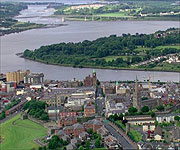 Like Dublin and Belfast, Derry sits where the river meets the sea. For all three cities their proximity to the coast has defined their development and history. Like Dublin and Belfast, Derry sits where the river meets the sea. For all three cities their proximity to the coast has defined their development and history. Until recently Derry was a key naval base and during the Second World War the port played a vital role for Allied convoys. Neil travels to Derry to find out more about events that unfolded at the end of the Second World War when a North Atlantic fleet of German submarines surrendered here. 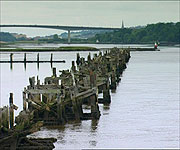 He joins Maeve Kelly who, on an afternoon off from work, witnessed Sir Max Horton of the British Navy taking surrender from the Nazi submariners. At the time Maeve didn't realise that she was witnessing history being made. He joins Maeve Kelly who, on an afternoon off from work, witnessed Sir Max Horton of the British Navy taking surrender from the Nazi submariners. At the time Maeve didn't realise that she was witnessing history being made.
In one of the final acts of the Second World War the U-boats were taken back out to sea and sunk just off the coast of Derry - and they still lay there. Would you like to find out what music was used in this programme? Dublin to Derry: Thursday 23 Nov, 8pm on BBC TWO
|