Cornwall & the Isles of Scilly
Cornwall is England's most coastal county. Often viewed as isolated and remote, its golden beaches have made it a perfect holiday destination. But besides this county's dramatic good looks, it has been home the birth place of global communications and new technologies of their time.
Saltash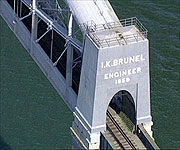
Neil Oliver begins his journey on the River Tamar - the natural border between Devon and Cornwall. If it wasn't here, some say Cornwall would be allowed to float away as an island. In 1859 a bridge opened across the River Tamar, designed by Isambard Kingdom Brunel, it unlocked Cornwall to the rest of the country. Looe Fish Market
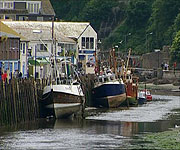 Looe is an idyllic picture postcard town - but there's much more to this town than meets the eye. Looe is an idyllic picture postcard town - but there's much more to this town than meets the eye. Looe is classed as one of Cornwall's traditional coastal harbours and is one of the busiest fishing harbours in the county, second to Newlyn. But what is its success down to?
 The harbour is small and shallow so it can only accommodate day boat fishing.This means that the portlands some of the freshest fish in the UK, resulting in a very busy fish auction. The harbour is small and shallow so it can only accommodate day boat fishing.This means that the portlands some of the freshest fish in the UK, resulting in a very busy fish auction. Neil Oliver meets fish merchant and auctioneer Steve Farrar to find out why 90% of the fish in Looe ends up going abroad. Carlyon Bay Beach - is it down to mother nature?
At Carlyon Bay, the locals have been fighting - what they describe as - a 'costa-del-style' development for the past five years. 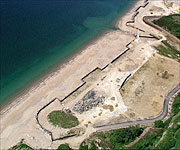 But appearances can be deceptive as the beach they're fighting to protect isn't just any ordinary beach, it's man-made and rather unique. Nicholas Crane meets geologist Glynda Easterbrook to investigate why Carlyon Bay beach isn't down to mother nature. He discovers it is made from China Clay waste, washed down from rivers further inland. But appearances can be deceptive as the beach they're fighting to protect isn't just any ordinary beach, it's man-made and rather unique. Nicholas Crane meets geologist Glynda Easterbrook to investigate why Carlyon Bay beach isn't down to mother nature. He discovers it is made from China Clay waste, washed down from rivers further inland.
At Blackpool pit, Nicholas meets Ivor Bowditch and discovers there's more to china clay than tea cups. It has over 500 uses from paper to paint, even down to medicine! Falmouth Packet Ships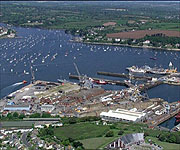
Between 1700 and 1900 Falmouth was the most cosmopolitan port in England. But it was much more than a major commercial and military port, it was an international communications centre, with people arriving daily from around the globe. But why? When war broke out with France in 1688, Britain lost most of its overland trade routes. Falmouth was far enough from the French coast but British ships were still vulnerable. The solution was the Falmouth P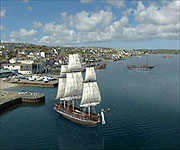 acket; lightly-armed brigs,fast enough to outrun the notorious French privateers. acket; lightly-armed brigs,fast enough to outrun the notorious French privateers. For two hundred years they carried government mail, bullion and VIPs, providing the glue that held the British Empire together. Falmouth would often hear of news from around the globe before London, and was the first to receive news of Nelson's death. The Manacles - wreck dives on this stretch of coast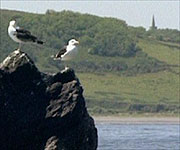
It was the sea that brought prosperity to Falmouth, but sometimes this came at a price. The coastline is littered with thousands of wrecks. The Manacles, just off the Lizard, with its submerged rocks has caught out even the most salty of sea dog. Many sailors used the spire of St Keverne's Church on the mainland as a landmark to try and avoidthe rocks, but it couldn't always guarantee their safety.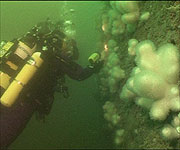
Miranda Krestovnikoff dives off the Manacles with Marine Biologist Paul Naylor who's been exploring the remains of boats like the Mohegan passenger ship, and the rocks surrounding them, for over 15 years. Together they investigate the marine life on this decaying wreck. Lizard Peninsula - The return of the Chough
 The Lizard is the most southerly point in Britain. Fifty years ago, it was home to a rare bird - the Chough. The Lizard is the most southerly point in Britain. Fifty years ago, it was home to a rare bird - the Chough. The Chough can't feed on short vegetation and changes in farming practices during the 1950s saw them disappear from the Point. But there's been a resurrection and now the Chough is making a comeback to these parts. Quite importantly this is not a reintroduction  - with the help of conservationists and farmers, they've come back on their own accord. - with the help of conservationists and farmers, they've come back on their own accord. Neil Oliver meets Claire Mucklow from RSPB to find out more about their comeback. He catches up with Chough Watch - a volunteer group dedicated to keeping an eye on the birds - to see what steps have been taken to protect these birds. 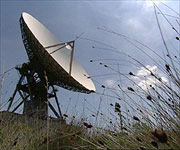 Goonhilly - Satellite Communications Centre Goonhilly - Satellite Communications Centre
Goonhilly houses the world's biggest centre for satellite communication.
It is also home to Arthur, a giant antennae which received the first ever TV pictures across the Atlantic via a communication satellite in 1962.
Porthcurno - Communications hub for the British Empire
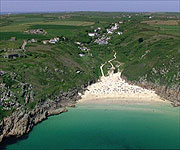 Cornwall witnessed a method of communication that is still as important today as it was a hundred and thirty years ago cables! In 1870, the secluded cove of Porthcurno was where Britain was wired to the world. Cornwall witnessed a method of communication that is still as important today as it was a hundred and thirty years ago cables! In 1870, the secluded cove of Porthcurno was where Britain was wired to the world. A network of fourteen cables stretched from under this beach around the globe. For the first time in history, telegraphy made rapid communication possible between Britain and her distant colonies. 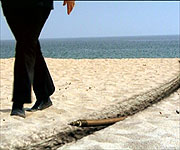 But why Porthcurno and not Falmouth one of the worlds busiest harbours at that time? Neil Oliver meets Mary Godwin from Porthcurno Museum to find out why Porthcurno was chosen as the location. But why Porthcurno and not Falmouth one of the worlds busiest harbours at that time? Neil Oliver meets Mary Godwin from Porthcurno Museum to find out why Porthcurno was chosen as the location.
However at Poldhu Point in 1901, thirty miles away from Porthcurno, a young Italian scientist - Guglielmo Marconi transmitted the first transatlantic wireless signal to Newfoundland. Wireless communication had arrived.
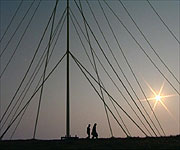 Although many cable companies denied their concern about this new technology, Neil Oliver finds evidence that they spied on Marconi and tampered with transmissions. But they need not have worried. One advantage cable had over wireless was difficulty of interception. During the war Porthcurno was so important, security measures were put place to protect it from Hitler. Although many cable companies denied their concern about this new technology, Neil Oliver finds evidence that they spied on Marconi and tampered with transmissions. But they need not have worried. One advantage cable had over wireless was difficulty of interception. During the war Porthcurno was so important, security measures were put place to protect it from Hitler. Isles of Scilly - The mystery of the Isles of the Dead
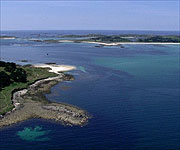
The Isles of Scilly have over fifty islands with crystal blue waters, super soft stand and stunning v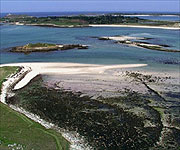 iews. But to archaeologist they are known as the Isle of the Dead. iews. But to archaeologist they are known as the Isle of the Dead. The Isles has the densest concentration of burial chambers in Britain. Over 60% of the islands are classed as archaeologically important. With 83 known burial chambers, this is a huge concentration for such a small area. The chambers are Bronze Age ritual-burial monuments, but who were the dead and why are there so many? Were they brought over from the mainland or did they reside there? Mark Horton meets up with local archaeologist Katharine Sawyer to try and solve the mystery of the dead. 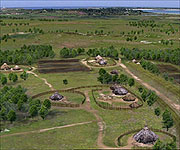 They visit burial chambers on the islands of St Mary's, Gugh and Samson which has the largest concentration of burial chambers. They visit burial chambers on the islands of St Mary's, Gugh and Samson which has the largest concentration of burial chambers.
The discovery of the best preserved burial chambers on these islands, Bant's Carn on St Mary's and Obadiah on Gugh help solve this mystery. At low tide the island of Samson reveals evidence of Bronze Age living. Field boundaries suggest this island was once part of one landmass but as sea levels rose the Isles of Scilly were formed. Isles of Scilly - One of the smallest football leagues in the world
 The Isles of Scilly has the smallest national football league in the world. The league's two clubs; Woolpack Wanderers and the Garrison Gunners, play each other around 20 times a season and compete for two cups as well as the league title. All ages take part from 15 to 64 years old. The Isles of Scilly has the smallest national football league in the world. The league's two clubs; Woolpack Wanderers and the Garrison Gunners, play each other around 20 times a season and compete for two cups as well as the league title. All ages take part from 15 to 64 years old. There may only be two teams in the leagues, but they don't take the game lightly. St Ives - quality of the Cornish light
The romantic landscape and the 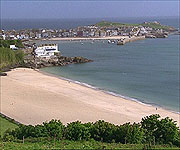 unique quality of light have attracted artists to Cornwall since the early nineteenth century when Turner famously paid a visit. By the 1920s, it was a full on bohemian artist's colony. unique quality of light have attracted artists to Cornwall since the early nineteenth century when Turner famously paid a visit. By the 1920s, it was a full on bohemian artist's colony. Cornwall has the largest concentration of artists outside of London. When Tate St Ives opened in 1993 it was official confirmation of St Ives's status as a major cultural centre. St Ives' peninsula landscape has a lot to inspire painters. Alice Roberts meets Naomi Frears - one of 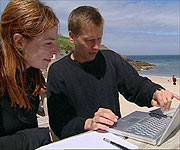 many artists to have fallen prey to the charms of St Ives - to find out why artists are attracted to this place. many artists to have fallen prey to the charms of St Ives - to find out why artists are attracted to this place. But does St Ives really have a unique quality of light? And why is the light so different? Alice Roberts joins Beau Lotto from University of Central London as he carries out light sensor tests to find out what makes the light here so special. St Agnes - industrial past of the Cornish Tin Miners
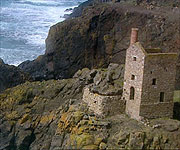 For 2000 years local miners made a living out of tin mining. They were exposed to toxic working conditions and the mortality rates were high. The whole community was involved in the industry and when the industry started to declined here, they took their skills around the world. For 2000 years local miners made a living out of tin mining. They were exposed to toxic working conditions and the mortality rates were high. The whole community was involved in the industry and when the industry started to declined here, they took their skills around the world. But what is the link between these miners and the Cornish pasty? The story goes that its shape is down to the toxic past of the miners. There would be meat and veg in one end, and the other would have something sweet like jam, but the famous crust was for the benefit of their toxic fingers and was to be thrown away afterwards. Padstow - Lobster Hatchery 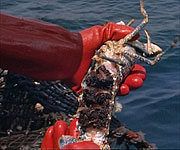
With our increasing demand for freshly caught local lobsters, demand can often exceed supply. In Padstow, they're trying to do something about it. Local fishermen and shellfish merchants are taking pregnant lobsters to Padstow Lobster Hatchery as part of the Stock Enhancement Programme. The Hatchery aims to give juvenile 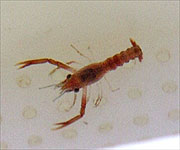 lobsters a better chance of survival in the early stages, harvesting and releasing them eight months later into the wild. lobsters a better chance of survival in the early stages, harvesting and releasing them eight months later into the wild.
Miranda Krestovnikoff joins Dom Boothroyd from Padstow Lobster Hatchery to find out about the work they are doing to preserve declining stocks.With the Hatchery's help, four out of five should make it to maturity. Would you like to find out what music was used in this programme?
Cornwall & the Isles of Scilly: Thurs 16 Nov, 8pm on BBC TWO |