
| |
| 疑难解答 | |
 | | | | | | | ||||||||
| | |||||||||||||
Identifying American Accents 辨别美语口音 | ||||||||||||||
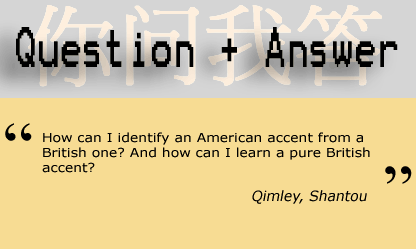
Listen to this programme first and then read the information below. 请先听节目然后再阅读以下内容。 Qimley has a question for us this week about accents. She wants to know how to identify an American accent from a British one. It's important to say there isn't an easy answer to this. In Britain there are so many accents and some are similar to American English and some aren’t. Similarly, North America is huge and there are a lot of different accents so there isn’t just one way to speak American English. We spoke to Dana Hunter from Canada, who has lived in the UK for 10 years, so she knows a lot about the differences between the two Englishes. She pointed out a few of the general differences to try and help you. First of all, vocabulary used in American English and British English differs with certain words. For example, North Americans say apartment and British people say flat. North Americans say garbage and British people say rubbish. There are many examples of this different vocabulary that you can look up on the internet. There are also some words that are spelt the same but pronounced differently in North American English. Tomato and herb are good examples of this. There are some general differences in the pronunciation of certain sounds, as Dana mentioned. In North American English, the letter R is much more pronounced than in most British accents. In a word like car, the British pronunciation sounds more like caa. When North Americans say words with t and u – in words like Tube (the subway in London), tuba, and tuna it sounds like too – toob, tooba, toona. The British pronunciation sounds like ch – choob, chooba, choona. Certain 'a' sounds are pronounced differently too. The word water sounds very different in North American to British English. You can hear all of these words in the audio programme accompanying this page. If you want to learn British English as opposed to North American English, our Learning English expert Nuala O'Sullivan advised you to look for British-based resources to learn English – British websites like bbcchina.com.cn, TV programmes, films, audio programmes like our BBC Learning English ones. Her most important advice, however, was to not worry about which accent you speak or learn English with. Aim to understand a variety of Englishes, and just be yourself and use your own accent to speak in. Native English speakers don't care which English accent you learn or speak in – if you can communicate with them then accent really doesn’t matter. Thanks for your question Qimley. We hope the advice is useful to all of you learning English. If you have a question you would like to ask us about the English language, email us: questions.chinaelt@bbc.co.uk. We look forward to hearing from you. Glossary 词汇
| ||||||||||||||
| ||||||||||||||
| ||||||||||||||


 本周问题与答案
 Download the script of this programme 点击此处下载文字材料