



 | | | | | | | |||||||||||||||||||||||||||||||||||||
| | ||||||||||||||||||||||||||||||||||||||||||
|
Haiti cholera toll exceeds 1,100 | ||||||||||||||||||||||||||||||||||||||||||
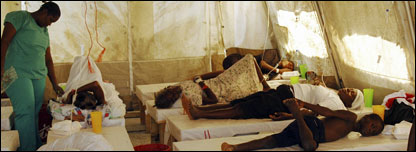
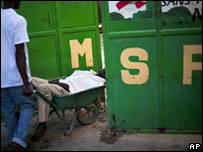
The cholera outbreak in Haiti has now claimed over 1,100 lives. More than sixteen thousand people have been treated in hospital, and the disease has reached almost every province of the country. Aid agencies however say the government figures may understate the epidemic. The United Nations says it is trying to collect more data to include information from communities to get a more realistic picture of the outbreak. The greatest worry has been over the overcrowded camps for displaced quake survivors. Cholera is caused by bacteria transmitted through contaminated water or food. It causes diarrhoea and vomiting leading to severe dehydration, and can kill quickly if not treated through rehydration and antibiotics. Spreading Aid agencies are battling to contain cholera in the capital Port-au-Prince, amid fears it will spread through camps housing 1.1m earthquake survivors.
The aid group, Medecins Sans Frontieres (MSF) has warned that its facilities are already overrun and that it will not have the capacity to treat the growing numbers of patients in the coming days. The UN is appealing for $164m (£101m) to treat the disease in the next year. Earlier this month, Hurricane Tomas brought heavy rains, which aid agencies say contributed to the spread of the disease, as rivers burst their banks.
Up to 200,000 Haitians - similar to the number who died in the earthquake - could contract cholera, the United Nations says. The Caribbean country is still reeling from January's earthquake, which killed an estimated 200,000 people and displaced about 1.3 million. The Dominican Republic, which shares the island of Hispaniola with Haiti, has detected its first case of cholera, following the outbreak across the border. The health minister said the patient was a Haitian migrant who had recently returned from his homeland to eastern Dominican Republic. The Dominican authorities had stepped up border controls and health checks to try to stop cholera from spreading from Haiti. Attacks As the disease contuinues to spread within Haiti, there have been attacks on United Nations troops who some Haitians blame for bringing the disease into the country.
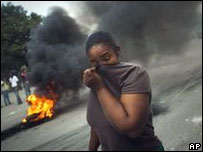
The Haitian President Rene Preval has appealed for calm amid fears that riots aimed at UN peacekeepers could spread to the capital. On Monday, armed demonstrators also opened fire on peacekeepers at Quartier Morin in the Nord Department, a UN statement said. At least two protesters were killed, including one hit by a bullet fired by a peacekeeper in Quartier Morin. Six UN personnel were injured in Hinche. Appeal for calm In a national address Mr Preval warned that the violence in Haiti's second largest city of Cap Haitien has hurt efforts to fight the disease.
"Disorder and instability have never brought solutions to a country going through hard times," he said in a national address. "You must be even more watchful of those who exploit the country's misfortunes for their own benefit." "Gunshots, throwing bottles, barricades of burning tires will not help us eradicate cholera bacteria. On the contrary, it will prevent the sick from receiving care and to deliver medicine where it is needed." President Preval said barricades were keeping people from getting care. It's a concern that is being expressed also by UN officials who say that the demonstrations are stopping them from dealing with the epidemic. Aid flights had been cancelled, water purification and training projects curtailed, while food had been looted or burnt at a warehouse. Presidential and parliamentary elections are due to take place on 28 November. | EXTERNAL LINKS The BBC is not responsible for the content of external internet sites | ||||||||||||||||||||||||||||||||||||||||||
| |||||||||||||||||||||||||||||||||||||||||||
 | |||||||||||||||||||||||||||||||||||||||||||


 Gunshots, throwing bottles, barricades of burning tires will not help us eradicate cholera bacteria
 Cholera Q and A