



 | | | | | | | |||||||||||||||||||||||||||||||||||||
| | ||||||||||||||||||||||||||||||||||||||||||
|
Caribbean cholera concerns | ||||||||||||||||||||||||||||||||||||||||||
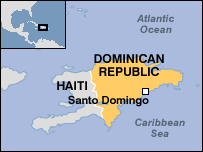
Caribbean nations closest to Haiti are working to counter the possible spread of cholera from Haiti, where there is an outbreak. Experts said the disease is likely to spread eventually to neighbouring Dominican Republic, where the government is already taking precautionary measures. So too are the Bahamas and the Turks and Caicos Islands. The Pan American Health Organisation (PAHO) said it was also alerting other states in the Caribbean about the epidemic, the first of cholera in the Americas since a 1991 outbreak in Peru. In the Dominican Republic, Public Health Minister Bautista Rojas Gomez has visited the border with Haiti to monitor local preparations. The government's Cholera Commission has met and laboratory facilities for testing for cholera have been strengthened. Across borders The UN Office for the Coordination of Humanitarian Affairs said the government in Santo Domingo had mobilised a contingency plan in the border area, "partly closing" four crossing points to those without passports. "There is no need to close the borders or restrict travel or trade because a neighbouring country has cholera. This is what we say for all cholera outbreaks worldwide," said World Health Organisation spokeswoman Fadela Chaib.
However, she said it was important that neighbouring countries take measures to be prepared in case of cholera emerging across borders. "Now that cholera has established itself with a strong foothold in Haiti, it probably will not go away for several years," said Dr. Jon K. Andrus, PAHO's deputy director. In the Bahamas, local health services have started emergency medical screening at airports and seaports, according to the Tribune newspaper. "Passengers travelling to and from Haiti and the Dominican Republic may be subject to airport screenings or medical surveys, the paper said. The Turks and Caicos Islands ministry of health said it was working closely with PAHO and the Trinidad-based Caribbean Epidemiology Centre (Carec) to monitor the situation and potential threat to the territory. "No new signs" Officials stressed that there was no need to panic. "Cholera is A condition that's quite easy to treat," the WHO's Paul Garwood said In Haiti itself, tens of thousands of people are still threatened by an outbreak of cholera despite some signs that the epidemic is stabilising, the UN says. UN humanitarian co-ordinator in Haiti Nigel Fisher said the UN was preparing for a wider outbreak although there were no new signs of it spreading.
A total of 259 people are now known to have died from the disease. Three hundred new infections have been recorded, taking the total to 3,342, Haiti's health ministry said. Frightened nation "This is an extremely serious situation and based on experience with epidemics elsewhere it would be irresponsible to plan for anything but a considerably wider outbreak," Mr Fisher said on Monday. The UN and aid agencies are now also boosting prevention efforts in and around Haiti's capital Port-au-Prince, where some 1.3 million survivors of January's devastating earthquake live in tent camps.
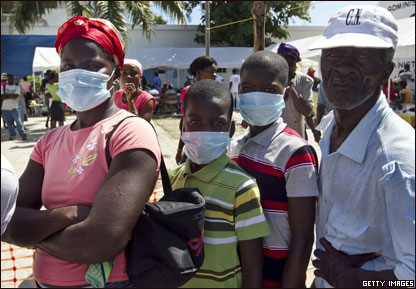
Five cholera cases were detected on Saturday in Port-au-Prince but they were quickly diagnosed and isolated. Another 20 suspected cases were under investigation, medical aid organisation Medecins Sans Frontieres (MSF) told the BBC. Haiti has not seen a cholera outbreak for about half a century, and many people are said to be frightened by the news of the outbreak and unsure of what steps to take to avoid the disease. Poor sanitary conditions make the camps and slums vulnerable to cholera, which is caused by bacteria transmitted through contaminated water or food. Cholera causes diarrhoea and vomiting leading to severe dehydration, and can kill within 24 hours if left untreated. It is easily treated through rehydration and antibiotics. Planning for the worst The director general of Haiti's health department, Gabriel Thimote, confirmed on Monday that the rate of increase in cholera deaths had slowed. However, the number of infections had increased by 10% since Sunday, rising from 3,015 to 3,342, and aid agencies insisted they would remain on alert. "We think that the situation is stabilising. That doesn't necessarily mean we have reached a peak," he said. Agencies battling to contain the disease echoed Mr Thimote's caution. | |||||||||||||||||||||||||||||||||||||||||||
| |||||||||||||||||||||||||||||||||||||||||||
 | |||||||||||||||||||||||||||||||||||||||||||


 We are preparing ourselves for the worst case scenario, which is a cholera outbreak in the whole country”
 Archive