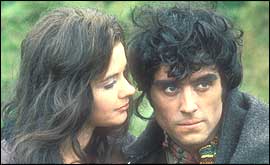
By 1909, Bronte films had begun to appear - there were four in 1915 alone and they have been coming thick and fast ever since.  A love story every woman would die a thousand deaths to live A love story every woman would die a thousand deaths to live | Tagline for Jane Eyre (1944) |
Watch Laurence Olivier glowering as Heathcliff in the 1939 classic Wuthering Heights or Orson Welles playing Rochester to Joan Fontaine's Jane in 1944. This version of Jane Eyre bore the tagline: "A love story every woman would die a thousand deaths to live." George C. Scott and William Hurt were amongst those who later played Mr R while Ralph Fiennes is the most recent cinema Heathcliff in a version that makes use of the landscape. The Olivier classic never went outside the studio. 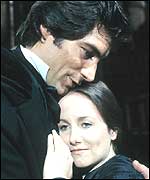 | | Timothy Dalton as Mr Rochester in the BBC's 1983 production of Jane Eyre |
Over the years most of the novels have been serialsed for the small screen. Ian McShane provided a Heathcliff suited to the 1960s. Timothy Dalton has played both of the two strong male roles to great acclaim - Heathcliff in 1970 and Rochester in 1983.
And then there was the Monty Python version of Wuthering Heights in which Cathy and Heathcliff signal their cries to each other in semaphore! More recently comedian Victoria Wood portrayed a guide who took her party around the Parsonage pointing at the "wuthering" views from every window.
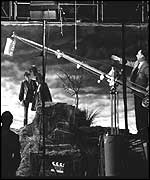 | | Filming the BBC's 1962 version of Wuthering Heights |
Wuthering Heights seems to have had most success in crossing cultural barriers, but using very diferent interpretations. There is a 1954 Mexican version directed by Bunuel - Ajandero returns to the hacienda. In Japan the story is given a Samurai treatment.
There are also the Bronte sagas, dramatisations not of the novels but of the Brontes lives. The best of these is still the 1973 series, The Brontes of Haworth, starring Alfred Burke as the Rev Patrick Bronte. As a result visits to the Parsonage reached an all time high of 250,000 that year. Sadly we are still awaiting the film version of the 1931 book, The Brontes Go To Woolworths!
Thanks to the Bronte Society and the staff of the Bronte Parsonage Museum for their help with these pages. |
|