| 13 November 2014 |

| |
| BBC Homepage | | |
| |||
| Contact Us | | |
Places featuresYou are in: Bradford and West Yorkshire > Places > Places features > Landscape and lyricism in the Calder Valley Landscape and lyricism in the Calder Valley"Ted Hughes understood the power in the landscape, but the gloom could never leave him." So says John Billingsley, fan of the legendary Mytholmroyd poet. John's been discovering why Hughes was both inspired and repelled by the landscape around him. 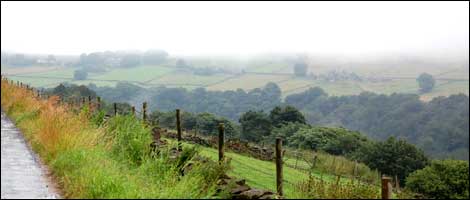 Influential: Misty Calder Valley John is a regular sight around the Calder Valley these days, showing fellow Ted Hughes enthusiasts around the poet's old stomping grounds. He explains that his guided walks reveal a lot about what influenced Hughes - as well as putting a few misconceptions to rest: "I started off leading walks because I found that people had second-hand ideas about Ted Hughes' poetry. A lot of people could only see Hughes in terms of his relationship with Sylvia Plath [poet, author and Hughes' estranged wife who committed suicide in 1963] which is connected with his poetic dynamic but isn't really a way of appreciating his literary status. A lot of people had read him and thought he was very dark, very gloomy, so I started taking friends around various places in Mytholmroyd." 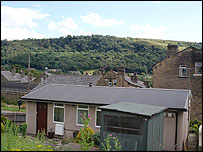 Mytholmroyd: Homes among the hills From the start, John has been on a mission to explain how the landscape of the Calder Valley - where Ted Hughes lived for the first eight years of his life - had such an effect on the poet and his verse. John says his walks around Hughes' old haunts reveal the absolute sense of place which can be found in much of his poetry: "I'd just read part of a poem from Remains of Elmet or from one of his local poems and say that it was written here, now how do you feel about the poem? Everybody said, 'This makes sense. Here I am in this place, we can see it, we can hear it. Suddenly we're there.' It intensified the experience of place for them. At the same time it made them understand the poetry of Ted Hughes a little more and they could go to other poems and begin to see what he was looking at...He was supremely connected with the landscape in the Calder Valley."
While the landscape around Ted Hughes' childhood home plays such a large part in his poems, it's fair to say that he very much had a love-hate relationship with the countryside which surrounded him in his early years. John explains: "The sense of meaning of the place was overwhelmingly gloomy. He did an essay called The Rock. He described his experience of those early years and a few points in this show that he really didn't like the valley very much. There's this landslip, this cliff of rock, above Mytholmroyd called Scout Rock...He says that rock was not happy, it was a witness of gloom and some days it was darker than others. From his bedroom window he'd look one way and he'd see the rock, he'd look another way and he'd see the chapel, this massive chapel overlooking his house only a few yards from his bedroom window which blocked out the light. So he's seeing restriction here, restriction there. He goes out into the valley and there are its two walls - further restriction. You can just go East and West. He didn't like it, basically! His family brought him back to the valley time and time again but those first eight years that he lived in Mytholmroyd, he felt himself stifled." 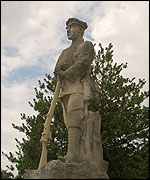 Legacy: Mytholmroyd's war memorial John believes that one of the key locations on the route of his walks is the canal running through Mytholmroyd and along the Calder Valley. John says this is one of the defining places for Hughes' poetry: "There are two particular poems about the canal, The Canal's Drowning Black and The Long Tunnel Ceiling, both of which are very expressive of two things: the valley itself and what it meant. The Long Tunnel Ceiling talks of how the valley was a conduit between the East and West of England opening out in one way to New York and in the other way to Europe, but in the middle you're actually trapped". Clearly, the landscape surrounding his childhood home made its mark on the young Ted Hughes - and it wasn't for its beauty! Another less tangible shadow also loomed over the dark landscape of the Calder Valley during Ted Hughes' childhood in the 1930s. John explains that the legacy of the Great War would have been a big influence on young Ted: "You have to understand what Mytholmroyd was like in the 1930s. It was still reeling from the effects of the First World War. His father, for instance, had joined the Lancashire Fusiliers and 13,742 of them were killed during the War. Now, that's a large chunk of the menfolk of this part of West Yorkshire and East Lancashire. Only seven returned from Gallipoli and his father was one of them. You can imagine how that affected the atmosphere of all the villages along the Valley - and in the 1930s that would still have been shedding its gloom because everybody would have lost brothers, fathers, husbands."  John checks the route of a Hughes walk Back in the 21st century and John enthuses about the clues the landscape in and around the Calder Valley reveal about the inspiration behind much of Ted Hughes' writing. He says that visiting the places where the poet has been is a fantastic way to gain a better understanding of his work: "I find this landscape speaks to me very clearly. One of the things that opened me up to Ted Hughes was a footpath which he used, one which goes up to the moor. The first time I went up there it felt like I was peeling off the layers of landscape as I walked and climbed further up. I was tremendously impressed with my own impression of that. Then a few years later I read The Rock and realised he'd said exactly the same thing. I realised at that point that it's in the landscape. The landscape's not a blank canvas, it does actually have a depth of sensation that is not just open to one individual to pick up, it's ready and waiting for anyone with an open mind to pick up. There's a kind of living landscape, a kind of living energy within the land which can fire the imagination!" More informationMany of the places referred to here can be found in John Billingsley's booklet A Laureate's Landscape, published by the Elmet Trust and Northern Earth. Ted Hughes' Elmet, published by Faber & Faber, is the best starting point for his poems in and around the Calder Valley. The Elmet Trust, based in Mytholmroyd, is a charitable trust set up to celebrate Hughes' poetry and holds regular festivals in his memory, including The Ted Hughes Birthday Festival which takes place between Saturday 15 and Monday 17 August, 2009. If you're passionate about the poetry of Ted Hughes, you can have your say in the BBC's vote to find the Nation's Favourite Poet. The shortlist was compiled in consultation with The Poetry Society and The Arts Council. Just click on the link below.last updated: 04/08/2009 at 16:20 SEE ALSOYou are in: Bradford and West Yorkshire > Places > Places features > Landscape and lyricism in the Calder Valley [an error occurred while processing this directive] |
| | About the BBC | Help | Terms of Use | Privacy & Cookies Policy |