Your paintingsUncovering the nation's art collectionIn association with The Public Catalogue Foundation

Archives for August 2011

Landscapes

Post categories:

Mark CurtisMark Curtis|13:53 UK time, Wednesday, 31 August 2011

As an art teacher, I love the opportunity given in this site to get students to consider how tradition and narrow preset views are constantly challenged in the arts - introducing the concept that punk rock wasn't the first time it happened.

A common complaint from my art students will be: 'Why do I need to look at all this old stuff?'. Most assessment criteria reflect the fact that understanding context is highly valued in arts practices. But establishing buy-in from students is essential.

I often start with a topic or theme that explores one of the big categories that I refer to as meta-narratives. 'Landscape' is an example of one of these narratives.

I start by asking students to look at definitions of 'Landscape'. Before doing so I give all students an A6 scrap of paper and give them a few seconds to draw a landscape. Most students have a paradigm of landscape, which is well set: orientated as a conventional landscape, normally natural, with a range of hills or mountains, a river or lake, and almost certainly a tree or two.
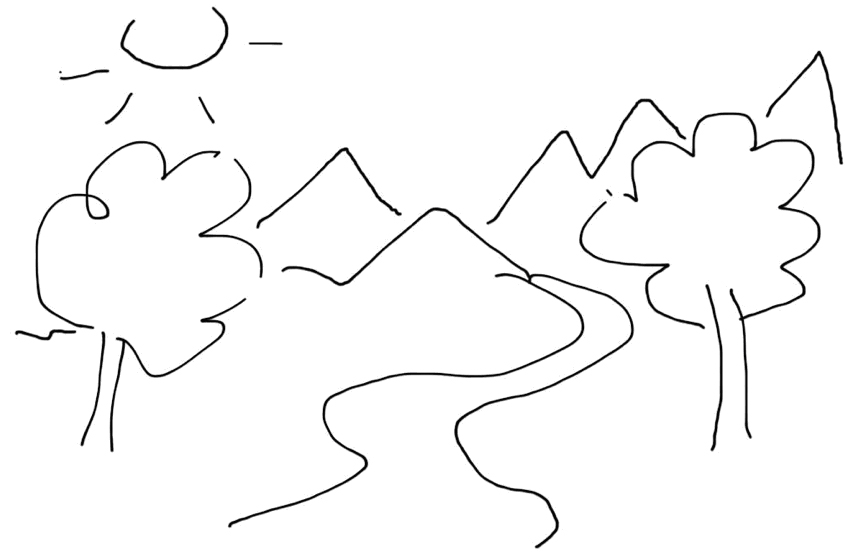
A drawing of a landscape.

It's at this point that I show them the work of the traditional landscape artists and show the connection with their paradigm. The learning for the students is that they are already conditioned.

This allows us to benchmark a current understanding and begin to explore the notion of 'Landscape' as a concept, asking questions like, 'Why did we arrive at similar outcomes?' and 'Does our preset or paradigm stem from our cultural or even geographic location'?

(Incidentally I live and work in Somerset. There are very few mountains here, yet very often mountains, or at least rolling hills, make an appearance. If given too much time, the creative students will already consider bucking the stereotype and produce cities and Manhattan-style skylines. There are not many tower blocks in Somerset either...)

There are other 'typical' landscapes it's worth looking at, at this point, that students may recognize from postcards or the occasional chocolate box. Paintings such as the Constable below, or the photographs of Ansel Adams, can lead to discussions about how the reference to the work of others is already informing their thinking. You can suggest that by consciously selecting the reference material, a student can take greater control of their outcomes.

Challenge your students to use the Your Paintings collection to find examples of a landscape that does so much more than our often narrow preset views. They can explore the work, and consider what else was going on in the world at the time they were created. Some of the paintings tagged with landscapes are here, and I've picked out a few that challenge the common paradigm.

As well as examples of the paintings on this site, I also like to use Japanese woodcut landscape and photography from the new topologists such as Lewis Baltz or Robert Adams; explore cross over from landscape photography to paint and print through Ed Ruscha; and even jump back to the Russian revolution and look at Alexander Rodchenko and the rejection of tradition.

(Editor's note: Let us know if you come across any particularly interesting examples of 'Landscapes' in the Your Paintings collection, that could or have provoked debate in the classroom)

(Copyright information:
Landscape No.3 © the artist
The Outgoing Tide © the artist's estate
Red Landscape © estate of Graham Sutherland
Landscape with Birds © the estate of Patrick Caulfield/DACS 2005)

The Industrial Revolution

Post categories:

Anna ChallandAnna Challand|08:00 UK time, Wednesday, 31 August 2011

Great pictures to help with history lessons

As a historian and teacher, I am constantly looking for images and documents to help pupils piece together their own picture of the past. Most periods of history are not saturated with photographic images, so it is difficult to find visual stimulus that will inspire and create a sense of people and places in bygone eras, as well as provoke discussion about interpretations. Fortunately this site contains a wealth of material that can be used to teach both secondary and primary history.

The Industrial Revolution

Understanding the causes of the Industrial Revolution helps place the economic, political and social development of British and Commonwealth society throughout the 19th and 20th centuries in a wider historical context. This should help pupils develop a greater sense of change and continuity, and make links from the past to contemporary social, political and economic themes.

The series of paintings I’ve chosen here helps illustrate the causes and consequences of the Industrial Revolution.

This typical 18th century rural image is a good starting point.

Ask the class to record a list of words that sum up the impression of life in the countryside given by this painting. Then pupils could be directed to look at the way fields are divided in order to discuss the impact of enclosure and how it helped industrial entrepreneurs.

The next five paintings indicate how the textile industry changed from the domestic system to the factory.

1. An idyllic image of a country girl sewing at home.

2. A rich woman doing intricate needlepoint.

3. A weaver at a loom, in a domestic setting.

4. A 'weaving shop', showing workers in a factory.

5. The impressive Ebley Cloth Mill at Stroud, one of thousands of cloth mills that were built across the country.

This painting of Richard Arkwright Junior sums up the social mobility of the period. (Arkwright Junior was the son of Sir Richard Arkwright, the inventor of the Spinning Jenny).

How did he gain his wealth, and why did he have this painting done? You can split the class into pairs to discuss how rich they think he was by looking at the clothes. It’s also interesting to look at where the family is standing, and the skill of the painter. Then you can talk about how Arkwright continued the changes to the textile industry, begun by his father.

Discuss why entrepreneurs such as the Arkwrights were essential to making England an industrial and wealthy country. Ask the class to imagine what Arkwright Junior would say to Alan Sugar about why he should invest in his business and make him his apprentice. The class could present this as a series of statements made in the boardroom in response to the question from Lord Sugar ‘Why should I not fire you?’

The next two paintings show the changing landscapes caused by industrial development.

Pupils can play Spot the Difference between the painting of Dixton Manor and the 20th-Century image of industrial development. They can then think about why industrial development had occurred, and what may have been needed to help this development, such as transport links. You can then ask the class to imagine the valley before development, and in groups produce a report for the planning committee of the local council to explain why this site is excellent for industrial development.

One of my favourite artists is LS Lowry. This Lowry painting of Ashton-under-Lyne encapsulates the changes of the industrial revolution perfectly.

Use this image to look at the provision of back-to-back housing and discuss the development of the industrial working class, coupled with the advantages and disadvantages of industrial development. Analyse the importance of this painting as a source about the horrors of the industrial revolution when compared with other material.

In this picture by William Blake, Satan’s legions could be interpreted as some members of the industrial working class.

The impact of the Industrial Revolution on Blake's imagination can be seen in poems he wrote, such as London, and Jerusalem. You could read Jerusalem to the class, and discuss why the phrase 'dark satanic mills' may have been a reference to industrial development. The class could write their own version of a poem or a tourist postcard to describe the industrial landscape.

Once all the paintings have been studied they can be printed and arranged in a collage to illustrate the causes and consequences of the Industrial Revolution.

There are many other beautiful images on the site to inspire teachers. If you find any that are useful for teaching the topic of the Industrial Revolution, please do share them in the comments section below.

(Copyright information:
Industrial Landscape © the artist's estate/Bridgeman Art Library
Industrial Landscape, Ashton-under-Lyne © the estate of L. S. Lowry. All rights reserved, DACS 2011)

Your Paintings: an art resource for all teachers

Dan Gluckman - Product Lead|18:00 UK time, Tuesday, 30 August 2011

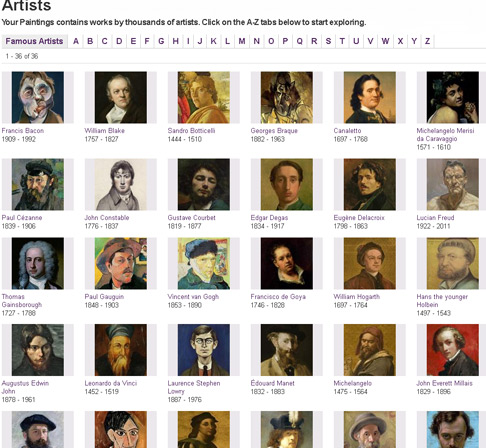
If you’re a teacher, you can now draw on paintings by nearly 20,000 artists, in a wide range of styles, painted over the last 800 years. Most of the great masters are well represented, with some of their best known works - but also examples of their lesser known paintings.

screenshot of Your Paintings artists index page


For art teachers of all age groups, this makes Your Paintings a valuable teaching resource.

For history teachers, it could be an even richer resource. The UK’s national collection of oil paintings is probably the best pre-photographic visual record of UK history and society. There are paintings showing everyday life, as well as the great historical events of the last millennium.

There are also paintings that tell us about the physical and human geography of Britain, paintings of costumes and theatrical productions, paintings of (mostly Christian) religious scenes and imagery, even scientific advances. (We haven’t found any good paintings for Maths lessons – but if you’re a Maths teacher, and find something useful, please let us know!)

With the autumn term just beginning, we are planning to publish a series of blog posts by teachers, with ideas for lessons, and links to interesting paintings that will help with classroom teaching.

Here are our first two:

As well as these blog posts, we have guided tours of the paintings on the site, by celebrities, artists and art critics, to bring the stories behind some of the paintings to life. Subjects range from the art of war and Britain in the 20th century, to romance, Shakespeare and Roman and Greek myths and legends. And once the whole collection is digitised, there will be paintings from every part of the UK on the site.

Please let us know what you think of all these resources, ideas you have for others, and any other feedback you have on how we could improve the site to make it work better for you.

(We will be making some improvements to the site in the coming weeks and months. For example, we’ll be improving the search facility.

And we're looking forward to getting the first tags from the Your Paintings Tagger project, being run by our partners, the Public Catalogue Foundation. Your Paintings Tagger asks the general public to add tags to paintings, so that they are easier to find. We’ll be publishing a blog post in the near future, about how Tagger could be incorporated in the classroom).

New collections coming soon to Your Paintings

Post categories:

BBC EmilyBBC Emily|14:34 UK time, Tuesday, 9 August 2011

It's been six weeks since we launched the Your Paintings website and we're now looking forward to sharing even more of the nation’s paintings with you. 

We’ve had great feedback from everyone to date so thank you all for your encouraging comments and suggestions! We’ve also had overwhelming participation in our Art Detective scheme, with hundreds of you helping us to uncover the mysteries behind some of the paintings. The PCF will soon start the detailed process of investigating all these new insights but we can always use more so if you know something about any of the paintings in the public collection, do get in touch! (Remember to include the title and URL of the painting in your email to us, if possible). 

Over the coming weeks and months we are planning to launch new collections from across the UK and exciting new features too such as resources for teachers and My Paintings - a tool which you can use to create your own collection. 

In the meantime you can get your artistic fix by watching our fascinating and entertaining collection of celebrity Guided Tours. Planning a holiday in the UK? Let Matt Baker take you on a tour of British landscapes. Looking for love? Check out Tracey’s Cox’s insights into the body language of romantic paintings. 

Got a favourite guided tour? We’d love to hear your feedback so leave us a comment below and watch this space for further updates.

BBC © 2014The BBC is not responsible for the content of external sites. Read more.

This page is best viewed in an up-to-date web browser with style sheets (CSS) enabled. While you will be able to view the content of this page in your current browser, you will not be able to get the full visual experience. Please consider upgrading your browser software or enabling style sheets (CSS) if you are able to do so.