
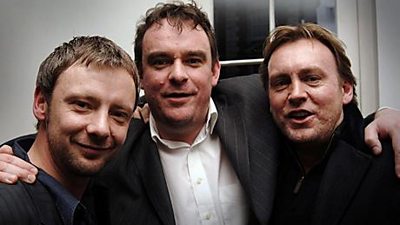
In Part One of our interview with Matthew Graham we discussed EastEnders spin-off Redwater, the origins of Life on Mars and how the writing industry has evolved in recent years. In Part Two we talk more about Gene Hunt and friends and discuss Doctor Who and Bonekickers. Matthew also shares advice with new writers wanting to break into television.
BBC WR: What was the hardest thing about writing Life on Mars?
MG: It was finding the heart of the show. When I wrote early drafts it was very comedic. Much more comedic than it eventually emerged. In fact we thought about Neil Morrissey to play Sam Tyler, so that’s how we were thinking. Then we started developing it with Channel 4 and I started making it bleak and Kafka-esque. It became very complex and very interesting but it also became very unlikeable. Very bleak. So that didn’t really work…
When Four rejected it we went back to the BBC and at the last minute that we realised that the heart of Life on Mars was Sam and Gene! It’s that bromance, making it a proper buddy show. It seems obvious now. If it’s a Sweeney you need a Regan and Carter. In those early drafts Gene would just come in and out as part of the fabric of the 70s and then suddenly we realised if you put the two of them together in the centre of the show, everything could go through them.
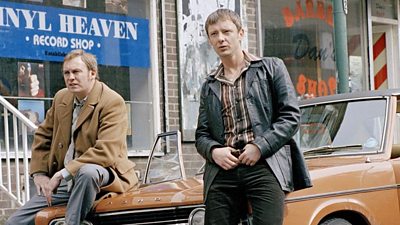
BBC WR: Can we talk Bonekickers? I thought it was a terrific show. Really enjoyed it and I know a lot of people did. Why do you think it only ran for one series?
MG: It was pretty much ripped to shreds by the critics! [In fact, some reviewers were harsh but others were more enthusiastic. Lucy Mangan, for example, writing in the Guardian, called Bonekickers, "utterly bonkers but curiously satisfying…"] We made a mistake running it at 9pm. The original idea was for a The Da Vinci Code / Indiana Jones style adventure. To be fair, the BBC and Peter Fincham said we should make it an 8pm show and we could have a lot of fun with it. And I said no, no, no! We must have 9pm because history is brutal and we must show that brutality. And because of Life on Mars, Peter said okay. He trusted me. But he was probably right and I was wrong. We should have made it an 8pm show. I think it would have done well. I think it would still be running today.
You know we were given the opportunity to do some Bonekickers specials? I mean the critics hated Bonekickers. Not all of them, but most of them gave it a real drubbing. But the BBC said we could recalibrate it and make it an 8pm show. Maybe make it a 3-part serial and reinvent it. The actors were all up for it – they enjoyed making it - but Ashley and I were so bruised from it… I said I don’t think I can summon the willpower to write it! So that was that. Nowadays I think I’d have ploughed on if they’d given us the opportunity.
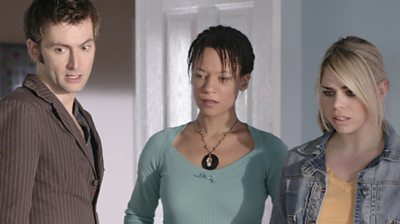
BBC WR: Tell us about your writing on Doctor Who! [Matthew wrote the David Tennant episode Fear Her and the two-part Matt Smith adventure, The Rebel Flesh/The Almost People.] Steven Moffat is on record as saying Doctor Who is one of the hardest shows to write… How did you find the experience?
MG: There are very few shows that have the levels of scrutiny that Doctor Who has. But I personally find it easier to come in on a show which has established, iconic characters. I didn’t find writing for David Tennant and Matt Smith difficult because they had such strong flavours. I had a strong idea how they would react and I had a sense of their voice, and Amy’s voice and so on. So, to me, it wasn’t difficult. I’ve been told a lot of writers do find it tricky but maybe my EastEnders training – coming in any picking up an established character – helped!
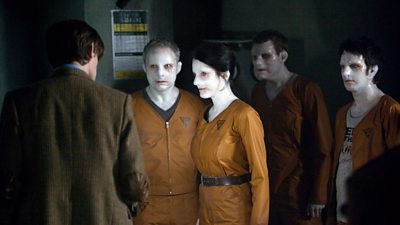
BBC WR: When you’re writing for something like Doctor Who which has a show runner, how much is it your writing and your ideas? And how much is from the lead writer?
MG: Steven [Steven Moffat – Doctor Who’s lead writer and exec producer] only asked for two things... I went to his house, we sat at his kitchen table and he said, I want you to write about some creatures. I don’t know where they’re from or their background or who they are but they’re made out of the stuff eyeballs are made of. And they do jobs that are too dangerous for human beings and they somehow want to break free of their masters. And that was pretty much it. We talked about it and I came up with the idea of the Doppelgangers. The Gangers.
I phoned him a couple of days later and pitched a rough idea about them working in a factory full of dangerous equipment and the stuff the creatures were made of would be called the Flesh. He was happy. As I was doing the fourth draft I saw Steven, Beth and Piers [Beth Willis and Piers Wenger - Steven’s fellow exec producers on Doctor Who at the time] for lunch and Steven did something which Russell [Russell T Davies – Doctor Who’s lead writer and exec prouder from 2005 - 2010] had also done…
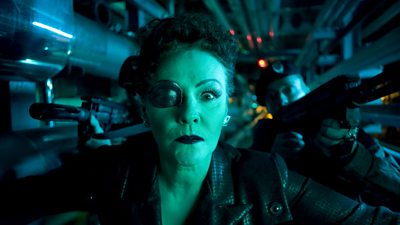
He said, I need to give you the ending. Amy has to be made of Flesh! And somehow, right at the end when the story’s tied up, I need two extra scenes where she suddenly starts falling apart and the Doctor says something along the lines of, ‘Get her into the TARDIS, Rory!’ and to Amy, ‘You’re not real. You’re not here…’ He zaps her with the sonic and she turns into a big bowl of goo. She wakes up in a birthing chamber, and she’s with a woman wearing an eye patch. And Steven said to look back over the two episodes and see if I could find any points where I could have Amy behave a little differently or have the Doctor look at her out of the corner of his eye, as if he’s observing her.
And at the very last moment he phoned me and asked for a couple of shots where a wall slides open and we see the woman with the eye patch staring through. And that was it!
Russell did the same thing, funnily enough. At the end of Fear Her he phoned me and asked if I could put something in where there are fireworks and the Doctor tells Rose that there’s a storm coming... I don’t mind doing things like that at all! It’s fun! And because Russell and Steven are such showmen they won’t tell you why they’re asking for it! I asked Steven, who is the woman with the eye patch and he said, ‘I’m not telling you that!’
BBC Writersoom: What advice would you give new writers? Writers wanting a career in television?
MG: The first thing you should do is write. Don’t talk about writing… Write! And it sounds obvious but you should get an agent. Something else - don’t just write one thing and drag it round for years… New writers should be writing all the time because it should be a restless need in them. Use scripts to get representation because once you get representation, well, all things start from there.
Otherwise it is really hard – there are so many people writing and so many people want to break into the business. It’s tough. Another piece of advice – try to work on an existing show like Doctors. Or if the opportunity comes up to work on someone else’s show, take it! Nothing beats the experience of writing in production. Writing with those pressures and ramifications. It teaches you so much about structure and the reality of writing. It teaches you that it’s not just a case of writing what you want and arguing with everybody. It’s actually all about compromise and teamwork and listening. And you can make your mark on a show that’s not yours! I did, even on EastEnders.
BBC Writersroom: If some catastrophe was going to wipe out the vast majority of television programmes and you could only save one episode of your output, which would it be?
MG: I think the very last episode of Life on Mars. It was so satisfying to write. It was bitter sweet to write but I think it worked very well. So yes, that last episode. Not the first episode because I’ve seen it so many bloody times I’m sick of it!
Matthew and I then spoke informally about Life on Mars and I mentioned how the finale gripped the nation. ‘Those things, those moments don’t happen very often,’ he reflected. ‘We all know that… When those moments do happen, when you’re at the centre of the zeitgeist it is special. You have to enjoy that moment. It’s so special. Enjoy it…’ He paused and smiled. ‘And then you have to move on.’
Big thanks to Matthew Graham for this interview!
And you can read part one of the interview now!
