
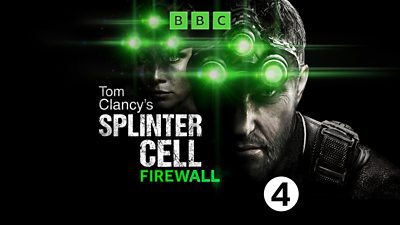
Tom Clancy’s Splinter Cell: Firewall has been adapted for BBC Radio 4 and BBC Sounds. This landmark adaptation sees the Splinter Cell universe - previously portrayed in the hugely popular video game series, and novels by James Swallow - brought to life on the airwaves for the first time.
The eight-part series follows veteran Fourth Echelon agent, Sam Fisher on a new mission, recruiting and training the next generation of Splinter Cell operatives for the National Security Agency's covert action division.
We spoke to the writers, Sebastian Baczkiewicz and Paul Cornell about how they approached this unique project and what tips they had to offer for writers.
How did you both get started in writing for Radio Drama?
Sebastian Baczkiewicz: So my start was when I was invited to apply to be the Writer in Residence for BBC Radio Drama in 2000. I was the first (I don’t think they do it anymore) but that was really the start of my radio writing career. I was writing plays before that and performing as an actor.
I then just carried on making work and did some adaptations of Les Misérables and The Count of Monte Cristo, and originated two series: Pilgrim and Elsinore. I also worked on Home Front.
I never really thought about writing for audio. I've always thought about writing for writing. I think of Radio as a completely visual medium. There are some things you have to sketch in, but the audience is very good at working out what's going on, and the more that you can stimulate their imagination the better, really. Some writers get really hung up about writing for Radio but I've never really worried about it. Drama is drama. Story is story and the technical stuff follows on from the Drama.
Paul Cornell: I'd written a few Doctor Who audios for Big Finish Productions and I’d written two audio plays which Nadia Molinari, the Director of Splinter Cell, also directed. The first of those I got, because I shared an agent with Iain M. Banks, and Iain wanted to have one of his novellas, The State of the Art adapted for radio. So I got into that and I've always loved it.
In your work, you both lean towards Genre (Sci-Fi, Horror, Fantasy). Where did this come from? And what are your influences?
Sebastian: I sort of came into it accidentally. When I started to develop Pilgrim, we were invited to come up with a series idea during a residential (organised by BBC Writersroom). I’d just become very interested in folklore and, at the time, there was very little actually about it. Now it's everywhere but then it wasn't, and I just couldn't believe that there was such a resource of English and British folk tales that just sat there in books waiting to be talked about or discovered. I was then very keen to use them as the DNA for stories and not set them in distant times but in our world and explore what would happen if it was true and happening now.
With Genre, I learnt to write through thrillers really. That's always been a big influence on how you tell a story. Hitting the ground running is always a good thing, and I think both Paul and I have done that with Splinter Cell.
Paul: For me, I've been a fan of genre from when I was tiny. I'm a fan of all things fantastical, and I've actually joined a lot of fandoms. I've joined some fandoms before I knew what they were about! It's a wonderful way of being in conversation with one's peers, and knowing the nuts and bolts of how that particular genre works.
I think that Fantasy and Science Fiction provide a tremendous tool box for dealing with the modern world. You know we're living on so many different levels now, and so much that, when I was a youth might have been regarded as fantastical, has simply become how we see the world. How things are. I would take as an example, perhaps, the concept of multiple worlds, which has gone from the realm of abstract physics to people just kind of knowing in their bones that it might be true, and that being reflected in current media, how we can deal with there being multiple Batmen for example.
Genre is steeped in my bones. I am a fan boy from my boots. I'm a Doctor Who fan specifically. I mean, I can quote you detail on that which would make your toes curl! And that fandom especially, that stew of my peers in the early nineties, where we were all getting on together, and we all knew each other and each other's work so well that when one of us got a professional gig, the feeling was "Well, if they can do it, so can I!” There's nothing else like that being part of a gang who will come up together.
Speaking of fandoms, what connection did you have, if any, to the Splinter Cell one?
Paul: I’d played first person shooters, so I was familiar with the genre but not so much the Splinter Cell game itself.
Sebastian: Coming to the Splinter Cell franchise fresh and not being overburdened with ‘Sam Fisher’s got to be this’ and ‘it's going to be that’, was actually quite liberating I found. I think the plus of a fandom situation can be that you know all the ins and outs, you know all the levels, you know who gets killed, where and when and by whom, but coming to it like, ‘Well, this is a new story that's never been heard before’, was the only way Paul and I could come to it. We had to examine this story as though it had never ever been told before and in a completely new way.
The thing about Splinter Cell is that it's very mission based. It’s not like Doctor Who which has got different planets and societies. You're very much in a world that is defined by the game.
Paul: I’d played enough first person shooters to know what we should be doing. For example, one of my scenes in Splinter Cell is set in the railway station where it's very much: you shoot that bulb, you get under that train before those people turn around the corner and I thought that feeling was important for the audio drama.
It's a unique project in that the source material is not only a game but also a novel written by James Swallows which ties into the Ubisoft franchise. How did you approach this?
Paul: Well, oddly, James is one of those peers that I talked about. He was part of that stew back in the day and I haven't seen him for ages! Basically it was taking that structure of the novel and simplifying, compacting and reducing dialogue to what we could use. It was really good to have something to fall back on all the way.
Sebastian: Also, the genre demands strong narrative. The book has got a very strong narrative structure so thank you very much, James! I mean, I had to move a few things. The opening of the book is slightly different from the opening of the radio episode one as I wanted there to be a “hot opening”, as I'm told they say, in the trade. But the changes are really tiny. I don't know about you, Paul?
Paul: I had to zhuzh things around a bit to form cliff-hangers sometimes, and simplified the ending. I think I changed the focus of the very ending in order to give us the possibility of a sequel which was very much what everybody seemed to be after! It was a good solid piece to work from, and I tried not to go against the spirit of it.
Sebastian: Yeah, I think that's well said. That's always your job. Whatever you're adapting from Les Misérables to Splinter Cell. You have to be true to it. It’s no good going off and saying, ‘here's my much better version’. You’ve got to be respectful in the most practical way.
Paul: James also wants us to make him look his best. So it's more respectful to change things if the change is necessary to make it fly, you know.
Were there any other challenges you faced when you were adapting this project?
Sebastian: I think the challenge was to try to emphasise that there is a moral dimension to it which I think needs to be placed. In a game, you can go around shooting as many people as you like, and then you have a lie down but, for a Radio Drama, you can't just go around killing everybody. There has to be something about what it means to do what they do. It was at the forefront of my thinking all the time and I had to retain a kind of moral grip on what could have just been a kind of shoot-‘em-up for the radio. I had to hold that quite strongly in my mind that it was about people, and then people will die, and that can't just be nothing.
Paul: Also I wanted to put in more humour. I think as soon as you put some humour in the audience starts to like the characters and empathise with them more. With Sam Fisher being so down the middle, he really needs people around him who warm him up a bit. He is capable of dry humour, but it's very dry.
Sebastian: What you're saying about humour is really important. It's kind of finding the truth in the genre. That's the really important thing. It's when it feels like the reality of the genre is being adhered to. The rules of the game if you like. We used to say this on Pilgrim, that there's no ‘winking’. There's no: ‘This is crazy, isn't it?!?!’ kind of acting. This is what's really happening and there really is an ancient psychotic spirit from a thousand years ago, and he really is in that front room.
A lot of writers who submit their work to us are interested in genre writing. Do you have any other advice for them?
Sebastian: Don’t wink!
Paul: You have to know your genre really well. I mean if I ventured into, say the Western right now, I would write a pastiche. I would write something that was the most surface gloss on it, because I don't know anything. What you need is to know what other people have done in that genre and be in conversation with that. React to it, or ignore it, or push against it, or go with it, but know where others have trod. That will always serve you well. I mean, if I wanted to write a Western I would go and actually read up a lot about the real old West and find something new to talk about.
People seem to think of Science Fiction and Fantasy as easy genres, because there is not a body of historical fact or anything like a police manual that you can read. But there is a body of work by people who've done a lot of this before and you really should pay attention to that.
Sebastian: I think that's really a good point. Splinter Cell has very defined rules. You know, Sam Fisher’s not going to appear in cabaret any time soon, for example. Interestingly in Pilgrim (which was Fantasy), I had to have really strong rules about what Pilgrim could or could not do. However wild it got, it needed to be held by the reality and the truth of the situation they were in. I think audiences respect that. Even if they don't even necessarily know what you're doing, they know that they are being held, that there are rules in this world, and our respect to the audiences is that we're not just going to break them like that. If we break the rules there'll be a good reason for it.
It’s keeping true to the scenario you set up and not suddenly going, ‘Oh, I did that. But you know what? I can do this because I can do anything!’ That's kind of cheating. If you can do anything, it doesn't mean anything.
You started writing the project in June and then it was on air in early December so it was a quick turnaround! How was that and how did the Radio Drama team support the writing process?
Sebastian: The production team Jessica Mitic, Lorna Newman and Nadia Molinari were on this from the start. So we were working from a brief and could use the book and I guess, in both of our cases, a degree of experience and knowing how to do this, so as not to have a meltdown about it.
Paul: Yes, calm throughout from all sides! Which was lovely. I do think something which would be useful for writers to hear is, my way of working is that I try and get a first draft - I don't know golf at all but to use a golfing metaphor - I try and knock it down the fairway and get it somewhere near the green with the first draft and then lots of notes. With the second draft I'm really looking to get there and to firm it up. My first drafts are often pretty rough so I'm after those notes from the Radio Drama team. They help with that.
Did you both attend the studio for the recording of Splinter Cell? What role does the writer play there?
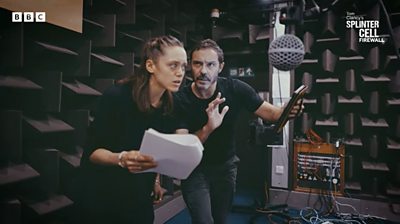
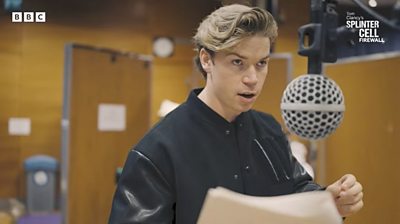
Paul: I was there for one day and was called upon once or twice to change a line because it wasn't working. I think it's not quite like it is on television where you really are just popping in to say, 'You're all doing very well!' and have lunch and go. There is something for you to do.
With my previous play, the Iain M. Banks one with Nadia Molinari, I got to be on the floor and stand amongst the actors as Nadia directed them. At one point an actor asked us a question and she replied, and then I replied too. Then I found myself going, ‘Oh, sorry! Two voices!’ because on television that would be really a no, no! Then Nadia said, they're grown-ups they can listen to two voices. I really appreciated that. It is definitely more of a writer’s medium and your input is more part of the continual process.
Sebastian: Sometimes, in studio, you can be useful as the shorthand for actors and directors to say what's happened before because we are the ones who've got the overview. We know why people are doing what they're doing, and when they're doing it, as it were. Also sometimes things need to be cut or shortened, and certainly with Splinter Cell I thought of myself in studio as a sort of resource to be called upon and I enjoyed it. I like to see it being made. I think it's just part of the excitement of the process. To me, it's the reward.
What are the challenges you face in writing for Audio?
Sebastian: I think that what we're doing in Radio and Audio Drama often is that we're making something out of absolutely nothing. For TV, you've got a set. You've got lighting. You've got sound for the show. You've got all these things that are 50% of the work. What we have to do is build it up out of nothing and we have to do that by using characters and what they're saying, and what they're talking about, and immediately draw the audience in. You've just got to have an emotional connection immediately to the thing being made.
Paul: And leaning a lot more on dialogue of course.
Sebastian: That's it. There is nothing else. Our job is to make things appear in the imagination of the listener as vividly and as clearly as we possibly can. Radio Drama tends to get overlooked, you know. Obviously, it's not as sexy as television or film, it doesn't have the allure of the lights, but it has brilliant people in it, there are brilliant actors all the time in Radio bringing their talent to the words we make.
What are the benefits in writing for Audio?
Paul: I don't think there's any limitation with Audio. It's easier to do special effects!
Sebastian: Exactly. It makes the budgets much more friendly too! One of the great things is, you can develop an idea for television or film and you can be years doing that and that can be - for this writer - that could be quite a soul destroying experience. I know somebody who's been developing a film for nearly twenty years! So the great thing about Radio is that, although you know it doesn't have the kind of high media profile that television and film has, and theatre has to some degree, the advantage is you can realise your work without having to have an £80 million budget.
Paul: I think it's also a very good medium for idea-led Science Fiction. The only person really doing that in movies is Christopher Nolan. He has big visuals to go alongside his big ideas and because audio is led by dialogue, it's led by ideas. So you can actually develop a complicated science fictional argument quite well, and it's hard to do that and maintain great visuals in Film and TV.
Sebastian: Also, dialogue is character, it’s people talking to people. With Splinter Cell, the people come first. We don't have the visuals. We don't have the games. We don't have the guns. We don't have the dripping pipes. We don't have the whole world of that. So what do we have? We have these extraordinary characters, and those are the people that we have to animate into action, and as soon as they're doing something, the audience is with them. So characters don't just talk on Radio. They are doing things to each other in action; action being the operative word. That's true in a Christopher Nolan movie, it’s true in a play at the National Theatre as it is on a radio piece, as it is in EastEnders. It's people doing things to other people using words.
Any further writing advice?
Sebastian: The great joy of writing is cutting. Some less experienced writers find it hard to let go of anything but it's so liberating. You just go, ‘I don't need any of that. I don't need any more exposition. It's just there’. By doing this, you're keeping your work as light on its feet as possible. Also, if you’re interested in Audio Drama, listen to some.
Paul: That is surely the first thing that any aspiring writer should do is actually consume a lot of the thing they want to write. And yet…
Sebastian: There's such a huge variety of work out there. From Splinter Cell to a domestic drama set in Northumberland to a play about street gangs in London. Also The Classic Serial. There’s such a huge umbrella of ideas and content going out every week. Listen to things you're interested in and read. Reading is really important. It fertilises the mind and that's what we’re in the game for.
Paul: I enjoy having my mind fertilised!
