
Laughing Stock: How to Get the Most out of a BBC Residency
As you've probably seen by now, several other of my fellow Laughing Stock winners have written blogs about their experiences of the contest and being on residency with Aunty.
I thought it'd try and write the list I would have liked to have stumbled upon before embarking on a week away with the BBC.
1.Get Your Script Noticed
In order to get on a residency in the first place, you'll need to get your script noticed.
The nine scripts that were chosen for further development all possessed such strong, individual voices and it was clear that the BBC were genuinely keen to develop us all further as writers.
This came as a surprise for my initially-cautiously-pessimistic group who thought that the whole week would just be an exercise in box-ticking and that we'd be forced to sit on a production line stuffing envelopes with threatening "a-court-date-has-already-been-set" licence-fee letters (while better looking people are photographed being "mentored" to fulfil some public remit).
However, this was not the case and only one of us was replaced in photos for someone better looking. All the producers and commissioners who came to talk to us seemed to really grasp what made our writing truly "ours". I've never had such considered and probing feedback from people I'd only just met.
Failing that though, do what I did and submit a script in a good enough font - they'll be forced to sit up and pay attention.
2.Write a Better Script
The joy of discovering I was one of the final nine sitcom writers was quickly tempered by the fact our first task was to sit in a circle and read each other's work aloud.
My heart sunk.
However good a first impression I was likely to make on my fellow writers it would be ruined by how seemingly little writing talent my script displays. I kept telling myself it wasn't going to be that bad and, after all, it had come this far. Foolishly, the night before we embarked to Bore Place, I asked my housemate to perform it with me. I realised that the only good joke in it had been ruined due to a spelling mistake and that the grammar was so poor, it felt like a tester question for a 'How To Learn English' exam.
"Why don't you just take the script that won the contest?" my housemate asked.
"This is the script" I replied, crushed.
3. Pack Properly
We were away for a week and I had decided to leave my packing until the morning of departure. Major mistake. I was called into work on an emergency and quickly threw two un-ironed shirts into a bag (which gave the impression I didn't change clothes for our whole stay in the country) along with two and a half pairs of socks.
I also forgot to pack any deodorant so stole some degraded Lynx Africa from my work's showers, which meant that I spent five days smelling of a cross between a teenage disco and a sex pest.
Unpacking in my room, I realised I hadn't emptied the bag and found, in the side pockets, three energy saver light bulbs, two sets of swimming goggles and all my childhood passports. If the staff at our accommodation had insisted on going through our luggage they would have assumed I was going through a complete mental breakdown.
The only plus side of having a half-empty bag was that it was far easier to steal items from my room to sell so others could attempt to recreate the retreat for themselves as home. For sale on e-bay right now: some Bore Place tea towels, several wicker baskets and a large oak headboard.
In the interest of BBC transparency, I should be honest and say that I'm joking: in reality I hardly stole anything from Bore Place.
4.Go with an open mind and an empty stomach
What surprised us all was the expectation that we'd come up with new ideas together as a group to pitch to various executives. This was far more fun than I'd have ever anticipated. The experience of being locked away in deep countryside with a group of other people who enjoy writing comedy was a joy. To most people I meet, writing comedy is seen alongside making animals out of pasta shapes.
To meet a group of other people, who not only enjoy it but also actively want to do it for a living, was both exhilarating and liberating.
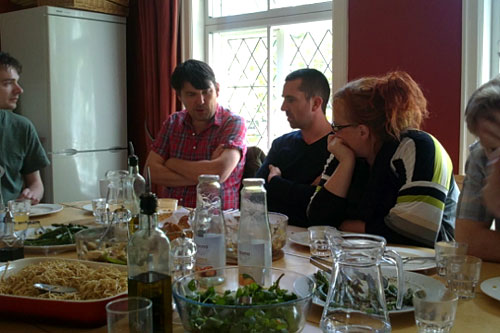
It's worth pointing out that the food was also incredible. Starve yourself before you go, as you'll eat like a king.
There's an amazing chef, a 24-hour cheese board (which we all made the most of) and free apple juice. I've never drunk so much fruit.
A week that I'd initially worried would be slightly awkward and embarrassing was, on reflection, the best experience of my professional life so far. The myth that comedy writers are dour depressing people who are deflating to be around is far from fact; as we sat up late playing games, walked through the perfect gardens in small groups and generally lived a Brideheadian existence for just one week, soaked in sunlight, feeling that our dreams might not be so far from our reach after all, I can think of nowhere else on Earth or even in my own memories that I'd rather have been.
5.Never agree to write a blog about your experience
Writing this blog has been harder than writing the script I entered for the contest. The pressure to be entertaining while factual(ish) is only overshadowed by the feeling that this could be "part of the contest" and "they're judging my every word".
David was one of the winners of BBC writersroom's Laughing Stock comedy competition. Writers were asked to submit an original narrative comedy script with series potential.

Comment number 1.
At 11:58 23rd Jun 2011, Catsmeat Potter-Pirbright wrote:Great blog post. You're obviously an entertaining and funny writer. Good luck with your sitcom!
Complain about this comment (Comment number 1)
Comment number 2.
At 20:10 23rd Jun 2011, Kirsty Writer wrote:Never commented before. Just wanted to say that this blog really made my day. Clearly very witty, sharp etc. Is David's sitcom getting made? When can we see it?
Complain about this comment (Comment number 2)