
There are times in this job when you can find yourself asking personal questions that border on the impertinent.
One such involved a conversation with Zac Smith, who, three years ago was at 50 stone, arguably the most obese man in Wales.
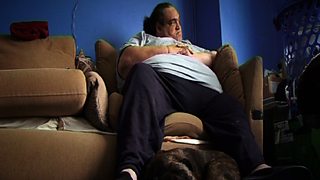
Three years ago Zac Smith weighed 50 stone and was arguably the most obese man in Wales.
“There are some people who will wonder if you deserve any sympathy,” I said. “You ate yourself into this state so why should we as a society think you deserve our help?” I asked the question not because it reflected my own opinion but because I know that privately it is what many people will think. Obesity is often still seen by the cynical eye as the result of gluttony and sloth.
Zac knows it. He has had years of sniggering and abuse.
“People look at me and say you’re the guy who ate all the buns”, he said. “And they’re right. I am the guy who ate all the buns. But why am I?”
The answer is rooted in self-loathing and depression.
“No one who is morbidly obese looks in the mirror and thinks, ‘You’re looking great today,’ he said. “In fact, they don’t look in the mirror at all.”
Zac, who is of mixed race, grew up in a predominately white area in south Wales. His father, who left home when Zac was young, was a giant 7ft tall. Inheriting those genes Zac was always big for his age - so the bullying and teasing cut deep and he found sanctuary and comfort in food.
By the time he reached his 30s it was out of control. He was literally eating himself to death. Food was his preferred analgesic. “It’s not illegal and it’s easy. All I had to do was to reach for the fridge,” he said.
Zac turned to the NHS in Wales for help but none came because he was told that he didn’t meet the stringent qualifying criteria for bariatric surgery in Wales. He was big enough but not ill enough for support.
In our programme we show how he turned instead to foreign alternatives - private operations in India - to help him find a solution. They helped him lose almost 30 stone. But for many others, this isn’t an affordable or viable option. They just don’t have the money or family who can rally around.
There are literally thousands of people in Wales who are classed as morbidly obese. Carrying so much weight that even simple exercise is tiring and the consequences for their health are dire. Heart disease, strokes, diabetes and joint failure - one, two or all of the above - are what will almost certainly lie ahead unless they can bring their obesity under control.
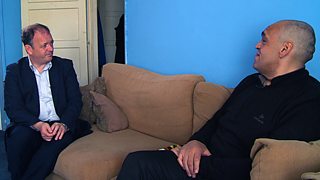
Zac had a private operation in India which helped him lose almost 30 stone.
So, should we as a society care and are we in any way obligated to help? To re-iterate the question, “Don’t they have themselves to blame?”
Meeting Zac made me realise that it is far too easy to judge and much harder to understand. What I learned while making this programme is that in many cases super obesity is the result of a collapse in confidence where self-worth has devalued into despair.
So let’s ask another question. Does depression deserve our attention and can we afford not to help? It is said that obesity is becoming a growing problem in Wales - more so than anywhere else in Britain. But what I discovered is that a response based on a stereotype is no response at all. Yes a good diet and lots of exercise is important. But let’s not always assume those who ignore such advice are ignorant. Zac did eat all the buns, but why did he. Think about it. It’s why we should care.
Week in Week Out is on Tuesday 5 August, 10.35pm on BBC One Wales.
