
Laura Sinnerton, viola player for the BBC National Orchestra of Wales, explains the process of getting a bow rehaired.
There are some things in life that are just a given. For example, there will always be a million toffee pennies left at the bottom of a box of Quality Street, and zero strawberry creams, or as soon as you upgrade your phone, the company will release a brand spanking new, shinier model that makes you coffee in the morning.

Laura Sinnerton with her viola. Photo: James McLaren
Equally, it is a given that just when you have precisely zero time in your diary, your bow will become seriously challenged in the hair department, requiring an immediate rehair. And so it is that I find myself, on my single day off, ensconced in an overheated train carriage en route to London to visit my preferred luthier (a gentleman/lady who looks after the maintenance of string instruments and bows).
A bow is a very personal thing. Each is uniquely weighted and balanced. They are incredible pieces of workmanship, consisting primarily of a wooden stick, the ‘frog’ which is the bit at the bottom near where your hand goes, the tip or point which is at the opposite end of the bow, and horse hair drawn tightly between these two extremities.
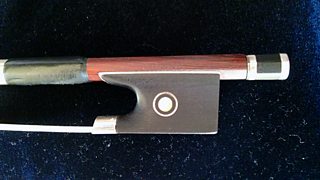
The frog of the bow near where the hand goes.
It is the bowing arm, not the fast flying fingers, that creates the magic in string playing. You could probably teach a monkey to do the left hand acrobatics, but it is the relationship between the weight of the arm and the manipulation of the contact between the strings of the instrument and the hair of the bow that enables string players to play expressively and to create colour. It is with this arm that we pull the actual sounds from the instrument, and so the bow is a very important piece of kit.
You can imagine that in the course of our work the bow hair takes a bit of abuse and so, naturally, it becomes thin and brittle, requiring it to be replaced periodically which is what we call a rehair. Depending on what repertoire you are playing and the amount of work you have on at a given time, rehairs last a varying length of time, sometimes only about four months. As the bow hair stretches and thins the bow becomes harder to control, less responsive, and less satisfying to work with.
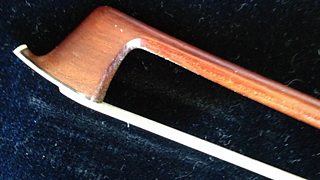
The tip or point of the bow
And so today my bow is going to have its hair done. I would dearly like to have my hair done but my bow’s need is greater right now. My luthier will remove all of the thinning, dirty, stretched old hair from my bow and replace it with lovely thick, fresh new hair, and when it is all dry and ready in a few days time I will pick it up again.
Stringed instruments require a lot of specialist care and attention, so the relationship between a musician and their luthier is an important one. I have been using the same gentleman for my bow maintenance for years. He won’t just rehair the bow, he will also check for any signs of wear and tear on the whole bow. My main bow was made in the 1850s and still has all of its original parts, and the stick is in pristine condition. I feel a charge of duty to look after it, not just so I can enjoy it at its best, but also because I want violists after me to have the opportunity to enjoy it as well.
Thomas Søndergård conducts the BBC National Orchestra of Wales in two works by Sibelius in BBC Proms Masterworks: Walton and Sibelius. Watch on BBC Four at 7.30pm on Thursday 21 August.
