Writer Owen Sheers on his time as the Welsh Rugby Union artist in residence

Polly March
It has been over a year since the novelist and poet Owen Sheers rolled up his sleeves and ventured forth into the world of rucks, mauls, Ralgex and national heroes.
From sweaty changing room pep talks to a pitch-side view of some of 2012's most thrilling matches, he has enjoyed an access all areas pass to the very heart of the nation's best-loved sport.
The result of this unique experience is Calon: A Journey to the Heart of Welsh Rugby, Owen's account of his time with the boys in red, which is published by Faber and was launched at the Millennium Stadium last Friday.
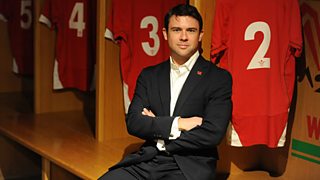
Owen Sheers in the Millennium Stadium changing rooms. Photo: Huw Evans Agency
Owen told me that when the WRU and Arts Council of Wales appointed him as the company's first-ever artist in residence, nobody had any idea quite how it would work.
But looking back on a year that has seen him observe exhilarating highs, such as Wales' third Six Nations Grand Slam in eight years, and gruelling lows, like their disappointing summer tour of Australia, Owen believes his exclusive insight into the passion of the Wales team will stay with him forever. This is why he has called the book Calon, which is Welsh for heart.
"My lasting impression of rugby after this year is a real appreciation for the intensity of those sporting moments where the script is unwritten and everything can change in a second," he said.
"As an individual supporter you have a connection with the squad and stand in the stadium with everybody while your emotions follow exactly the same contours - it's incredible really."
The residency has seen Owen being privy to crucial team meetings, travelling alongside the squad by plane and on buses during the tour Down Under and visiting clubs at grass roots level in Ebbw Vale, Llandeilo and Ammanford.
"To start off with it was pretty surreal, having played rugby at county level and having loved Welsh rugby since I was five years old. There was a moment when Shaun Edwards was giving his pep talk and Jamie Roberts was giving his defence advice to the team in the changing room and I just had to pinch myself.
"It's a very tight-knit group, as it should be, so as a writer coming in and trying to observe that initially made for quite a strange mix.
"But on the flip side the players needed to address the question of me being there so I got to explain it to them and that I was not there as a journalist but as an artist and afterwards things felt more stable because we got drawn in to shared goals and aspirations.
Owen drew on interviewing skills he had learnt during the research for his play about soldiers wounded during the Afghanistan conflict, The Two Worlds of Charlie F.
He said he and the players soon came to understand each other's worlds.
"I ended up being on great terms with many of them and really understanding that these are not just icons but human beings."
Watching this Six Nations and knowing how the team fared in the autumn internationals, Owen finds it harder to watch, as he has a far more acute sense of what the players are going through.
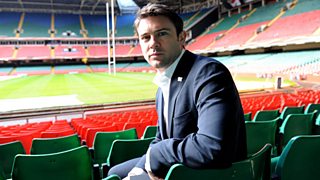
Owen Sheers at the Millennium Stadium. Photo: Huw Evans Agency
"It's totally changed what it means to be a spectator and a supporter because you know the individuals, you know their stories.
"Having got to know the ground staff, I can't help but look at the pitch and think, 'oh dear they will have a job fixing that after that scrum,' or it's different knowing a particular player has been struggling with injury and you see him looking like he might be about to go off.
"I think I will definitely be suffering withdrawal symptoms throughout this Six Nations."
Three key moments
While those once in a lifetime moments have been numerous, there are three which hold a special place in Owen's heart:
"Being able to walk out right after the team had run down the tunnel and hear that sonic tidal wave of cheering hit them and then getting to be there pitch side when they won the Grand Slam.
"And then of course when we went on tour to Oz, I was invited along to kicking practice in Brisbane.
"You could hear all these cane toads sounding off and after the main training session I got to kick the ball back to James Hook, Rhys Priestland and Lee Halfpenny - I've never concentrated harder on my kicking accuracy! It was an incredible moment for me."
It was on the Australia tour that Owen got more time to get to know the players and coaching staff as he was able to speak to them in depth during long bus or plane journeys.
He even went to see Under Milk Wood at the Sydney Opera House with Shaun Edwards, Rhodri Lewis and Ken Owens.
But it was on his return from this bitterly disappointing series of matches that he knew he had enough content to make a book.
"The mark of a team is not only in how they win but in how they lose," he said.
"I was impressed with how they absorbed that defeat by falling back on each other and becoming an even tighter family unit.
“When a team works so hard and has so much expectation and then loses when the clock has gone into overtime, you have to give them space.
"It's a kind of grief, so although the writer in me wanted to be in the dressing room afterwards, as a person I just couldn't.
"And the next day many of the players were happy to talk to me about what went on and who said what, after they had had that time to process their defeat.
"It was amazing how quickly they bounced back."
Breaking the mould
If he has time while preparing the paperback version of Calon, Owen plans to include some of his reaction to the autumn internationals, where Wales' performance was widely slated.
It is his hope that the novel breaks the mould of a traditional sports book and echoes one of his heroes, the great American sports literature writer Norman Mailer.
"I wanted to write this account of rugby in a lyric and honest way. I wanted it to be as novelistic as possible and to attract readers that may not be fans of the sport.
"It was interesting because as everybody knows what happened in the matches, that basic narrative tool is taken away from you, so you have to fall back on other techniques like really getting into the stories of the characters."
The book focuses on the day of the Wales v France Six Nations match last year and takes the reader right through the day, from the moments the players wake up, to a glimpse at the kit man preparing the changing rooms and the groundsman tending to the pitch, all the way through to the late night carousing on Caroline Street as the players look ahead to the next challenge.
"It's fascinating what happens after a match in Cardiff - there is this diamond moment of victory which is so brief, but by 7pm on Caroline Street, it's an awful mess."
During his residency Owen wrote a poem for each home match programme and now hopes to pen a book of rugby poems.
He is in discussions with various schools to make the most of the educational possibilities his post offered and is talking to National Theatre Wales about a "significant piece" of rugby theatre, which he hopes could be partly staged in rugby clubs around Wales.
"Because rugby has such an extraordinary place in the Welsh psyche, it's an amazing opportunity to engage people.
"I feel very, very lucky to have had this experience."
This week saw him venturing into his old school, King Henry VIII in Abergavenny, and visiting his former rugby club in the same town to chat about his book.
Listen to Owen talking about his experience on the BBC Wales News website, and listen to one of his poems.
