
As the Commonwealth Games begin in Glasgow take a look back to the summer of 1958 when its predecessor, the British Empire and Commonwealth Games, took place in Cardiff.
Held between 18 and 26 July 1958, the Cardiff Games saw sportsmen and sportswomen from 35 nations, nearly 1,500 of them in all, gathering together to compete in athletics, boxing, cycling and other events.
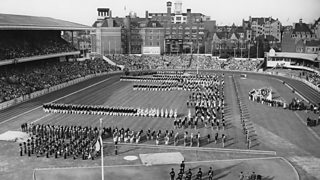
The opening ceremony of the British Empire and Commonwealth Games - Cardiff, July 1958. Photo: Popperfoto/Getty Images
Twenty-three different nations won medals, places like Singapore, Ghana and the Isle of Man claiming gold, silver or bronze for the first time in what was the largest gathering of athletes from Commonwealth countries until then.
For the first time the Queen's Baton Relay was held to mark the opening of the event. It was a hugely popular event and the baton relay has been held at every Commonwealth Games since then. Sir Roger Bannister, the first man to break the four minute mile barrier, began the first leg of that first relay at Buckingham Palace – the identity of the runner who was to bring the baton home was kept a closely guarded secret.
Just after six-o-clock on the evening of Friday 18 July, the mystery runner appeared at Cardiff Arms Park, the venue for the opening ceremony. It turned out to be none other than Welsh rugby winner and Olympic silver medallist Ken Jones. As Jones handed the baton to the Duke of Edinburgh some wag in the huge crowd called out "Nice pass, Ken." The place erupted and even the Duke managed to grin.
Wales had prepared well for the Games. A new competition swimming pool, the Empire Pool as it was known from that moment until its demolition some 50 years later, was built on the banks of the River Taff and 178,000 tickets were sold for the various events. Athletics competitions took place in the Arms Park, swimming and diving in the new pool, cycling at Maindy Stadium and boxing in Sophia Gardens.
Although the focus for events was Cardiff, many of the competitors actually stayed in a specially constructed athletes' village at Aberthaw near St Athan in the Vale of Glamorgan. The village was later used by the Boys Clubs of Wales as a base for evening and weekend activities.
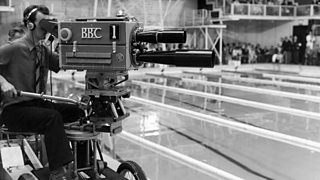
BBC camera at the Empire Pool during the 1958 Games in Cardiff
Three world records were set during the Games, in the 440 yard hurdles, the women's javelin and in the 4 x 110 yards women’s relay. England topped the table, winning 29 gold, 22 silver and 29 bronze medals. Australia came second with 27 golds.
Wales won just one gold, a young Howard Winstone claiming victory in the bantamweight division of the boxing.
The Cardiff Games was the sixth time the event had been run but the city had had to wait a dozen years to hold them as, in the wake of immediate post-war austerity, the 1946 Games had been cancelled and everything automatically 'shunted backwards'.
The Cardiff Games were also noteworthy as they were the last time that South Africa, then in the throes of apartheid, competed in the Commonwealth Games for almost 30 years. South Africa withdrew from the Commonwealth in 1961 and some of the events in Cardiff witnessed protests from anti-apartheid activists. It might have been expected as so many black athletes were prohibited by their government from traveling and taking part in the Games. In general, at least for those who managed to get there, the Cardiff Games were a happy and enjoyable experience for everyone.
The Empire Games had begun life in 1911, the gathering of athletes from all over the British Empire being billed as a 'Friendship of Empire'. Given the nature of what was happening in many of the far-flung corners of British rule, there were many who thought the statement was something of a hollow boast and by the end of World War Two the whole concept of Empire had lost credibility.
Empire was one thing, a Commonwealth of Nations something else entirely. As a result, in 1954 the Games were re-titled the British Empire and Commonwealth Games. The gathering of athletes finally became the Commonwealth Games in 1970.
The Commonwealth Games have always been billed as 'the friendly games' and the coming together of athletes at Cardiff in 1958 was no different. When the competitors returned to their native lands they took with them lasting memories of a glorious spectacle organised and run by a tiny nation. It had been an achievement of which everyone involved could be proud.
The legacy of the Games – in the shape of things like the Empire Pool and the cycling track at Maindy – also remained for the people of Cardiff and Wales. The city had followed in the footsteps of larger, wealthier communities such as Auckland, Vancouver and London – and, more importantly, had done so with pride and friendship.
