
Doing a gig at the PENfro Book Festival, near Cardigan, last weekend, I was asked if I knew that Welsh publishers just weren't interested in historical fiction.
Well, no, I didn't, really, and I'm still not sure how true that is.
What I do know is that publishers generally are more interested in certain areas of history than others - i.e. the bits that most people have heard of. And there are great slabs of Welsh history that remain little-known even in Wales; an obvious drawback of sitting next to England, the country with arguably the best-known, most chronicled and most dramatised history in the world.
A lot of this is down to Shakespeare, who also cracked it for a few foreigners like Julius Caesar, Cleopatra and Macbeth.
The only obvious Shakespearean Welshman is Owain Glyndwr, whose otherwise-unfounded reputation as a windbag is also down to the bard. ("I can call spirits from the vasty deep!" booms the great man in Henry IV, Part 1. To which Hotspur responds, "Me, too, Owain. Big deal." Or words to that effect.)
And that's mainly it for Shakespeare's Wales.
Yet, when you think about it, Wales is largely responsible for what, as far as publishers are concerned, is currently the sexiest period in English - and therefore world - history.
About four years ago, my publisher suggested I should consider taking a short break from the usual contemporary thrillers and try something a bit period.
I started to sweat. Me? With my Grade D history A-level?
"We were thinking 16th century," he said.
Meaning Tudor. Tudor being big then and still big now, thanks to, among others, CJ Sansom's series about the hunchback lawyer Matthew Shardlake and Hilary Mantel, who could soon be the first author to win the Booker Prize twice, with two brilliant novels about Henry VIII's manipulative minister, Thomas Cromwell.
So I went for the only character I could think of who hadn't been done to death and gave me some potential locations I knew a whole lot better than London.
The Tudor roots are, of course, in Wales. As are those of my guy, Dr John Dee, astrologer and "adviser on the Hidden" to Queen Elizabeth I. In my first foray into the past, Elizabeth is very keen to emphasise her Welsh heritage and therefore cement a link with King Arthur, whose missing bones John Dee is directed to find.
Compared with figures like Drake and Raleigh, Dee, whose family came from Radnorshire, was hardly a Royal Household name. But then, within a few months of the book coming out, he emerged from centuries of obscurity as the hero of an opera by Blur frontman Damon Albarn.
So I got to do another novel about him. And this one, out in November, is far more Welsh. It takes Dee back to his father's old home, Nant-y-groes, which I'd guess most people, even in Wales, don't know exists.
Nant-y-groes is overshadowed by Brynglas Hill, site of Owain Glyndwr's greatest victory over the English, the aftermath of which is crucial to the plot.
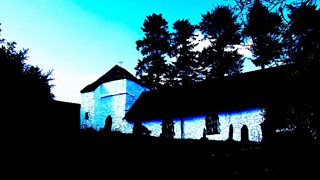
Pilleth Church on Brynglas Hill. Photo: Phil Rickman
Brynglas is far more accessible to most of England than the site of that other great English defeat, the Battle of Hastings, but how many English readers would have heard of it? It isn't exactly a tourist trap in Wales either. Every time my wife and I went up there to explore the wonderful Pilleth Church for research purposes, we were entirely alone.
Which didn't exactly augur well for big sales.
Neither did the real historical characters gathered into the story... like Rhys Gethin, Owain's general and the hero of Brynglas, best known these days for having his name pinched by the 20th century holiday-cottage arsonists, Meibion Glyndwr, to put on their press releases.
I thought I might be on firmer ground introducing John Dee's cousin-in-law, Thomas Jones - better known as Twm Sion Cati, the Welsh Robin Hood. But, after a brief TV series back in the 1980s, he's also gone back into comparative obscurity.
The works of Hilary Mantel and CJ Sansom feature the likes of Henry VIII and Anne Boleyn. And I've got Rhys Gethin and Twm Sion Cati and the words of the woman at the Penfro Festival echoing in my head like an axe on a block.
Never have been published in Wales...
Oh, come on, I don’t believe it.
I daren't believe it...
