
A new exhibition of work by portrait sculptor Ivor Roberts-Jones, which will appear much like a who’s who of leading 20th century Welsh figures, has just gone on show at National Museum Cardiff.
The Double Edge: The Portrait Sculpture of Ivor Roberts-Jones marks a centenary since his birth and captures the likenesses of the many notable figures in society and politics who sat for him during the 1970s, 1980s and 1990s.
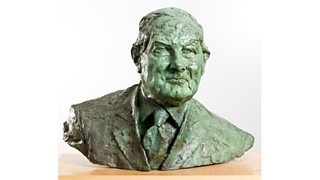
James Callaghan. Image: courtesy of the Estate of Ivor Roberts-Jones.
Roberts-Jones is perhaps best known for his commanding sculpture of Winston Churchill which stands in Parliament Square in London. His striking likeness of the painter Augustus John, which brought him to prominence, is on display in Fordingbridge, Hampshire, and his impression of doomed World War One poet Rupert Brooke stands in Rugby, Warwickshire.
Many of you may also have seen his 1984 sculpture The Two Kings at Harlech Castle, which illustrates a scene from the Mabinogion in which Bendigeidfran carries the body of his nephew Gwern.
This new exhibition features head portraits of many leading figures in Welsh life during the 1970s and 1980s, a key period in the development of contemporary Welsh identity when Roberts was the sculptor of choice for commissioned works.
Among those who sat for him were the notable politicians James Callaghan, George Thomas and Cledwyn Hughes, but also artists Augustus John and Kyffin Williams, Oscar-winning actor Hugh Griffith, opera singer Geraint Evans, and many more, although much of his work was also done from memory.
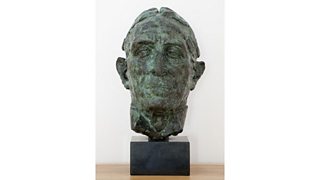
George Thomas. Image: courtesy of the Estate of Ivor Roberts-Jones.
Amgueddfa Cymru has 24 sculptures and three drawings by Ivor Roberts-Jones, making it the largest public collection of his work.
The title The Double Edge relates to one of his own terms for what he often sought to explore in his subjects - a duality of strength and weakness.
Oliver Fairclough, keeper of art at Amgueddfa Cymru, said: “It’s a pleasure to be able to show Roberts-Jones’ work in the museum. He was one of the leading figurative sculptors of his day. This year marks the centenary of his birth and it is fitting for us to look again at the work of this important sculptor.
“The exhibition is part of our Welsh Artists in Focus series at the National Museum Cardiff and is drawn mostly from the Amgueddfa Cymru collection but also includes works from the Glynn Vivian, Oriel Ynys Môn and Arts Council England.
“Part of the Amgueddfa Cymru collection comes from the Welsh Portrait Sculpture Trust, which was a voluntary body established in 1980 to commission portraits of Welshmen eminent in politics, the law and the arts for presentation to the museum. Ivor was the only artist employed by the trust, which was dissolved after his death in 1996."
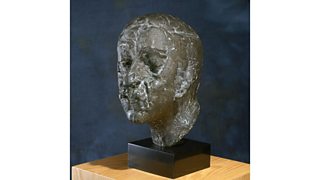
Kyffin Williams. Image: courtesy of the Estate of Ivor Roberts-Jones.
Ivor Roberts-Jones was born in Oswestry in November 1913 to a Welsh-speaking father and an English mother.
He trained first as a painter, and then as a sculptor at Goldsmiths’ College and the Royal Academy Schools in the 1930s, before serving in the army throughout the Second World War, afterwards making his career as a portrait sculptor. Roberts-Jones was also head of the sculpture department at Goldsmiths' College from 1964 until 1978.
His first full-scale commission was the memorial to Augustus John (1967), which led to his election as an associate of the Royal Academy.
The exhibition runs until 11 May 2014. There will also be lunchtime talks providing additional information on the artist.
The first takes place on 17 January 2014 and is “An Introduction to The Double Edge: Ivor Roberts-Jones (1913-1996) and Identity in Bronze”, by Oliver Fairclough.
The second is on 24 January 2014 and is titled “Finding the Double Edge: Ivor Roberts-Jones and Public Sculpture”, by Jonathan Black, senior research fellow in the History of Art at Kingston University.
