
Wales has produced many fine artists over the years but none are more significant or impressive than the Swansea-born painter Ceri Giraldus Richards.
Ceri was born on 6 June 1903 in the tiny village of Dunvant, just outside Swansea. His father was a tin plate worker but he was also a gifted musician, bi-lingual poet and conductor for the Dunvant Male Voice Choir.
As a consequence of all this artistic endeavour, Ceri and his siblings grew up in a cultured environment where all three were taught to play the piano, appreciate music and literature and enjoy the natural world.
It certainly paid dividends for the young painter as Ceri Richards was deeply motivated both by music and nature throughout his working life.
He particularly enjoyed the scenery of Gower, an area through which he had roamed as a child and adolescent.
Aged eighteen Ceri enrolled at the Swansea School of Art as a full-time student but it was during a week-long summer school at Gregynog Hall in 1923 that he began to realise his full potential talent.
At Gregynog he saw canvases by painters like Van Gogh and Renoir and was motivated to apply for a scholarship to the Royal College of Art in London.
Ceri's application was successful and he duly moved to England. Apart from a brief period during the Second World War when he was Head of Painting at the Cardiff College of Art, he remained in England but never forgot his Welsh roots.
His first solo exhibition was in 1930 at the Glyn Vivian Gallery in Swansea and he was soon being hailed as an artist of some consequence - exhibiting with artists such as John Piper.
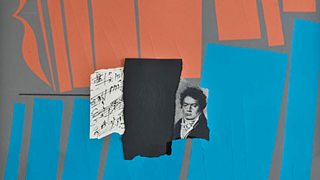
Ceri Richards' Major Minor screen print
He was renowned for his superb draughtmanship but was also able to absorb European influences and incorporate them into his own work.
Picasso and Kandinsky were both great influences on his work which gradually moved towards surrealism.
Ceri Richards was more than just a painter though and constantly sought to express his ideas and talent in the most appropriate settings.
He produced fine stained glass windows for places such as Derby Cathedral and the Liverpool Metropolitan Cathedral.
He was also interested in architecture and the process of illustration. It was in this field that he produced magnificent designs and illustrations for the work of Welsh poets Dylan Thomas and Vernon Watkins.
Ceri Richards died on 9 November 1971, renowned as one of Britain's most influential creative artists.
These days his work is held in a variety of venues including the National Museum in Cardiff, the Glyn Vivian Gallery in Swansea and The Tate in London which has a collection of over 90 paintings and other works.
It’s interesting that two of Wales' most celebrated creative artists, Ceri Richards and Dylan Thomas, came from the same town and created their art in more or less the same era but never really knew each other.
Ceri only met Dylan Thomas a few weeks before he set off on his final reading tour to America and was devastated by the poet's untimely death.
Following his death, Ceri immediately set about commemorating Dylan and his poetry in a series of paintings.
2014 is the centenary of the poet's birth and an exhibition of Ceri's paintings, celebrating Dylan Thomas and his work - is opening at the Martin Tinney Gallery, Cardiff on 6 March.
Ceri Richards - the Dylan Thomas Works is an exhibition celebrating Dylan's poetry through Ceri's magnificent paintings. It centres on the poem - The Force that Through the Green Fuse Drives the Flower which Ceri Richards painted in 1965.
The exhibition is an opportunity for anyone interested in the work of either Ceri Richards or Dylan Thomas to appreciate art and literature working in total fusion.
Unfamiliar with his work? Watch a slideshow of 90 paintings by Ceri Richards on BBC Your Paintings.
