
Pembrokeshire is often called the County of Castles. It might also be known as the County of Islands, as some of the most beautiful, remote and fascinating of all Welsh islands can be found lying along its rocky coast.
Quite apart from the five main islands – Caldey, Skomer, Skokholm, Grassholm and Ramsey – there are also dozens of little islets and rocks, some of which have been inhabited over the years, dotting the coastline.
However, there can be little doubt that Ramsey, which sits less than a mile out to sea from St David's peninsula, is the most beautiful of them all. It is also one of the most accessible.
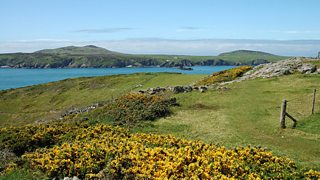
Pembroke Coastal Path and Ramsey Island
Image © Row17 and licensed for reuse under this Creative Commons Licence.
Despite being relatively close to the shore, the island retains a remote and somewhat desolate appearance. This, you feel, is exactly how an island on the western margins of Britain should look, washed by wild winter waves and battered by gusting winds.
It seems an inhospitable place and yet there is something strangely appealing about Ramsey – visit once and you will invariably go back for a second look.
Ramsey Island covers just 640 acres, being approximately two miles long and rising to 446 feet at its highest point. It is the fourth largest of all Welsh islands (behind Anglesey, Holy Island and the fellow Pembrokeshire island of Skomer). It comprises sedimentary, volcanic and igneous rocks, quite a surprising mixture considering the relatively small nature of the island.
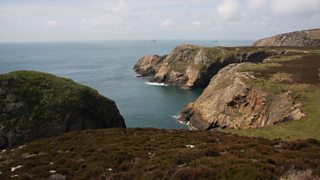
The south coast of Ramsey looking westwards
Image © Bob Jones and licensed for reuse under this Creative Commons Licence.
These days Ramsey is owned by the Royal Society for the Protection of Birds but for many years it was actually in the possession of the church.
In the early years of the 20th century the place was sold into private ownership and was farmed until the 1960s. At one time there was a deer farm on the island. The RSPB bought Ramsey in the early 1990s, running it now as a nature reserve.
The island is crucially important as a breeding site for grey seals, over 400 seal pups being born here each autumn. Ramsey is also noted for its soaring cliffs, which are the home of thousands of gulls and auks. Here you can also find ravens, buzzards and the wonderful Manx Shearwaters. There is also considerable heathland on the island which is universally regarded as one of the best locations to spot the rare red legged chough.
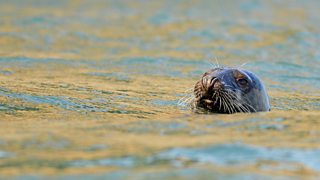
Grey seal off Ramsey Island by JBR on the BBC Wales Nature Flickr Group
History and legend abound on the island. According to folklore this was where, in the sixth century, St Justinian - the confessor of the Welsh Patron Saint David - came after growing discontented with the behaviour of his fellow monks at nearby St David's. It was remote and desolate enough to suit not just his somewhat masochistic needs but also those of most of the early Christian missionaries who came to Pembrokeshire.
Justinian hoped to found a colony of devout believers but his regime was apparently so strict that several of the holy men rebelled. They cut off his head. Legend says St Justinian simply picked up his severed head, put it under his arm and walked off across Ramsey Sound. He came ashore at the spot where the chapel of St Justinian now stands.
Perhaps more rooted in historical fact, there have been many shipwrecks on and around the island. The Greek steamer "Emmanuel" ran aground in the Sound in March 1925 when several of the crew were stranded on a small reef between the wreck and land. The ship was eventually pulled off the rocks and taken for repair to nearby Milford Haven where she promptly collided with the trawler "Arthur Cavanagh". Not the luckiest of ships, obviously.
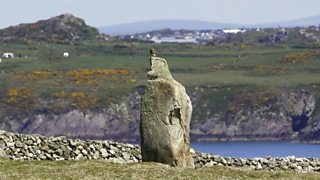
On Ramsey looking over Ramsey Sound. Photo by Sue from the BBC Wales Nature Flickr Group
Lifeboats have been stationed in the St David's area since 1869 but the 12-oared pulling boat "Gem" was lost when she went to the rescue of the ketch "Democrat" in October 1910. She struck the infamous Bitches, a string of rocks stretching between Ramsey and the mainland, and three crewmen died. The survivors huddled together on the Bitches until the following morning when the lifeboatmen and the crew of the "Democrat" were finally rescued.
Ramsey is surrounded by many smaller islands. These include the Bishops and Clerks Rocks, Ynys Bery and Ynys Eilun – and, of course, the infamous Bitches. They might be small but they are rugged and isolated, not the sort of place sailors ever wanted to encounter on a dark and stormy night.
Modern day visitors to Ramsey Island are unlikely to suffer the same harsh treatment. Tourist boats run trips around Ramsey – the scenery on the western side of the island is truly spectacular - and from Easter until the end of October people can actually go ashore. The trips leave from St Justinian's Lifeboat Station.
Ramsey is an island of spectacular beauty with an abundance of wildlife and scenery. It has a rich historical past and is well worth a visit if you should ever find yourself in the area.
