
Castell Coch, the fairy-tale creation of William Burges and the Marquis of Bute, sits easily among the trees of Fforest Fawr just outside Cardiff at the bottom of the A470. Over the years the castle and the forest have featured in many TV and movie productions including BBC Wales' production Doctor Who.
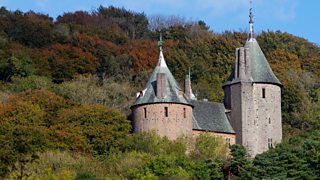
Castell Coch has been used as a filming location in many BBC Wales productions. Image: Gareth Jones in the BBC Wales Nature Flickr group
Yet the castle and its surrounding grounds have been more than just a filming location over the years.
Travelling back in time through the history of Castell Coch, there was a time when the castle had its own vineyard and sold some of the first commercially produced Welsh wine.
Wine drinking now has become fairly commonplace, many of us happily settling down to a bottle of 'plonk' with our Sunday dinner. However, for most of the 19th century and, indeed, for much of the 20th, wine was a tipple that was the preserve of the privileged few.
For a long time the upper classes and the well-to-do were the only ones who could afford the costly imported wines from places like Bordeaux and other French wine producing areas. For the ordinary man or woman in the street ale or beer was the regular drink – a lot safer than the dubious water supply available in most cities, it must be said.
Wine had been imported into Britain since the days of Richard the Lionheart and its production – for those who even bothered to think about it - was something that was synonymous with France, Spain or Italy. It certainly had little to do with the rather cold, wet fields of Britain.
Yet Britain was not quite a vintner's desert. Between the early 1870s and the start of World War One the vineyards of Castell Coch and, later Sully, did actually produce good quality white and red wine. It was a small enterprise but for nearly 40 years these vineyards produced the only commercially grown wine in the whole of Britain.

Parts of Doctor Who episode Robot of Sherwood were filmed in Fforest Fawr
Wine drinking had been introduced to Britain by the Romans who planted and cultivated many vineyards across the country. After they left in the fifth century wine making – and the drinking of it – fell into a slow and steady decline.
The great monasteries kept the practice alive, monks tending and pressing the grapes as well as seeing to their religious duties, but after the Dissolution of the Monasteries in the 1530s and 1540s it became a dead art or skill. For the next few hundred years there was virtually no British wine being produced.
Then, in the early 1870s the third Marquis of Bute decided that, having renovated and re-built Castell Coch on the outskirts of Cardiff as a quintessentially medieval castle, he needed a vineyard to complete the illusion. In 1873 he instructed Andrew Pettigrew, his head gardener, to look into the possibility of establishing a vineyard close to Castell Coch.
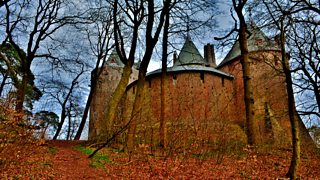
Castell Coch in autumnal glory. Image: Paula J James in the BBC Wales Nature Flickr group
The Marquis was serious about creating a Welsh wine and Pettigrew was sent to France for a few months in order to learn the trade. The area chosen for the vineyard was on a gentle south-facing slope to the south-east of the castle, protected from frosts and the worst of the weather by surrounding woodland.
The first vines were planted in 1875, a small forest of four foot high vines that completely covered the slope. The plantation stretched for nearly three acres across the hillside.
The grape chosen was the Gamay Noir, the same one that was used in the vineyards of northern France. It was perhaps not the best choice being better suited to a rather warmer climate but Pettigrew and his staff tended the plants with loving care.
The initial harvest took place in 1877. The weather had been good for the first two years of the vineyard's existence and as a result 240 bottles of fine white wine were produced. The grapes had been pressed in the gardens of Cardiff Castle and the wine was apparently "well received". It was likened to good quality still champagne.
The summer of 1879 was cold and wet and for several years no wine was produced from the vineyards of Castell Coch. In 1886 the Marquis ordered the creation of a second vineyard, at Swanbridge near Sully in the Vale of Glamorgan. It was a gamble but one that seemed to pay off. In 1887 Castell Coch alone was producing over 3,000 bottles of sweet white wine.

Castell Coch from a distance on a summer's evening. Image: Gale Jolly in the BBC Wales Nature Flickr Group
The year 1893, with its long hot summer, was a bumper one as far as production was concerned and between them the Marquis' two vineyards produced some 12,000 bottles. By now it had become possible to produce red wine as well, the product apparently being called 'honest and uncomplicated'.
Not everyone was of the same opinion. The satirical magazine Punch, on being informed that wine was being produced in Wales, commented that it would take four men to drink it - one the victim, two to hold him down and one more to pour the wine down his throat. Punch might scoff but by the end of the first decade of the 20th century the vineyards at Castell Coch were a growing commercial enterprise.
The Castell Coch wine was initially sold through the Angel Hotel in Cardiff and later became available from London wine merchants. It was, however, quite expensive - a single bottle costing somewhere in the region of £15. That price tag certainly put it out of the reach of ordinary Welsh men and women.
By 1905 there were a total of 13 acres of vines at Castell Coch and Swanbridge and it seemed as if the great gamble had paid off for the Marquis of Bute. Then, in August 1914, war was declared and over the next few years it proved impossible to obtain the sugar needed to help the wine ferment. Production of Welsh wine ceased and when peace returned in 1918 there was little inclination to start again – people had much more serious problems on their minds.
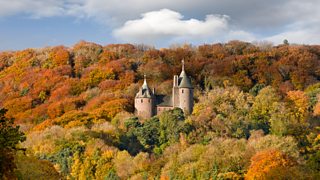
Castell Coch by Steve Ellaway in the BBC Wales Nature Flickr group
The vines at Castell Coch were uprooted in 1920 and the land where the vineyard once stood is now a pitch and putt golf course. Wine production in Wales disappeared once again as wine drinking went out of fashion for many years. It was only the importation of cheap German wine in the 1960s that made wine finally available to everyone. And with that availability came the desire to grow vines once more.
It took time but wine production has now returned to Wales. There are now approximately a dozen Welsh vineyards, each of them selling excellent quality products. And to think it all began with just a few acres of land at Castell Coch.
