
At BBC NOW HQ, it feels like we have been talking about the BBC Ten Pieces project for a very long time. Somehow, I can't believe we've actually got round to the cinema launch date!
I'm sure by now you will have heard something about this ambitious nationwide project that the BBC has embarked upon. The project will see more than 100,000 school children across the United Kingdom get acquainted with nine pieces of core repertoire, and a new work by one of Britain's brightest young composition stars, Anna Meredith (you may have seen the National Youth Orchestra of Great Britain perform her work HandsFree at the 2012 BBC Proms).
The Ten Pieces film is in cinemas and schools throughout the UK from 6th October 2014.
It feels like eons ago since we spent a number of days in an airport hangar in deepest, darkest Wales. We were coached out to the 'top secret' location - it felt a bit odd turning up in our concert finest to what was essentially a large field with a few cows in it - and then ushered into the hangar.
The first thing that struck me was how huge the space was! Dark, cavernous, and completely empty but for the orchestra and the lighting and camera rigs, the hangar made an impressive, blank stage upon which to create some magic with lights, a little bit of smoke, and (if you've now seen Ten Pieces you will also know) a lot of water.
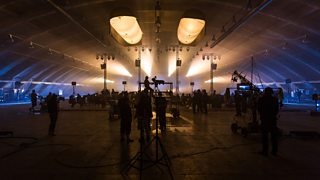
The hangar where BBC NOW recorded Ten Pieces. Image: Guy Levy
Filming is a much more start/stop process than recording. During soundtrack recordings when we finish a take we very quickly move into another take, or onto another cue, almost without pause. However, because of the necessity of resetting lights, camera positions and sometimes special effects, there is often a lot of sitting around between takes in filming.
To be honest, I even found the sitting around interesting. TV and cinematic production is a form of sorcery, and it was fascinating to watch how various effects were created. Lighting effects certainly added an extra energy to some of the works - playing Mars from Holst's Planet Suite bathed in an ominous red glow definitely helped to create the war-like feeling.
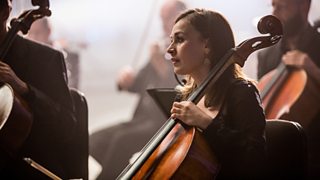
A member of the orchestra during filming. Image: Guy Levy
My favourite effect, however, came at the end of Night on The Bare Mountain (when the bells toll for the breaking of dawn). To signify the day breaking and the end of the frolicking of all the evil beasties, the hangar doors were slowly opened to allow a sliver of bright light to fall across the orchestra. It was really quite beautiful, even if, at the time, the most astonishing thing about it was that it was so sunny outside - inside the hangar there was no sense of time at all as there was no natural light whatsoever!
Amusing things happen during recording of any type - for one work it was felt that the cameras couldn't get quite the right passing close up shot of the faces of the woodwind, so the players were asked to play with their stands about six feet away from them in order to create a little track for the cameras to travel between the stands and the players. The stands, of course, were then too far away for any of the players to read, so they had to play the movement by memory or by dint of much squinting.
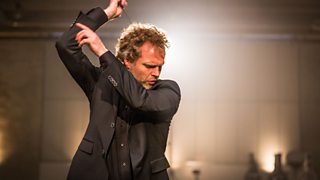
BBC NOW's Principal conductor Thomas Søndergård. Image: Guy Levy
Of course, Ten Pieces is about much more than our on-screen cinematic debut. It's also about a lot more than just Ten Pieces. It is an unprecedented, organised attempt to engage children with classical music.
There are follow up projects, ambassadors, champions, and a plethora of other material created for the project. If your child has seen Ten Pieces we would love to hear from you. If they enjoyed it, why not bring them along to see the spectacle live?
