
The artist Graham Sutherland is seen by many as one of the visionaries of 20th century art.
His early surreal landscape pieces capturing the wild coastlines of Pembrokeshire were once seen as important contributions to the Neo-Romantic period and are the paintings for which he is perhaps best known.
A new exhibition at the Oriel y Parc Gallery and Visitor Centre in St David's, Pembrokeshire, reveals how deeply Sutherland was influenced by the area's breathtaking scenery.
A key attraction in the exhibition will be an oil painting of his loaned by the Tate. Black Landscape was painted between 1939 and 1940, and is viewed as one of the best examples of Sutherland's early work in Pembrokeshire.
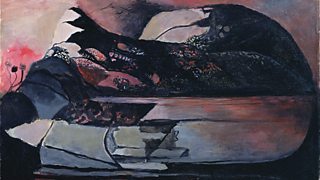
Graham Sutherland, Black Landscape 1939-40 © Estate of Graham Sutherland
I spoke to the exhibition's curator Bryony Dawkes, who told me how Sutherland's organic oil paintings were part of a very personal vision he had of the landscape.
During the 1930s he noted that "I felt as much a part of the earth as my features were part of me".
She said: "The exhibition will show how his work relates to the wider art world in the 1930s and how he became part of the national Neo-Romantic movement.
"The piece we have been loaned by the Tate in London is fantastic and one of the most important pieces in his early portfolio."
The exhibition shows how Sutherland's landscapes art developed before and during World War Two, and features other Neo-Romantic landscapes from the collection of Amgueddfa Cymru, including artists such as Paul Nash, John Piper and Ceri Richards.
Some of the locations captured by Sutherland, like Clegyr Boia, Porthclais and Sandy Haven, strike a somewhat strange chord and offer something more symbolic than just a reproduction of a landscape.
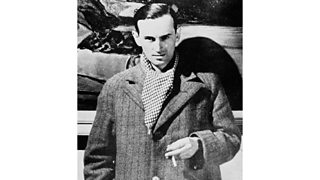
Sutherland standing in front of Black Landscape. Image © Estate of Graham Sutherland
Bryony added: "The movement harks back to the 19th century work of artists such as Samuel Palmer and William Blake, who had themselves lived through turbulent times.
"Sutherland and his contemporaries combined this pastoralism with modern European styles such as Abstraction and Surrealism, to try to capture the spirit of the British landscape at a time of change.
"The idea is to paint what you feel and express what it means to feel like you are actually part of the landscape."
Sutherland's work captures this nostalgia for the natural landscape before the ravages of industrialism and a catastrophic war took hold but also explores an emotional connection through the symbolic use of colour.
Sutherland was painting like this before the war broke out but it soon became fashionable among other artists working in Britain, several of whom became official war artists, capturing events as they unfolded.
Between 1940-1945 Sutherland also contributed to the War Artists' Scheme, keeping a pictorial record by drawing bomb sites, blast furnaces, tin mining and quarrying.
Spirit of Place: Sutherland and the Romantic Landscape will run in one gallery while in the rear gallery is a large installation by Anthony Shapland, which has been in the museum's collection for several years.
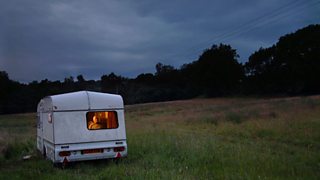
Still from Anthony Shapland's A Setting. Image © Anthony Shapland
Shapland's 2007 film A Setting is a transitional piece which features twilight as it evolves, as day loses its grip to night.
Through the use of traditional romantic symbols such as the rugged landscape and full moon it turns that artistic genre on its head.
The exhibition runs until 8 July 2013.
