
The date 4 November might not mean an awful lot to most people. But 4 November 1980 was when Welsh boxing entered its own, very specific, very sad “dark season” with the death of Merthyr bantamweight Johnny Owen, after his attempt to win the World Championship went tragically awry.
Johnny Owen was born John Richard Owens on 7 January 1956 from an ordinary working class Merthyr family. His parents, Phil and Edith, had eight children in all, Johnny being the fourth of them. He began boxing at the age of eight and in a very successful amateur career had 126 fights, winning several Welsh titles in the process.
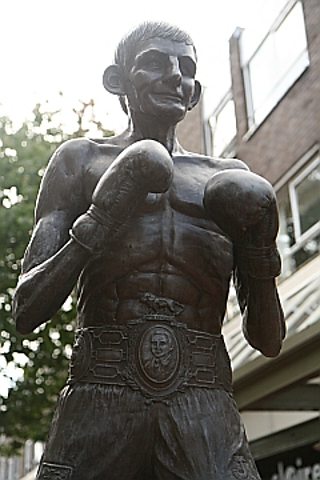
Statue of Johnny Owen in Merthyr Tydfil. Photo: Darren Wyn Rees
It was inevitable that Johnny would turn professional at some time. This he did in 1976, dropping the letter “s” and fighting under the surname of Owen.
His first professional fight was against fellow-Welshman George Sutton, then ranked as the third best bantamweight in Britain. It was meant to be an easy contest for Sutton but Johnny Owen surprised everyone, winning the match on points.
A quiet, reserved individual, young Johnny preferred to do his talking in the ring, where his skill and determination seemed, at first, to be at direct odds to his appearance. Standing at 5ft 8ins, his slim – even, some might say, skinny – appearance quickly earned him a string of nicknames – the Merthyr Matchstick and the Bionic Bantam being just two.
His looks were deceptive. Johnny had built up his strength and stamina by incessant roadwork, pounding along the hills and valleys of his native town and area. He was a determined fighter, a formidable boxer who opponents underestimated at their peril.
His entry into the British boxing scene was nothing short of dramatic and soon he had built up a following, not just in his home town of Merthyr but all across Wales. His career was destined to be short but boxing fans from all over Britain quickly took the lanky bantamweight to their hearts. Yet despite the adulation, Johnny Owen remained a Merthyr boy.
He won the Welsh bantamweight title after just six fights and took the British title after ten, knocking out the champion Paddy Maguire. Guided by his manager Dai Gardiner, Johnny Owen soon came to dominate the British bantamweight division. There was, literally, no-one in the country to touch him.
Johnny and Gardiner had wider ambitions, however, and soon the Merthyr Matchstick was able to add the Commonwealth title to his British crown. That fight against Australian-based Italian Paul Ferreri was a classic. Although pundits expected Ferreri to win easily, Johnny just wore him down with an immaculate demonstration of boxing skills.
Johnny Owen was the victim of a “hometown verdict” when, next, he fought Francisco Rodriguez of Spain for the European title. Despite dominating the contest, the points decision went to the Spaniard – Johnny’s first professional defeat. He gained his revenge, however, when Rodriguez came to Ebbw Vale to defend his title the following year and found himself on the end of an honest verdict. Johnny Owen was now British, Commonwealth and European champion.
After winning a Lonsdale Belt for defending his British title three times, Johnny Owen’s next target was the world championship. On 19 September 1980 he took on Mexican bruiser Lupe Pintor in a hot and humid Los Angeles.
Despite doing well in the initial stages of the contest – by the end of the 8th round he was actually ahead on points – Johnny was knocked down in the 9th. It was the first time he had been knocked down in his professional career and from that point on the contest began to edge in Pintor’s direction.
Towards the end of the 12th round Johnny was caught by a powerful right hook and crashed to the canvas. Unconscious, his head whiplashed onto the ring floor – he never got up. After lying on his back for five full minutes he was taken to hospital in a coma. And there he died several weeks later.
It later transpired that Johnny Owen had an abnormally delicate skull. Medical check-ups had failed to identify this problem and had his head not smashed into the canvas he might well have survived. Later analysis suggested that the fight should have been stopped but, as someone once said, hindsight is the only exact science.
Documentary telling the tragic story of Merthyr-born boxer Johnny Owen.
Johnny’s parents did not blame Lupe Pintor for the death of their son. They knew he was engaged in what was, potentially, a dangerous sport and actually sent a telegram of support to the Mexican boxer. When, twenty years later, a statue of Johnny Owen was erected in his home town of Merthyr, it was actually unveiled by Pintor.
Johnny Owen was, and remains, a legend in Merthyr Tydfil. His life was cut tragically short and nobody knows what he might have achieved had he survived that disastrous knockout in Los Angeles. The Merthyr Matchstick was a man of great heart, determined to succeed in his chosen profession, truly a man for all seasons.