
I started the day bright and early meeting up with 14-year-old Daniel Copley, who was entering the Horse Young Handler competitor for the very first time.
I also met Katrina Poole, who at 19 was competing for the very last time due to the age restrictions of the competition. It was fantastic watching these very confident young people ready their horses for competition, painting socks white with chalk and hooves bright with oil.
In contrast to Daniel, Katrina had won champion the previous year and there must have been a great deal of pressure on her to perform well again this time.
Heartbreakingly, despite a great effort, Katrina didn't make it through to the final with her horse Gems the Rustler this year. It was better news for Daniel, though, as despite only meeting Ben, the horse he was handling, the day before the competition he pulled off an incredible feat and was carded in the Junior Horse Young handler competition.
As he was in the top four finalists it now meant that Daniel would be pitted against the senior Young handlers with the top four competitors from each competition going head to head on Thursday for the overall supreme Horse Young Handler Champion.
Sometimes if we are ahead of the schedule I have an opportunity spend a little more time with a contributor. This was just the case with the Sir Bryner Jones Award winner Ieuan Edwards. We grabbed a cup of coffee and while the crew were setting up I could really get an insight into what winning the award meant and why Ieuan had been chosen. Ieuan had started as an apprentice butcher at the age of 16 and was running his own business at 20.
Ieuan said winning the Sir Bryner Jones Award had great kudos and meaning within the industry, and on three levels: it personally meant a great deal to him; for his hard working team back at Edwards of Conway; and he also thought that the society itself deserved a pat on the back for recognising the quality of the butchers we have working here in Wales.
He explained that Welsh food and drink is very much in vogue at the moment and for all the right reasons and that this great show of ours is a wonderful platform to showcase the wonderful goodness and value of our great Welsh food.
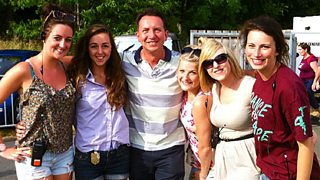
The wonderful runners who look after me during filming of the Royal Welsh Show
I'm always at odds how to reply to the very good meaning people who invite us to pop along and say hello when we have five minutes. The truth is we don't get any spare time at all during the week's filming. An average day involves getting up around 5.30am, shower, quick read over the day's schedule and then Sara Edwards and I are off in the taxi to the show ground.
We didn't stop once for a lunch break this year; we grabbed food and drink on the run and if we were lucky after a solid day's filming we may have got back to our hotel for around 8pm. Then it's food, a read over of the script for the next day (normally multitasking from a bath!) and trying to grab a few hours' sleep before we start all over again.
Two weeks before the show was due to air I had just flown back from lecturing in Kenya, nursing a broken wrist and ankle. The BBC then informed me I'd be training with the young farmers and learning how to pull in the tug of war competition.
How hard could it be? I met up with Sioned Owens, a competitor on the girls team to tell me how it all works. She explained that the teams met up three times a week and train long hours. It was quite obvious that this competition required a great deal of commitment from the competitors.
The first thing I noted was that it was pretty hot to be training but the girls and boys were soon up and running a warm-up lap of the field prior to getting their hands dirty. A Manitou was driven into the field sporting a large concrete block from its folks. To my disbelief, the girls then strapped a rope to this huge block and started hoisting it some 10 metres into the air!
I started wondering if I should enquire if there was a junior team I could train with instead. Their focus, coordination, determination and sheer brute strength was admirable and after watching the girls I really didn't want to jump on the boys' team, but as no junior team seemed to have turned up I was left with little choice.
Team leader Aled Roberts brought me over a set of boots that Neil Armstrong would have been proud of. With their solid metal plated soles they certainly seemed heavy enough to walk on the moon! In my naivety I assumed special treads would be used to achieve as much grip as possible but Aled informed me that the boots had no grip at all, just a bladed plate that you slammed into the ground.
He then ran through some of the techniques of pulling and the strategies used to win. I had no idea how technical the tug of war was and had just assumed two teams just pulled as hard as they could until somebody fell over, but there was far more to it than that!
I dug my feet in the ground and pulled. I doubt if the boys even noticed that I was included in the pull; their strength and skill didn't require any help from me. However, I was flabbergasted just how hard the tug of war was when undertaken properly. The body was held at a 45 degree angle, the legs pumped and straight and your forearms felt like they would explode.
We hoisted the concrete weight to its highest point, a feat in itself, and then were instructed to hold our position, hold....hold...and hold. I swear I saw the sun lower in the sky before I let go of that rope again. My forearms pumped as the blood ripped back to them and after a single pull I was spent.
To my amazement both the boys and girls teams continued on through the evening. The sport of tug of war and the young farmers competitors had just gained a mighty slice of respect from me!
Back at the Royal Welsh I caught up with both the boys and girls teams for the tug of war competition, at the height of the hottest part of the day as we sought shelter from the glare of the sun under their team gazebos.
I enquired of Sioned how the training had been going. She seemed pleased and confident but the competition looked fierce and the sun even fiercer. I reminded the boys that there would be hell to pay if the girls won and they didn't make it, they laughed and replied that they were feeling confident too.
After what seemed like endless rounds of pulling there was heartbreak for the boys. There was a three way tie to go through to the final and the judges had put the other two teams ahead of Montgomeryshire. Despite making the weight to compete they were still the heaviest team to qualify and this was the deciding factor in stopping them progressing further in the competition.
It was a cruel way to drop out and in my own opinion not the fairest way to have done so. They put on a fine display on the day and should be rightly proud. The girls continued to fight on and achieved and incredible third position. Quite rightly they were over the moon and continued to fly the flag for Montgomeryshire for another year.
After all that excitement it was a run down to the Fur and Feather pavilion where I met Rebekah Couch from Skewen, to hear a truly heartbreaking tale. We had filmed with Rebekah and her prize-winning rabbits back in 2010, but since then tragedy had stuck. Rebekah's livestock had contracted Viral Hemorrhagic disease (VHD) with the family losing 25 rabbits in all.
VHD is a very serious infectious disease where unfortunately once a rabbit is infected there is no cure. Rebekah was unable to show at the Royal Welsh for a year but was back this year with three rabbits including a stunning looking three year old Rex called Buster.
Judging rabbits takes a very long time and is done behind closed doors. We returned with our cameras later in the day to find an overwhelmed Rebekah clutching a hand full of cards. She had achieved all firsts and one best of breed. How's that for fronting up to adversity and winning? Rebekah was back, and the Fur and Feathers was a better place for it. It was a lovely happy ending to a hot and hard day.
I'd promised to pop along to the BBC compound for an hour Wednesday teatime to support BBC Summer of Wildlife. As I arrived I ran into Derek Brockway, who was busy making sure he was forearmed with all the weather data before giving you the forecast.
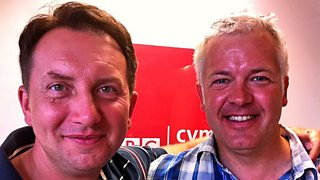
With Derek Brockway
I enjoyed talking to the South East Wales River Project about how clean the River Taff has become while examining some of its wildlife, talking about the need to know the difference between bees and wasps, and extracted some pineapple DNA with colleges of mine from Cardiff University.
After a few photo opportunities it was off to the Young Farmers Federation pavilion to undertake one more interview that would be pre-recorded for Thursday's Royal Welsh Show.
I'm a big rugby fan so to interview referee Nigel Owens was a great privilege. Nigel is the President of the Young Farmers Federation here in Wales, a 6,000 strong member organisation that adds more than a little colour and competition to the show.
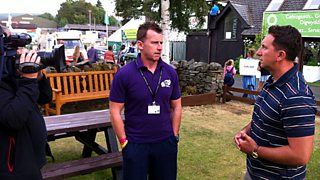
Interviewing Nigel Owens
Nigel and I met up a few minutes before the interview and it was great to catch up and talk about what the Young Farmers had been up to this week.
I myself had been closely involved in tug of war completion but Nigel went on to explain he had been refereeing the rugby and watching many performances from the main stage at the Young Farmers pavilion.
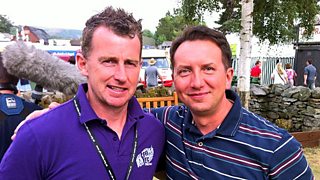
Nigel and Rhys after the interview
It's always nice to catch someone off guard and he looked genuinely surprised and pleased when I had congratulated him on becoming Wales' most capped rugby referee ever.
Looking to the floor he replied that he had mixed feelings as although it was a great honour it did mean that his best refereeing days were now behind him. I think it's safe to say that Wales best and most capped referee still has quite a few years left in him left yet though!
