
Ghost stories are a part of our cultural heritage, tales from a long and distant past shrouded in mystery. Stories that originated so long ago it is almost impossible to separate fact from fiction.
Before the days of radio and television, families would gather around the fire and as shadows leapt across darkened rooms and tree branches snapped against the window shutters, they would terrify each other with stories of hauntings, headless horsemen and mist-filled hollows.
Unfortunately, most ghost and horror stories are figments of the storytellers’ imaginations and many of them have travelled the length and breadth of our country before they have finally been settled in one particular location or another. Locals will swear that they originated from and belong to their particular stretch of the land, albeit with little proof. And sometimes the same tales can be found in widely disparate parts of Wales.
There is, for example, a wonderful tale from Amroth in Pembrokeshire where the son of an old farmer who tries to scratch out a living on the windswept coast, goes to sea to make his fortune and simply disappears from view.
Years later a ship is sighted, beating in from the Atlantic, and the wreckers – the old farmer amongst them – set false lights to lure the ship onto the rocks. There is little evidence of “wrecking” around the coast of Wales but that matters not in the creation of a good story like this. The ship duly ploughs onto the coast and the following day the farmer and his colleagues go down to pick over the remains.
At the water’s edge is the half-dead body of a sailor. There can be no survivors and no witnesses, so the farmer takes a boulder and smashes in the man’s head. When he turns the body over he finds that it is none other than his long-lost son.
It’s a great story but one which is also told about the Glamorganshire coast – exact locations vary – and about the Llyn Peninsula in North Wales. Which one is the true location – if any of them – is not known but as the man once said, why let the truth get in the way of a good story.
Llantwit Major, once a major religious and educational centre, is the scene of several well-known ghost stories. Boverton Castle, on the eastern edge of the town, was once owned by the Earl of Gloucester. His daughter Hadwista was the first wife of King John but when John succeeded his brother Richard Ias King of England, he divorced her to marry Isabella of Angoulême. Hadwista retired to Boverton Castle where she spent the rest of her days, pining after her lost love. That much is certainly true.
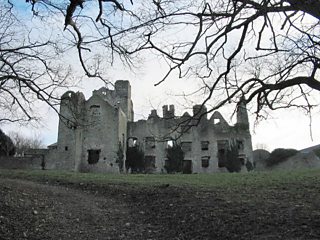
Boverton Castle, which is said to be haunted by The Black Lady of Boverton
When Boverton Castle was being renovated and, eventually, destroyed in the late nineteenth century workmen claimed to have seen the spectral shape of a woman dressed completely in black wandering around the ruins. She had long black hair – just as Hadwista had – and was seen and heard to weep copiously. It was, people of the town declared, the ghost of Hadwista, still pining for evil King John. The spectre was immediately christened the Black Lady of Boverton.
Such tales clearly have a basis of truth, although the “ghostly” element has been added later to give a touch of menace to the story. With some of these stories, it is relatively easy to see the joins between fact and what, to superstitious locals in the dim and distant past, are meant to be tales to terrify – and perhaps educate.
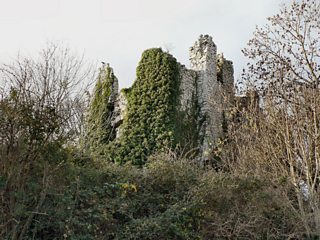
The Old Place in Llantwit Major is also rumoured to be haunted.
Llantwit Major was the scene for just one of these stories. According to legend, an old woman, on her deathbed, made her daughter-in-law promise to divide up her estate between the family members. The daughter-in-law simply kept the money for herself and settled back, happy, rich and content. However, before long the ghost of the old lady began to visit the woman, hitting and pinching her and keeping her awake most of the night.
Eventually the ghost gave the woman a choice – admit the deceit or throw the money into the river. She chose the latter but threw the cash upstream, not down towards the sea where it would have been carried out into the Bristol Channel. The ghost then supposedly threw the woman into a whirlpool from where she was later cast up onto the river bank.
Found, battered and bruised by locals from the town, the story soon came out, much to the shame of the woman. Family members were, for many years, haunted by weird noises at night and long after her death, it was claimed, members of the woman’s family were regularly haunted.
A drunken brawl? An unfaithful wife caught out by a husband who then beat her? Or simply a story to explain away the sudden good fortune of husband and wife? The possibilities are endless – all part of the wonderful wealth of ghost stories from ancient and medieval Wales.
