
There can be little doubt that The Hound of the Baskervilles is Arthur Conan Doyle's most famous story. Dozens of films and television programmes have been made about the hound and the man who brought it to summary justice, Sherlock Holmes.
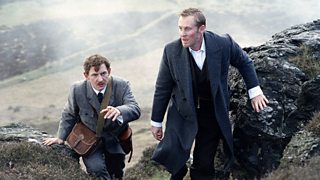
Ian Hart as John Watson and Richard Roxburgh as Sherlock Holmes in the 2002 BBC dramatisation of The Hound of the Baskervilles.
The story - written eight years after Conan Doyle had killed off Sherlock Holmes in The Final Problem and supposedly an earlier event in Holmes' career - was immediately successful, so successful in fact that the author was forced to bring his detective back to life.
Reviving Holmes was something Conan Doyle was, at first, loath to do as he had grown heartily sick of his creation. In the end he yielded to pressure and Holmes duly returned to 221B Baker Street for many more stories.
Meanwhile the popularity and success of The Hound of the Baskervilles continued to grow. The story is set in Devon, on Dartmoor, and is the tale of an enormous ghostly hound that haunts and brings about disaster to members of the Baskerville family.
For many years the origins of the tale and where Conan Doyle found his inspiration have been a puzzle for researchers. There have been many candidates, both for location and for characters, but Wales may well have had a part to play in the creation.
Stories about ghostly hounds are quite numerous in Wales, where the legends of enormous black dogs are commonplace. The Welsh name for them is Gwyllgi which can be translated as Twilight Dogs, a name that seems to fit as the apparitions rarely seem to appear in the day but prefer those dim-lit moments just before dark.
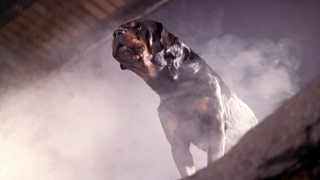
The hound from the 1968 BBC dramatisation of Sir Arthur Conan Doyle's famous story.
In one story a terrified servant girl from Skewen was followed home one evening by a huge black dog and although the farmer, her employer, immediately went out with his gun, searching for the creature, it was nowhere to be seen. Yet the following morning strange footprints were found in the muddy lane where the girl had walked.
Another version of the tale is set in Carmarthenshire. A hound, or Gwyllgi, appeared in front of a man called Davies. He, however, was made of sterner stuff than the servant girl from Skewen and lashed out at the beast with his stick. To his amazement, the stick went right through the apparition which then promptly disappeared.
In Laugharne a girl called Rebecca Adams once apparently encountered a black dog in the lane leading to the old Norman castle. It sat in front of her, barring her progress, and began howling and shrieking loud enough to wake the dead.
There are dozens of similar tales and legends but Baskerville Hall in Clyro, Powys, might have claims of rather more substance. Quite apart from its name, the hall is a stately and imposing building which, apparently, Conan Doyle visited on several occasions. Owned by the Baskerville family since 1839, the legend of the hounds of Black Vaughan add an extra edge to the claim that this was the setting for the Conan Doyle story.
Conan Doyle's first wife had strong links to Wales and it is highly likely that she would have told him about the legend - particularly if they were about to visit the hall. According to that legend the Vaughan family, land owners in the same area as the Baskervilles, possessed a pack of wild hounds that roamed along and around nearby Hergest Ridge.
It was said that Black Vaughan often set his hounds on walkers and passers-by who had annoyed him. Some, so the story went, had even been mauled to death. True or not, it is unlikely that Conan Doyle - knowing his predilection for the supernatural and for fantasy tales - did not know about the legend.
Similarly, his wife would have told him about the Welsh stories of dangerous dogs appearing in the twilight - meat and drink to a man with Conan Doyle's imagination.
The immediate inspiration for the book was probably the Devon legend of the wicked Richard Cabell, a character just like Hugo Baskerville in the published story.
Conan Doyle wrote The Hound of the Baskervilles soon after he returned from serving as a volunteer doctor in the Boer War and was eager to get down to something more palatable than real death and suffering.
With his writer's instinct he would have already stored away the information about Baskerville Hall in Powys, the Welsh legends of the Gwyllgi, mixed them up with the story of the Devonian Richard Cabell, and when the time came used them all in the creation of the hell hound of Dartmoor.
It all makes wonderful speculation. One thing is sure, however, the Welsh legends about black dogs remain, perfect material for detective stories and folk tales of a time long ago.
