
Imagine being 81 and training daily to compete in the worlds masters swimming championships, or on your 57th birthday starting a five-year-run-around-the world.
Not that long ago, it was absurd to think that grandparents would be participating in the Olympics. Japan's Hiroshi Hoketsu, London 2012's oldest Olympian, recently competed at the age of 71, and the oldest man to take part in the London Marathon this year was 101-year-old Fauja Singh from Ilford.
So is age now just a number? Are these achievements a sign of changing times and does society need to re-think how it views older people? It seems some commonly held preconceptions about ageing are gradually changing: that it's not all about decline and a steady reduction in activity.
To mark International Older People’s Week and European Year for Active Ageing 2012, we examine the art of growing old and look back at some extraordinarily feisty people across Wales for whom, it seems, age did not wither or deter.
The table tennis player
On Saturday 26 May 2012, the Olympic torch travelled to Swansea where it was carried by the oldest torch bearer on the Welsh leg of the journey.
Betty Gray MBE, 91, has been playing table tennis for 70 years and earned more than 250 caps representing Wales. She has been playing table tennis since war broke out.
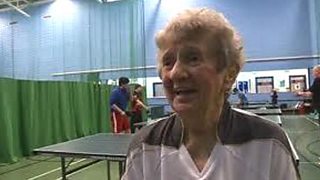
Betty Gray MBE
All these years later, this champion of the sport is still involved and helping to teach others. "When you decide to carry on playing past your peak, you have to accept that you're going to lose," she says. "I've never minded that. It's the playing and the trying that's important."
In 2001 Betty was honoured for her services to table tennis in Swansea with an MBE in the New Year's Honours list.
"I don't think I'll ever stop playing, it has been my life."
The farmers
The oldest farmers in the UK are Elwyn Williams, 74, his brother Ceredig, 85, and their sister Nancy, 89, who live together on Rhiwlug Farm and run two other farms near Llandysul, in Ceredigion, west Wales.
The Williams brothers get up at six each morning to tend the livestock, while their sister still makes her own butter.
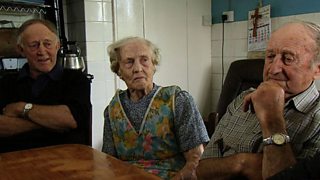
Elwyn, Nancy and Ceredig Williams at their farm in Wales. Photo: S4C/Cefn Gwlad
Forgetting to put your teeth in seems an unlikely occupational hazard. Iain MacDonald, 80, recalls a trek into the hills of Skye to round up sheep and only then realising he had left his dentures at home. Without his teeth he could not whistle commands to guide his collie Pip.
The festival grandparents
For music festivals it seems you're never too old. Fans of a certain age were indignant at the suggestion that music festivals are just for the young at this year's Green Man Festival in the Brecon Beacons.
Pat Stancomb is over 70 and at the festival with three generations of her family.
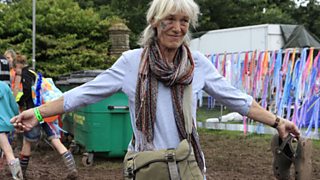
Pat Stancomb at the Green Man Music Festival 2012. Photo: Melanie Lindsell
"I've always loved live music," she says. "Despite the mud we're all having a fantastic time and everybody is delightfully friendly."
"I like different bands from Granny," says her 14-year-old grand daughter Lilly. "She likes acoustic acts and doesn't like loud banging music, but we all like Van Morrison."
The swimmer
The world masters championship draws thousands of competitors from across the world, including 81-year-old Baz Owen from Bangor. They battle it out by age group. The lifelong swimmer takes part in the backstroke, butterfly and individual medley in the 80-84 years category.
Mr Owen, from Llanfairfechan, Conwy, has been swimming for over 70 years and runs a class in swimming and diving at the Arfon Masters Swimming Club. The former salesman still trains four times a week. His swimming career began when he was eight years old, in the local quarry, and the love for the sport has never left him. He said the competition was "always fierce" at the world championships.
"You get such a feeling of wellbeing and as it's weightless, it's good for your joints," he says.
"You need to keep yourself fit - we're only here once as far as we know and it makes sense to make it last as long as possible."
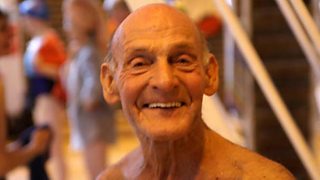
Baz Owen
To warm up he starts with a length from the pool underwater. Then it’s down to it: four times a week he swims, maintaining his fitness and stroke technique.
But why keep going when other 80-year-olds are putting their feet up? “You sit down in the chair and your body gives you a little nudge telling you to get up and do something.
"Instead of sitting there watching soaps on the TV, I get up and have a swim."
The skydiver and climber
Eric Jones, 75, from Tremadog near Porthmadog is a solo climber, skydiver and Base jumper and was the first British climber to solo the north face of the Matterhorn.
At the age of 61 he jumped from the Angel Falls in Venezuela, and is the oldest person to have done so. His achievement was shown in the 1998 documentary film The Man Who Jumped To Earth.
His jump into the Cave of Swallows in Mexico at the age of 66 was shown in the 2003 BBC documentary The Man Who Jumped Beneath The Earth. He has also done work as a stunt double for Sean Connery.
66-year-old Eric Jones completes does a stunning, and perilous, base jump in Mexico
Having jumped from balloons as a skydiver, Jones started Base jumping (jumping from a fixed object, natural or man-made) at the age of 50. His first Base jump was off the Eiger, and he was the first person to do this. His self-proclaimed motto is "Life is adventure or nothing at all".
Today he also owns and runs a small cafe at Tremadog which is popular with climbers and bikers alike. Some of his exploits can be seen in photos on the cafe walls.
The adventurer
On 28 August 2008 Rosie Swale-Pope, then aged 61, arrived home after an epic round-the-world run she began almost five years earlier. She did it to raise awareness of prostate cancer after it claimed the life of her husband Clive, 73, in 2002.
Her aim was to run around the northern hemisphere taking in as much land mass as possible, with no support crew and just minimal supplies and sponsorship.
Rosie started from her home town of Tenby on her 57th birthday, 2 October 2003, equipped with just a small specially designed cart of food and basic camping equipment. The trip was funded by renting out her cottage.
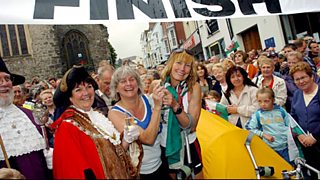
Rosie Swale-Pope completes her five year around-the-world run
By April the following year she had reached Moscow, and on 15 September 2005 she arrived in Magadan in far eastern Russia. After facing extreme conditions in the Alaskan winter she reached the road again in April 2006, and in October 2006, she was in Edmonton, Canada.
Four years after the departure, on 2 October 2007, she arrived in New York City.
On 18 June 2008 Rosie arrived at Scrabster in Scotland’s far north by ferry from Iceland, and ran from there back home to Tenby. Despite stress fractures in both legs, which turned the final few miles into a hobble on crutches, she returned to her home on 25 August 2008. Her distance travelled was 32,000 kilometres (19,900 miles).
Rosie continues to take on new challenges, often a little closer to home.
The world's second oldest twins
Lily Millward and Ena Pugh, aged 101, from near Brecon, were named as Guiness World Record holders two years ago. Older twins have since emerged in Scotland, who are 50 days older.
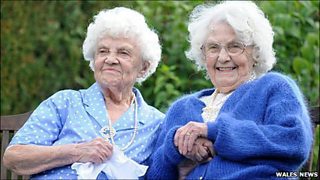
Ena Pugh and Lily Millward, the world's second oldest twins
Farmer's daughters Mrs Pugh and Mrs Millward were born on 4 January 1910 when Queen Victoria's son Edward VII was king.
Great-grandmother Lily has said the secret of their long life is "laughter and having a joke with each other".
How to Live Beyond 100
According to the last census there are now over 600 centenarians in Wales and 12,000 in the UK. Over the next 25 years that number is expected to rise to over 90,000. A quarter of all children born today are expected to live to 100 and beyond. Does science have some of the answers when it comes to the secret to reaching 100, and what are the effects of diet, exercise and alcohol on life expectancy?
Research has suggested a lot depends on the feel-good factor. Being an optimist and putting others before yourself seems to be top of the list. A study published in the journal Applied Psychology: Health and Wellbeing in 2011 appears to back up this theory, claiming that positive thinkers and happier people do live longer.
There was also a decrease in mortality figures among those who put others before themselves. The theory is that giving back can provide a sense of purpose and self-worth and result in the "helper's high" - a physical sensation resulting from the endorphin release after an act of kindness or generosity.
Some argue that these feelings can reduce stress, promote wellbeing and strengthen the immune system. He suggests that the difference in how a person views the same situation could actually have an impact on the genes affecting their brains which in turn could change certain chemicals and alter stress levels. All this could potentially have an effect on health and longevity.
Related links:
Eating five portions of fruit and vegetables a day
Wales deaths from drug and drink issues
Regular exercise 'extends life expectancy'
Balanced, healthy diet, rich in vitamins and minerals
Elsewhere on the BBC
Explore lots more content on the subject of ageing from across the BBC:
European Year for Active Ageing
BBC Radio 4: You and Yours - Positive ageing
BBC Radio 4: You and Yours - A Minister for older people?
BBC Radio 4: You and Yours - Pensioners in debt
BBC Radio 4: You and Yours - Working after retirement
