
Most people who visit Wales are intrigued by the names of our towns and villages. They may not be able to pronounce them – many of those who live in the country would be equally as hard put - but they are still fascinated by the look and by the sounds of those names. They are part of what makes Wales different but where did they come from and what is their origin?
At the risk of over-simplifying the matter, when the Romans invaded Britain in 43AD the vast majority of the native population was Celtic and most of them spoke one of two languages, Brythonic and Goidelic. They were derivations of Common Celtic (Brythonic) and Gaelic and Manx (Goidelic). Brythonic was not unlike the Welsh that is spoken today.
In the pre-Roman days there was little or no tradition of people banding together into communities so there was no need to give names to settlements – they simply did not exist. Instead, names were given to geographical structures such as hills, rivers or harbours. The civilising nature of the Roman occupation changed all that with small communities springing up in various parts of the country.
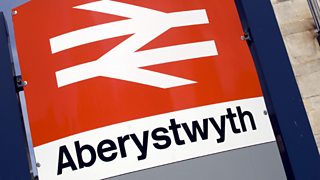
Aberystwyth - meaning 'mouth of the river Ystwyth'
The pre-Roman names for land features were quickly gathered up and used, now, as the names for settlements. As a result many of the towns in Wales begin with the prefix Aber which means “mouth of” – Aberystwyth meaning the mouth of the River Ystwyth, Abergele the mouth of the River Gele and so on. Places like Porthcawl have a rather special meaning – harbour with sea kale.
Despite the Roman occupation, Brythonic survived rather well in the 400 years after the Roman invasion. By the time the Legions left in 410AD Brythonic was beginning to absorb Latin words but the Saxon raids and conquests of the fifth and sixth centuries saw the Celtic peoples pushed further and further westwards. They went and they took their language with them.
It was not as simple as that, of course, and, inevitably, the old Welsh tongue was adulterated over the years as other languages also left their influence or their mark on the traditional Brythonic. These include Viking, Norman, Anglo-Saxon and even English.
The Anglo-Saxons were a Germanic people who spoke a language quite similar to Old Norse and in their eyes the Britons or Celts were foreigners. They gave these foreigners the name of “walas” and, almost by default, the name stuck to the land these people occupied in the west. The Brythonic name for the people who lived there was Cymry.
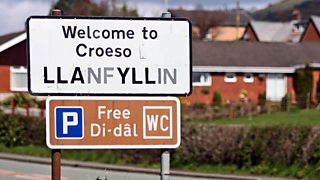
Llanfyllin - one of many places in Wales with the 'Llan' meaning 'Church or parish of' prefix
Even now the names of many places in Wales begin with Llan. It means “Church” – or, rather, the enclosed land around the church where Christian converts had settled – and, as far as town or church names are concerned, is often combined with the name of an individual. Saints, in particular, are often commemorated in this way. Llanbadrig, for example, is named after St Patrick, Llandudno after St Tudno and Llanelli after St Elli.
Eglwys, which also means church, is often also coupled with someone’s name so that Eglwys Brewis in the Vale of Glamorgan is named for someone called Brewis.
Just to confuse matters, there are also towns beginning with Llan that do not have church connections. Llandaff, on the fringes of Cardiff – despite housing the most magnificent cathedral - is named, not after a saint but after the River Taff while Llandrindod in Powys is called after the Trinity (y Drindod in Welsh).The industrial and oil producing centre of Llandarcy, situated between Port Talbot and Swansea, has a much more modern origin and is named after the industrialist William Knox D’Arcy.
Sometimes modern towns were named in the ultimate pragmatic fashion. So Doc Penfro, the Welsh for Pembroke Dock, got its name as the dock that was built in the shadow of Pembroke and its mighty castle – logical and simple.
Trees and plants also gave their name to Welsh towns and communities. Bedw – meaning birch trees or birch woods – is a common name in Wales while a place like Ysgawen derives its name from the elder tree.
The same can be said of animals. Pen means “head of” so the seaside town of Penarth means “Head of the Bear.” Ships captains beating up the Channel used to say that the headland and landmark on the coast before Cardiff was shaped like a bear. Consequently, when the town and its docks were formed in the mid nineteenth century Penarth was a logical name to call it. Other animal connections include Bryn Ceffyl, Ceffyl being the Welsh for horse, and Castell Moch which, in English is Castle or Fort of the Pigs.
Pant means valley or hollow, pont is bridge – you do not have to look far in Wales to find names beginning with both of those. Legends also give other names. Bryn is the Welsh word for hill so places like Bryn-yr-Ellyllon translates as “Hill of the Goblins” while Bryn yr Hen Bobl means Hill of the Ancient People.
There are so many fascinating names for Welsh towns. It would need four or five books to do the subject full justice. Suffice to say that you could spend a month logging and translating the Welsh place names of our country – there are worse ways to spend your time.
