
When you think of Welsh fishing ports your mind invariably travels no further than Milford Haven. Although its glory days have now long gone, by the end of the Victorian period the docks at Milford were full of trawlers and drifters. By the middle of the 20th century the west Wales town was playing host to the sixth largest fishing fleet in Britain.
Such was the majesty of Milford that we often don't realise that for many years there were numerous other ports and harbours along the Welsh coast - towns and communities where fishing was also the main industry. They were places that, for a while at least, were as significant as Milford was later to become. In particular there was Tenby.
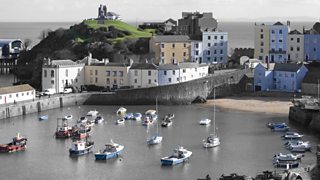
Tenby Harbour. Photo: Maciej Martyka
These days we know Tenby as a tourist haven, but consider its Welsh name, Dinbych-y-Pysgod. Its meaning can be roughly translated as ‘place of the fish,’ a clear indicator of the importance of the fishing industry to the life of the town.
Tenby was one of the earliest Welsh fishing centres, a thriving town and port from before the middle ages. Its original pier was said to be the oldest in Wales, a structure that dates from the 14th century. Edward II gave the community the right to levy tolls in order to build the structure, a curved pier that gave the ships of the town protection from the north-easterly winds.
The chapel of St Julian was built at the pier head - it was demolished in 1842, the same year that the present stone pier replaced the original structure - and prayers for the fishermen and their boats were regularly said there. Maritime historian J Geraint Jenkins wrote:
“A tax of a halfpenny was paid to the officiating priest by each fisherman and a penny for each boat.”
In the 18th century those were not insignificant amounts. Clearly it paid to be a member of the clergy in a fishing community.
To begin with most of the fishing from Tenby was in-shore, the boats being too small and too insubstantial to face the gales of the Atlantic. Carmarthen Bay - perhaps reaching as far south and west as Lundy - was the area of operation for the Tenby fishermen. Herrings and oysters were the mainstay of the industry, being mainly caught in the stretch of sea between the Gower peninsula and Caldy Island.
By the 19th and 20th centuries the boats had become bigger and far more robust, and the town's fishermen began venturing further afield. Soon they were plying their trade off the southern coast of Ireland and out into the Western Approaches where the catches might be better but the dangers and the risks were far more considerable.
It was not just Tenby locals who used the port as their base. Many of the men who fished out of Tenby actually came from the Brixham area in Devon, sailors who were simply using Tenby as a centre for their summer activities and fishing cruises. Over the years many of these men did settle in Tenby so that instead of being just summer visitors they were now actually residents.
The coming of the railway in the 1860s provided the Tenby fishing fleet with a ready market for their catch. Now Tenby fish could be despatched each morning to the Welsh valley towns, even to London, and as a consequence the fleet grew quite rapidly.
By 1870 the port was the most significant fishing base in west Wales. Twenty years later there were 19 boats of over 50 tons based in Tenby, as well as many smaller, in-shore vessels.
While most of the bigger boats carried out beam trawling, the smaller craft - usually open-decked luggers - operated a system of line fishing. Their catch was usually cod although some oyster gathering also took place. At the beginning of the 20th century there were approximately fifty such luggers operating out of Tenby and the harbour was a teeming forest of masts and sails.
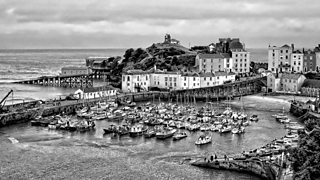
Tenby Harbour. Photo: Gale Jolly
Many of the boats were owner-operated, others working on a cooperative, shared basis between skipper and crew. In general, most of the larger boats were manned by a crew of three, plus a young boy who was there to do ‘the dirty work’ and learn his trade. The harbour in the town was thriving and as the 19th century came to a close it seemed that the future of the industry in Tenby was well assured.
However, by the beginning of the new century the fishing industry of Tenby was already starting to decline. The town's growing importance as a holiday resort - bank holidays having recently been introduced for all working people - was partly to blame.
Tourists did not want foul smelling boats pulled up on the sand, fish heads and scales beneath their feet, and as far as the fishermen were concerned, it was a lot easier to run pleasure boats around the bay or over to Caldy than it was to risk the rigours of a winter gale out in the Channel or Atlantic.
Milford Haven, of course, was now also engaged in its rapid expansion, and that was a real problem for the long-established but vulnerable fleet at Tenby. It was Milford's better access to the Atlantic and its docks where steam driven trawlers could come and go at any stage of the tide that finally spelled the end for Tenby's fishing fleet.
It was a gradual demise but it was a fatal one. The number of boats engaged in fishing began to decline and by 1914 only 7.9 tons of fish were landed at Tenby. In the early 1920s only a handful of in-shore fishing vessels were left. The fishing industry had moved, lock, stock and barrel, to Milford.
These days summer visitors stroll Tenby's pretty streets, gaze at the handful of boats moored in the harbour and move on to their next ice cream. Only very few of them realise that they are staring at the remnants of what was once the most significant fishing port in west Wales.
