
One of the consequences of the resurgence of the Welsh language has been the changing of some of the more anglicised town and village names in the country. Over the past few decades more authentic Welsh spellings - and, arguably, more authentic pronunciations - have re-emerged and have now become the accepted form.
Sometimes the changes have been as a result of local government or community council decisions, perhaps because of local usage. Sometimes there has been no change at all but debate still runs red hot, with fervent supporters all eagerly arguing their corners. The most obvious example of this is the town of Criccieth on the Llyn. Should there be two ‘c’s or one? There is no double c in Welsh, yet for the moment the spelling remains at Criccieth.
There are other debates in progress. Should Rhayader become Rhaeadr? Should Ruthin really be Rhuthun? There may not, yet, be answers to these questions but there undoubtedly will be in the future. Both sides of the debate, both sets of supporters, hold firm opinions.
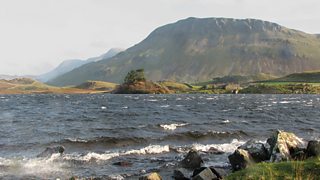
Cadair Idris. Photo: Helen Hall
Whatever the cause or reason for alterations, change is undoubtedly slow. So while Cader Idris has, over the past few years, become Cadair Idris – even featuring as such on Ordnance Survey maps – some of the road signs in the area still call it Cader Idris. Perhaps when the road signage is due for renewal, then things might change.
There is no doubt that some change has occurred. Caernarvon, for example, is now Caernarfon and, perhaps most noticeably, Conway has disappeared for ever, replaced by the more accurate Conwy. The steel town of Llanelli has long dropped the anglicised y off the end of its name.
The root of the issue can be found in the Norman Conquest in the period following 1066. For the next 300 years, the language of the court – and therefore the language of all government dealings – was Norman-French. The language of the people of Britain, however, remained the Old English (Anglo-Saxon it might be called) and, in areas like Wales, the Brythonic tongue that eventually developed to become Welsh.
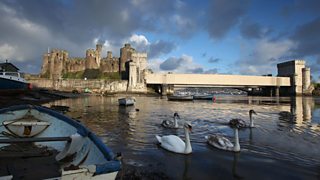
Conwy. Photo: Ian Owen
Even then the situation was unclear. Different parts of Wales used different stresses in the Brythonic language and, of course, court French and the language spoken by Normans going about their daily business were equally as different. In court the word or phrase Beau was pronounced ‘bo’ while out in the real world it was rendered as ‘bew.’
Inevitably, all of this led to different pronunciations and different versions of the same names. Standard alphabets are a modern phenomenon, and names of places and people were as changeable as the weather. Even as late as the 16th century William Shakespeare was spelling his name in several different ways.
Confusion was clearly the name of the game with local pronunciation, as much as the restrictions of the language, deciding on the exact rendering of the word. There are many examples.
In England, the Hampshire town of Beaulieu is pronounced ‘bew-lee’, not ‘bo-lee’ although quite why this should be remains something of a mystery.
In Wales the town and castle of Beaumaris on the shores of the Menai Straits might well be pronounced ‘bo-maris’, at least in the anglicised version of the name, but it has, in Welsh, the spelling Biwmaris and is pronounced ‘bewmaris.’ In west Wales the little village of Carew is still called Care-ee by many old Pembrokeshire people. And so it goes on.
Language and the pronunciation of words are changing all the time. They are, after all, what make the language and the history of our land so interesting. Whether the changes and differences are down to local pronunciation, to custom and practice, or to government legislation, the languages - both Welsh and English - remain vibrant and alive.
