
Beti and David: Lost for Words - is a programme focusing on caring for someone with dementia
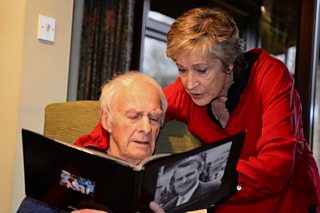
David (Parry-Jones) was diagnosed with Alzheimer’s over eight years ago. He’d been a journalist, news and current affairs presenter, and rugby commentator at BBC Wales - “The Voice of Welsh Rugby”. His life from a very young age had revolved around words. Ironically they were the first to go when the disease took hold.
I, Beti (George), David’s partner and carer, am so often lost for words at serious failings in dementia care. I’m a “veteran” broadcaster and with this programme I’ve been given a voice for the tens of thousands of family carers who save the UK billions of pounds a year. There are 55,000 people with dementia in Wales and the cost of caring for them is £700m a year, with two thirds of that being met by carers and families. (Alzheimer’s Society’s figures)
It’s a Sunday morning and I’m sharing my thoughts with you. I’ve had one of those very rare lie-ins because I over-indulged “my quality time” last night watching missed episodes of the Homeland series. It was way past midnight when I joined David, who’d gone to bed around 10 o’clock.
I knew there’d be a price to pay. He no longer gets up in the night to go to the toilet. He woke up this morning at around 7.30. But as I didn’t move he went back to sleep. Two hours later it was time to get up. Soaking pyjamas, bed pads and duvet cover. His personal incontinent pants and pads almost dry as usual! A mystery that no one seems to be able to solve, which is perplexing in this day and age of technical miracles! He’s provided with certain pads but a fortune is spent on buying others, that cost more and that claim “100% leakage proof”, and on waterproof duvet and pillow covers. Of course issues to do with toileting are not discussed enthusiastically!
Time to get the washing machine going for the first time today. There will be more.
David distressed. Tears rolling. Dignity challenged. Patience and hugs administered. All is well in the warm comforting shower and smiles and humour return.
An hour and a half later - breakfast. Feeling I’ve already done a day’s work! Thinking of professional carers who do this, day in day out, for a pittance. Until they’re paid a decent wage for one of the hardest jobs going, care services will always be second or even third rate.
He eats his cereal and fruit with gusto!
Now it’s medication time - another challenge. He gave up on swallowing tablets years ago. So every medicine has to be in liquid or dispersible form. I hide one of his tablets in a blackberry with his cereal. He has to take painkillers for his bad hip. So 15mil of one is put in a glass of apple juice because he won’t take it neat. The other is Calpol, which is dispensed for children. He, as an adult, has to take 4 at a time. Why oh why don’t these pharmaceutical companies take into account the needs of people with dementia! If only I ruled the world!
An x-ray has shown that his right hip joint has completely disintegrated. The dilemma facing me is whether a new joint would be the answer - it would certainly relieve him of the excruciating pain which he endures at times. Or else to manage the pain with medication. I’ve chosen the latter. So fingers crossed…
Tomorrow morning, Paul - David’s carer and “mate”, will be here to help out as he does every weekday morning since last October. For the first time in eight years I was assessed and it was decided that support was needed. 36 hours a week. Or as a friend pointed out - a day and a half! Paul does 24 hrs and we’re still on the look-out for another carer to do the rest. Not easy – they’re in such short supply.
The day itself passes without incident. The Wales v Italy match is on. David sleeps through most of it, but does wake up at times and will applaud a bit of skilled running or tackling by a player in red. But asks several times who’s playing!
All is calm until about 9 o’clock (apart from some contrary behaviour in the bathroom!) Now it’s time to prepare for bed.
It takes between an hour and three hours and I miss good programmes on the telly! Books and concerts and opera and theatre are no-go areas for me now.
But hey - why am I complaining! I take care of David because I care for him. He’s not a burden.
And life for thousands out there is much tougher than mine.
However, I’d argue that it’s time to think again about dementia care which includes caring for the carer in a meaningful way. Let’s start a revolution! I have ideas!
