I’ve just finished watching the first episode of ‘Iolo’s Great Welsh Parks’ with my wife and mum. They both thought the filming was fantastic, but they would, of course, as I was the cameraman.
I was brought up in the countryside near Chepstow. Being a wildlife cameraman was hardly considered a realistic career choice then - it was right up there with footballer, film star and astronaut. As I was just about to start a mechanical engineering degree, an amazing series called ‘Life on Earth’ appeared on TV with David Attenborough, and I decided one way or the other that I wanted to film programmes like that. The degree was ditched. Years later I heard that my sixth form teachers thought I had totally lost the plot, and maybe they were right! Even so, after a convoluted route I ended up doing the job that I still love.
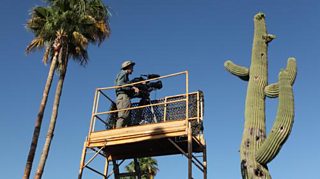
Graham Holder at work
Last year I travelled around Wales with Iolo and the team filming wildlife in four different parks. Singleton Park is the first programme in the series. For every fine day in Swansea we had a couple of atrocious ones. There is a scene where Iolo is sitting in the teeming rain in the dark waiting for foxes and you can hear the thunder rolling in off the sea. I think I can speak for all the crew when I say that the thing uppermost on our minds at this time was the restaurant just down the road. That said, concentration is key, because the law of wildlife filming states that the moment your mind wanders something interesting will happen… only this time it didn’t. Nothing happened! Wildlife filming isn’t all about getting the shot at the last minute; sometimes, with the best will in the world you fail.
For all the native wildlife we filmed throughout the year at Singleton, Pontypool, Wepre and Holyhead I will always remember this series for one species. Not the elusive adders of Holyhead, the freshwater crayfish of Pontypool or the great crested newts of Wepre. The award goes to… the ring necked parakeet of Swansea.
Just before starting the ‘Great Welsh Parks’ series I had been filming a documentary called ‘Planet Parrot’, which is about parrots living in cities around the world. That film took me to LA, where red-headed Amazon parrots live in their thousands; Phoenix, where lovebirds nest in holes in the huge saguaro cacti; Buenos Aries, where Monk Parakeets are part of the cosmopolitan city life; and Mexico, where scarlet macaws are being bred and released back into the jungle. When I heard that we would be trying to film a parakeet in Singleton Park I could hardly believe my luck!
Making good wildlife programmes is hard work. If you think it’s easy you’re not trying hard enough. Wildlife camera people do get all the glory, but none of it is possible without a great team, and as a team we are always thinking about the end result and what the people sitting at home will get out of viewing our programme. I hope the series encourages people to get out there and see what they have on their doorstep.
Catch up on Iolo's Great Welsh Parks on BBC iPlayer or watch highlight clips from the series.
