
On 20 April 1961 the BP oil terminal on Milford Haven opened for business. The terminal was not a refinery, merely a pumping station that took oil from in-coming tankers and then sent it via a pipeline to the refinery at Llandarcey outside Port Talbot. Nevertheless it was an important part of a major industrialisation of the Milford Haven waterway.
Milford Haven, with its deep water and gently sloping estuary sides, was ideal for the massive oil tankers of the 1960s and '70s. No less a person than Admiral Horatio Nelson had once called it the finest natural harbour in the world and there is no doubt that the place had been under-used for years.
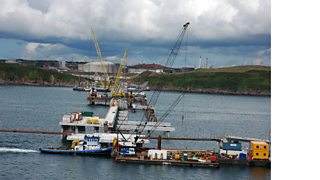
Refinery jetty, Milford Haven. Copyright Philip Halling, licensed under Creative Commons
When, in the late 1950s, the demand for oil – for industry, for petrol, for household usage – increased rapidly, the oil companies looked towards Milford.
The proposal to build refineries on the waterway was announced and there were immediate protests from concerned environmentalists. The National Parks Commission was horrified at the idea and renowned writers and naturalists like Ronald Lockley led the campaign but ultimately work began on the Esso Refinery near Herbrandston in 1957.
The refinery was opened by the Duke of Edinburgh in 1960 and had cost somewhere in the region of £18 million. The initial capacity was set at 100,000 barrels of crude oil a day but the refinery was soon producing in excess of 180,000.
The first tanker, the Esso Portsmouth, arrived during the first day's operations but, as if to confirm all the fears of the conservationists, disaster soon struck.
On the day after the opening, there was a fire and an explosion at the terminal and for a while it seemed as if the whole place might go up. In the event the fire was extinguished by the emergency services before any serious damage was done, but the incident certainly showed all the potential dangers of the oil industry.
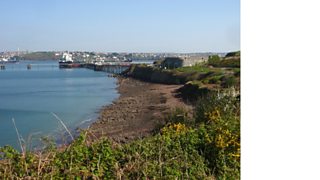
The old BP oil terminal jetty. Copyright Shaun Butler, licensed under Creative Commons
The opening of Esso was quickly followed by the BP Terminal and over the next 20 years by a series of other refineries on both sides of the Haven – Regent (later Texaco) in 1964, Gulf in 1968 and Amocco in 1973. Milford Haven was transformed from a sleepy rural backwater into the third biggest port in the UK.
By 1974 the refineries at Milford Haven were producing 58,554,000 tons of oil each year, three times the combined trade of all the other British oil ports. Building the various refineries had provided employment to hundreds of local people from a region that had been classified as a 'distressed area'. When the refineries were working they employed over 2,000 people.
There were critics, however. Many people said that the oil industry was not 'labour intensive' and that specialist workers from other parts of the country took the most important jobs. And then, of course, there was the security element.
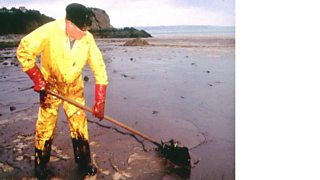
Cleaning up after the Sea Empress disaster, 1996
In 1984 a serious explosion on one of the oil tankers caused three deaths while in 1978 the Christos Bitas tanker ran aground just outside the Haven, causing considerable pollution and damage. The Sea Empress disaster in 1996 caused even more ecological damage, killing thousands of sea birds and spreading crude oil along the Pembrokeshire coast.
It was very much an 'occupational hazard' and there were dozens of other minor spills over the years. The Milford Haven Conservancy Board and firms like Marine and Port Services, which normally tied up the tankers when they reached port, soon developed expertise in dealing with such problems.
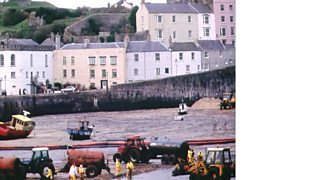
Cleaning up the oil pollution on the beach after the Sea Empress disaster, 1996
As the demand for oil fluctuated the future of the Milford Haven refineries was called into question. Esso ceased production of crude oil in March 1983 – although the production of petroleum products continued until 1988 when the depot finally closed. Gulf ceased to operate in 1997.
It was a time to diversify and lately Milford Haven has become home to two new liquefied natural gas (LNG) terminals. One of them was located at South Hook on the site of the old Esso Refinery, the first ship, the Tembek, docking on 20 March 2009.
Milford Haven continues to operate as an oil and gas port. The refineries might clutter the estuary banks, dominating the view whichever way you look, but they do, at least, make use of one of the finest waterways in the world.
