Can't Read, Can't Do My Sums!

Rachel Treadaway-Williams
A question for you… Is it possible for someone who’s gone through the Welsh education system to be unable to tell the time?
It’s a skill I’m working on with my 6 year old. We’ve not got to grips with the concept of how many minutes ‘to the hour’, but he can read an analogue clock and write down the numerical representation. I am playing quite an active role as a parent and am fortunate to consider myself confident when it comes to numbers. But even for those children without pro-active family members to help-out, surely after 10 plus years at school they should be able to tell the time?
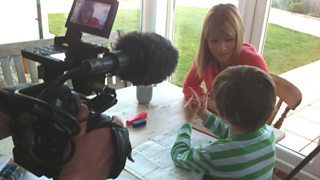
WIWO presenter Rachel Treadaway-Williams helps her 6 year old with his homework
Not so for Nick Bush from New Tredegar. 23 years old and totally dependent on his friends to decipher a train timetable. Nick attended school, but when it comes to his mathematical ability he’s not the exception. More than half of the Welsh adult population have maths skills of an average 11 year old or lower.
It’s this void in basic skills that’s been Wales’ undoing in the educational PISA tests and rather than improve, we’ve slipped down the rankings following successive assessments. It was this political bombshell that prompted amongst other changes the introduction of the Literacy & Numeracy Framework (LNF). This was hailed as THE solution to our literacy & numeracy woes but on talking to those who are actually responsible for delivering it - teachers - the way it was implemented does not appear to have been A*. Rather it was landed on an already overloaded workforce without enough support, a viewpoint reflected by Estyn following their early evaluation of the LNF published in January 2015. Also a viewpoint neatly illustrated by Clair Sweet, the Maths lead, at Tylorstown Primary School who told me that the Welsh Government had only just posted examples on their Learning Wales website of how teachers might make it work in practice. This was in February 2015. The Literacy & Numeracy was made statutory for schools in September 2013. You do the maths.
Interestingly when I questioned the Minister for Education, Huw Lewis AM, about this very fact, he claimed to know nothing of it, instead wanting to flag up the NEW online work that his department were engaged in.
Clair Sweet at Tylorstown Primary also made another interesting point. She felt that the principle of embedding literacy and numeracy skills in all teaching was a good one, but didn’t feel the need for yet another formal initiative with all its red tape and paperwork. Instead, she felt it was something that good teachers would have been doing anyway. Which raises another point: are we fussy enough about who is teaching our children? I have to be careful what I say here as the daughter of two teachers; so let me re-phrase that. Is the teaching profession regarded highly enough that it attracts the best calibre candidates? In the educational powerhouse of China the President recently urged that teaching become the most respected job in the country.
It’s clearly a topic that’s been on the Education Minister’s mind and he’s welcomed the various expert reports recently published calling for a boost in the status, autonomy, qualifications and professional development of teachers. He’s recently raised the GCSE entry requirement in Maths & English for Primary School teachers from 2C’s to 2B’s. He told me we can’t just magic up mathematics specialists but on the other hand, I wonder, could he not be moving further and faster to raise this particular bar and send out a message that we now want the best to be our teachers?
Week In Week Out: Can't Read, Can't Do My Sums! is on BBC One Wales, Tuesday 17 March at 10.40pm.
