
When Tim Berners-Lee launched the world wide web in 1991, I wonder if he could possibly have conceived how utterly brilliant and totally indispensable his invention would become in the field of family history.
It was demonstrated to me in all its wondrous glory when a friend living in Australia revealed the depth of her family history research, conducted almost entirely online.
Noelene Lucas is one of those lucky Australians who can trace their heritage because she is descended from not just one convict but three!
When you have criminals for ancestors the depth and detail available is incredible and better in most instances than if they were royalty.
Sarah Venables was born in Hertfordshire around 1815. In February 1834 and again in April 1835 she was tried at the Old Bailey for crimes of simple grand larceny.
She was indicted for stealing several items from her master including three aprons valued at one shilling; two pairs of stockings worth two shillings; one petticoat with a value of one shiling; and one thimble worth sixpence.
Incredibly, the report includes statements from witnesses such as Marian Rawlins who stated: "I am the wife of Henry Rawlins, a carpenter, and live in Tollington Street, Clerkenwell. The prisoner was my servant of all work for five weeks. I missed various articles from my drawers in the bedroom."
And so it was that at the age of just 18 Sarah Venables was transported for 14 years.
Along with 133 other convicts Sarah sailed onboard the Hector, landing in Van Diemen's Land on 11 June 1835. Her future husband Thomas Jones was not far behind, having been sentenced in 1835 for "stealing from a person" and arrived in Australia in 1836.
Both were assigned to work for Thomas and Edward Archer, and Sarah also worked at the Cascades Female Factory in Hobart, which has the most wonderful website packed full of details.
Thomas, who was a blacksmith, is described in the convict records available at foundersandsurvivors.org and archives.tas.gov.au as 5'5" and 3/4, complexion brown, with blue eyes, large head and dark brown hair. No Whiskers, high forehead, large chin, long nose, with a man and horse tattooed on the inside of his right arm. Who needs a photo with this vivid description?
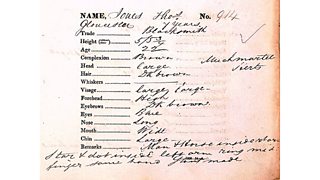
Description of Thomas Jones
By contrast, Sarah is described as being a housemaid from Hertfordshire, having a florid complexion and a small round head with the initials TC tattooed on her left arm.
It seems that Sarah struggled with authority and the strict regime of the convict colony since on 20 March 1837 she was given four days' solitary confinement with just bread and water for going absent without leave. She was given another 10 days' solitary confinement on 22 April 1838 when it was discovered she was out all night.
The Tasmanian Archives confirm that Thomas Jones and Sarah Venables were granted permission to marry. They did so on 8 August 1840 at St John's Church, Longford near Launceston.
Thomas was granted his Ticket of Leave in 1840. This was like parole, meaning that he was free to work for whomever he chose. In 1842 he was pardoned, but it wasn't until 1842 that Sarah gained her Ticket of Leave, by which time they were happily married.
They never left Australia or even Tasmania and quickly became true blue Aussies. Their first daughter Harriett was born in 1843 and three more children followed, including Noelene's great-grandmother Maria in 1847.
Noelene is not alone in her ancestry. The Australian former prime minister Kevin Rudd is said to be descended from Mary Wade who was the youngest ever convict transported to Australia at the age of 11, for stealing another girl's clothes. Mary spent the rest of her life in Australia, had 21 children and over 300 descendants by the time of her death.
Such illustrious ancestors and such immaculate record keeping; I’m almost jealous. But I’ll leave the last words to Noelene:
"Up until about 10 or 15 years ago it was still very shameful to admit to convict ancestors and this shame meant that there was a cultural amnesia - this resulted in us losing connection with the past, our place in our history, family ties and sense of place and belonging."
