
On 3 July 1969 Prince Charles, during a tour of Wales to celebrate his investiture year, made the announcement that the town of Swansea was to become a city.
Swansea was the second Welsh town to be granted city status although it had to wait until 15 December before it formally received its letters patent from the Queen. On that day the Prince of Wales made a return journey to the new city to grant the charter to the people and the civil dignitaries of Swansea at the Brangwyn Hall.
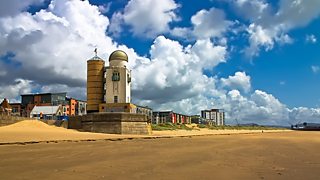
Tower of the Ecliptic Observatory on Swansea beach. Photo: Laurie Parker
Swansea may have been a new city but it has a long and distinguished history. The community initially developed as a Viking trading post and, as a consequence, there have been many suggestions and interpretations of its unusual name.
One version says that it came from the raised ground in the surrounding marshes – Sveinn’s Island – while another declares that it derives from the Viking chieftain Sweyn and the word 'eye' which can also mean inlet. At this distance in time it is hard to come to a conclusion and a final decision on the matter would, anyway, only spoil the fun.
The town’s first charter was granted by William de Newburgh, Lord of Gower, in the twelfth century. The second charter – and the first royal one – was given by King John in 1215.
After that the place developed rapidly, both as a port and as a town, trading in commodities such as wine, hides, cloth and, prophetically perhaps, even a little coal. The main market for the merchants and businessmen of the community was the West Country - Cornwall and Devon being within easy sailing distance for the brigs and clippers of the Welsh town.
Once the Industrial Revolution began to really take hold in Wales the production of coal became increasingly important and Swansea, with its docks and railway links, was ideally situated to take full advantage of the new development.
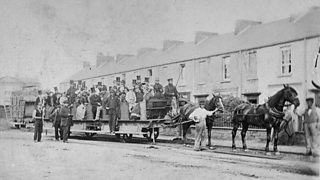
The Swansea and Mumbles Railway, 1864. Photo by Hulton Archive/Getty Images
Exploiting its connections with the West Country, Swansea also developed as a tin and copper centre. As early as 1720 copper works were beginning to blossom and bloom along the banks of the River Tawe and over the next hundred years dozens of works to produce copper, zinc, tin and arsenic were all established. Tinplate and pottery – and, of course, coal – were also produced in and around the town.
So significant was the copper industry to Swansea that the place was soon given the nickname Copperopolis. The population grew rapidly - 500% in little over a hundred years - much of the community being made up of people from outside Wales and the counties adjacent to Swansea who had flocked to the area to make a living.
For a long while in the 1840s and 50s, Swansea had a larger population than Cardiff, being second only to Merthyr Tydfil in size. Even then records are inaccurate as the census returns from the late nineteenth century did not include the surrounding communities which, really, had become part of the larger town.
Swansea, like many industrialised cities in Britain, suffered badly from the depression and economic stringencies of the twentieth century. The decline in heavy industry and the three day blitz of 1941 when German bombers turned the centre of the town into a blazing inferno, simply added to the decline.
Nevertheless, the town survived. New industries and the coming of the tourist trade helped to bring a degree of prosperity in the post war days. By 1969 when Prince Charles granted it city status, Swansea had found a place for itself in twentieth century Britain.
Swansea has a proud history. The site of the first fare-paying passenger railway in the world and with football and rugby teams that consistently performed at the highest level, it was more than deserving of the honour. And, of course, in October 1914, Swansea was the birth place of Wales’ most famous poet, Dylan Marlais Thomas.
These days Swansea is the second largest city in Wales, the 26th in Britain. The census returns for 2011 gave it a population in excess of 230,000. It remains a lively, vibrant community, one that thoroughly deserves the accolade bestowed upon it by its most famous son – "an ugly, lovely town."
