The history of Rude Britannia - from Chaucer to Little Britain

Alastair Laurence
People might ask why we made Rude Britannia - well you might!
As is sometimes the case with television projects, Rude Britannia had a long gestation period.
Nearly three years ago we made a series called Comics Britannia in which we celebrated, among other things, the rude genius that was - and still is - the magazine Viz. It got us interested in Britain as a fundamentally naughty nation.
Then I read a big, bold and brilliant book by a former university tutor of mine Vic Gatrell - City of Laughter - Sex and Satire in Eighteenth Century London. This stimulated us to start thinking more historically about the rude roots of our history.
But we didn't just want to confine ourselves to a series about satire. That had been done quite ably before. We wanted to roam further and do something quite new.
So after much discussion and document writing it suddenly came to us. It's all in one word: rude. So why not do a history of British rude? We thought that would be fun.
Of course now the challenge was to define what we meant by rude. I hope that our solution was not too restrictive or prescriptive when we decided on an investigation of the satirical, the bawdy, the lewd and the downright offensive in British history.
With these categories in mind we began to do our rude research. A crack team of rude scholars - 'Professor' Andy Hall and 'Dr' James Harrison - got to work. We knew we would end the series with today's rudeness but where would we begin?
In any historical programme you have to start somewhere. This is where the idea of Britannia helped us set our historical compass.
Of course before the eighteenth century there was much rudeness from Chaucer to Restoration Theatre and the rakish poet Rochester. But it was in 1707 with the Act Of Union that the whole idea of Britishness - Britannia - began. So that became the starting point for our rude history.
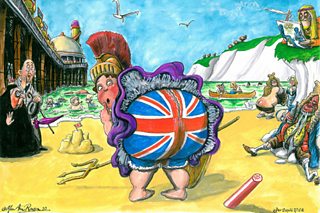
A second decision was to make Rude Britannia multi-media in focus. We would look at the rude traditions of graphic art from Hogarth, Gillray, Rowlandson and George Cruikshank through to the current cartooning of Gerald Scarfe, Steve Bell and Martin Rowson.
We would also look at the rude postcard art of Donald McGill and the first rude hero of British comics - the Victorian anti-hero Ally Sloper. In exploring all the rude media we could think of we found even more naughtiness and filth than we had imagined.
In the eighteenth century, ballads and songs were most certainly rude. This tradition continued into the music hall of the Victorian and Edwardian eras. But British theatre also has fine rude credentials from the Beggars Opera to the plays of Joe Orton.
And new and changing technology created a mass produced rudeness to horrify prude Britain. Rude photography created its own moral panic in the nineteenth century and the seaside peepshows of the early twentieth century - the mutoscopes - gave holidaymakers just the right kind of sauciness they wanted.
And of course in the last fifty years we have lived in what our last programme explains is a mass democracy of rude. Here first radio and then television have given us rudeness in the front rooms of Britain from Round the Horne to Little Britain.
All of this you will find in Rude Britannia - we hope you enjoy the programmes!
Alastair Laurence is the series producer of Rude Britannia.
Rude Britannia starts at 9pm on Monday, 14 June on BBC Four. To see all programme times for this show please visit the upcoming episodes page.

