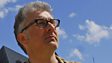
At a meeting just before Christmas 2010 Lucian Freud, a small ancient figure at 88, sitting surrounded by fresh piles of newspapers, with their lurid headlines, suddenly stared, with characteristic bulging eyes, out of the window of Clarke's restaurant in Notting Hill, London.
He had noticed a pair of mounted police, heads down, battling through a sudden heavy snow storm.
The street scene erased in the white-out left just the foreground of chestnut horses and fluorescent riders, like a children's book illustration. Lucian was thrilled with the sight.
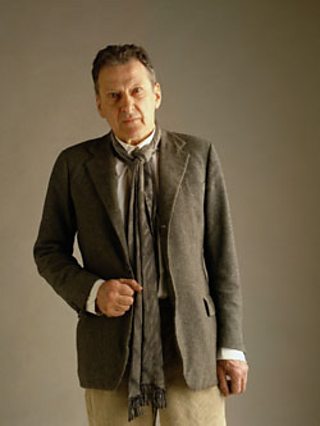
Lucian Freud
I don't want to pretend to have known Lucian Freud. I only met him three times for breakfast, with his wise and practical assistant David Dawson.We met to discuss Lucian Freud: Painted Life - the BBC Two documentary I was to make.
My impression was of someone extremely alert, animal-like, relying for information to a great extent on what he saw.
The bliss of looking, to struggle to capture in paint something precious, the presence of a human being, were his activities 24/7, but as the newspapers and conversations indicated, he was interested in anything.
At the meeting he asked me a few questions about the nature of documentary films, which were sharp, tough, and funny.
"Is a documentary" (residue of German accent) "like a sign that says 'Toilet'? Is it not merely educational?"
He tolerated my fumbling answers, but he expected absolute honesty. Apparently, I was told later by a close friend of his, this was a mild reflection of the much more contrary and confrontational younger Freud.
His questions put a finger on essential issues.
The problem of 'documentary' is that it claims some sort of automatic or special truth, through photography's claim to truth, an idea that dominated Lucian during his lifetime.
Where does the truth about something or someone lie? How do you deal with it in a film? Stop pretending your medium has any built-in objectivity?
Why bother, Freud would say. For him, painting was the only medium adequate to the task of searching for truth.
David Hockney on Lucian Freud's painting technique
Making a painting was the most important thing anyone could try to do, if they were to get close to the essence of things, to approach an absolute truth.
At another meeting, the sun was streaming in. By then Lucian knew I liked his regular food supplement: nougat. He cut me a slice without me asking.
At the end of the film, the art critic Sebastian Smee said that in the company of Lucian he did not feel the need to say anything clever, just to be with someone so intense and so alive was enough. I think that is so insightful.
I hardly said a thing - not that it would have been clever if I had.
Lucian started wiggling his fingers around to make interesting shadow patterns. The shadows were green by some accident of light reflecting from the leaves of flowers on the table.
He enjoyed the sight, and so did I.
We started production in the spring of 2011. Lucian said he would still be around for his exhibition at the National Portrait Gallery which started this month.
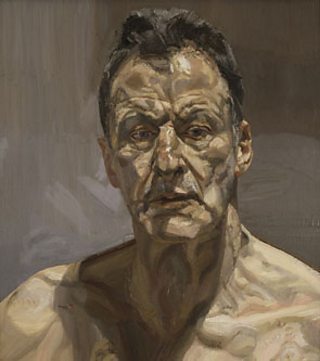
Reflection (self portrait) 1985
But of course he was wrong, in July he died. After his death the whole project changed.Many of his friends and family now felt free to take a bigger part in the film, and, in their grief, to articulate the feelings and insights that are so much in the foreground of the mind when someone you love dies.
The aim of the film is to look more closely, with an open mind, at the work. The editor, Paul Binns, and I tried to deploy the amazingly candid interviews from old friends and family to reveal themes in the painting.
At the moment I write this the composer and musician John Harle is performing a saxophone part for his intensely moving score.
I am sitting in a square room with red curtains on all sides, and a mass of sound mixing technology.
Thinking about Freud makes me look more closely and with greater fascination at the most ordinary of things - to realise what a strange place the world is, and how barely we understand it.
Randall Wright is the director of Lucian Freud: Painted Life.
Lucian Freud: Painted Life is on BBC Two and BBC HD on Saturday, 18 Feburary at 9pm.
For further programme times, please see the upcoming broadcasts page.
Comments made by writers on the BBC TV blog are their own opinions and not necessarily those of the BBC.
