
My main reflection after making When I Get Older is that it was a privilege to stay with Ivy in her home.
Ivy is a pensioner whose housing benefit doesn't cover her rent and she's in debt.
I found it challenging and humbling to live with her for four days and see how she had to analyse the £3 disposable income in her purse every day for food, clothing, toothpaste, toilet rolls, cleaning materials... you cannot do it.
Gloria and Ivy go shopping
I will never shop in the same way again.
I don't have to analyse every crumb that I buy and Ivy absolutely did. For four days primarily we ate bread.
I said to her one morning, can I have an egg, and she said no, because egg and chips makes a dinner.
Also the point about Ivy that we didn't see in the programme is that she is illiterate. A lot of her bills she is not able to read and so her management of her debt was very bad.
At the same time, she was very honourable in meeting the payments but going further into debt.
It was the combination of that plus her considerable health problems that she was so worn down. She'd given up in attitude so that she didn't ask for help although the help was there.
Maybe like a lot of people she didn't know how to ask.
As a mum - and we all do this as parents - she was trying to shield her children from how bad things were for her.
I took her out for a meal once, my treat. She said to me afterwards, "Do you mind me asking how much that was?"
I said it was £48 and she went "Oh my goodness, that would have fed me for a month."
So there was a big intake of breath every so often.
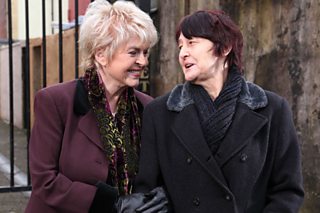
Gloria and Ivy
Even though she knew her privately rented house was eating up all her money Ivy had never asked her local authority for help. She felt that there was no point because it was going to be a four or five year waiting list.
Everything I suggested, her answer was negative, negative, negative.
And it wasn't that I'm involved in TV, it's that somebody tweaked her life that bit and showed her that if you go to your local council they can help with your debt management, if you ask the housing association you might just get an apartment that's cheaper.
I believe that attitude towards ageing is crucial. No matter how near you are to your third life, as I call it, it's the attitude of keeping your brain stimulated and yourself busy.
It's getting up, keeping your friends, and doing stuff for yourself.
I do accept of course that someone like Ivy has health problems but she is quite strong and there are lots of things she can do for herself.
It didn't make the final cut but when we took her to literacy lessons she was top of the class - she realised she knew more than she thought she did.
Since the stimulation of being in the programme, Ivy now has a new life. She has a lovely, cosy apartment which is far more efficient and affordable. She hardly needs to turn the heating on because the heat rises from the flats below - another saving which helps.
It's close to her daughter and she's got that inbuilt family help back. For Ivy now there's a feel-good factor every day instead of sitting alone indoors.
Since we finished filming, she'll ring me up occasionally and she'll go "Gloria, I bought fresh meat today and fresh fruit!" - because I used to say to her, you can't only eat toast.
Ivy taught me probably far more than I showed her.
I was moved by all the contributors in different ways.
Malcolm and Pat on how their marriage has changed since she became his carer
You could see how Philip, who lost his wife, had gone down that black hole of grief and I do understand that from my experience of losing my daughter. It's a mindset, you have to do a lot to help yourself get back out.
I felt very emotional watching Pat, the carer, and her husband Malcolm because you could see (and she was honest about it) her life had been stripped away.
And with John I was amused that there's Peggy, this lady who's cantankerous and on her own but she's quite fit and happy to lead her own life. And I thought, well if that's what you want in your older age, why not? It suits her and that's it.
I hope that by highlighting aspects of old age that we collectively look at the culture of respecting the elderly in the UK.
In countries like France and Italy often you get four generations all living together. Older people have dignity. Their opinion is asked for and people listen to them. I think that many older people feel invisible in this country.
Maybe through some of the issues raised by When I Get Older we could all do a little bit extra in our community.
After all, we all individually know an Ivy, a grandparent or a neighbour where we might be able to bring something to their lives, if only to have a cup of tea and listen to them.
Gloria Hunniford gave this interview at a press screening for When I Get Older.
When I Get Older begins at 9pm on BBC One on Wednesday, 5 July. For further programme times please see the episode guide.
If you would like further information about the issues raised in When I Get Older, please visit the information and support page.
The series is part of the When I'm 65 season - a selection of programmes about issues facing the elderly. The season includes The Town That Never Retired, How To Live Beyond 100 and June Brown: Respect Your Elders.
Comments made by writers on the BBC TV blog are their own opinions and not necessarily those of the BBC.

