My five top Sky at Night moments - by presenter Chris Lintott

Professor Chris Lintott
Presenter
The Sky at Night has seen some incredible things during its 750 programmes: when the show first got started Sputnik had yet to fly, vegetation on Mars was a serious possibility, and Pluto was still firmly a planet!
The production team have always had to be flexible to keep up with breaking news - even the first programme's script was rewritten at the last moment following the appearance of a bright comet in the sky - and as a result the Sky at Night captures the excitement of exploring space. Here are five of my favourite moments:
1. Mariner to Mars (August 1969): The first planet to have a close encounter with Earth's space probes was Mars, with the Mariner Missions. This Sky at Night special was produced in 1969 to highlight the first space probe to return pictures of the red planet.
Patrick’s enthusiasm is wonderful - particularly exciting are ‘the really spectacular pictures’ showing craters rather like those on the Moon. As ever, though, he’s quick to question what we still don’t know; is there life on Mars? The close of the programme anticipates an answer ‘within the next few weeks’ to the age-old question - and it’s something we still debate today.
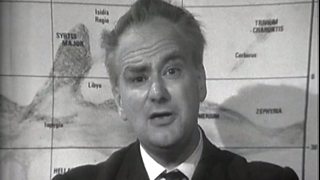
Sir Patrick Moore gets excited about the craters on Mars: "just look at that!"
2. Siberian Eclipse of the Sun (September 1968): Another episode from the 60s, this was an adventure of a different kind, with Patrick travelling to northern Russia for a total eclipse. His producer told me Patrick turned up at the airport with shoes held together only by rubber bands and he wears a suit throughout despite striding about the Siberian tundra.
Although there were technical difficulties in transmission, there’s nothing like a total solar eclipse, and the sheer excitement of the observing party makes this one of the great episodes. It also marks the start of a long Sky at Night eclipse tradition of interviewing people with strange equipment about to do incomprehensible experiments instead of enjoying the grandest spectacle in nature!
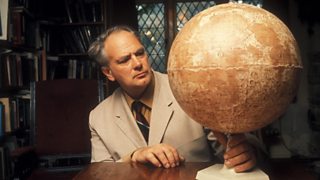
Sir Patrick Moore at his home in 1972
3. Neptune (September 1989): For me, the Voyager encounters with Uranus and Neptune in the late 1980s were the first space 'firsts' I remember, and I found out about them as a viewer of the Sky at Night.
Patrick's trips to the Jet Propulsion Laboratory in California covered all the excitement of these surprisingly interesting worlds. As Patrick says at the start - even on Voyager’s approach, Neptune proved to be more interesting than anyone hoped, from its strange ringlets to the ice volcanoes on Triton (its largest moon). Neptune gets the nod for me.
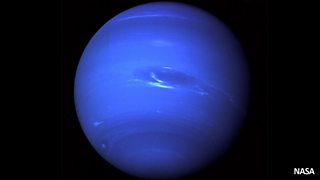
A view of Neptune, composed of images taken by Voyager 2
4. Unveiling Titan (February 2005):The Huygens probe which landed on the surface of Titan (Saturn's largest moon) was one of the great space adventures, and - having joined the Sky at Night team as a reporter by then - I had the enormous privilege of being at mission control. No one had any idea what lay beneath its dense orange clouds, and it was an enormous privilege to be at mission control to wait for the first images to come back.
From the first signals being received late in the morning in mission control itself, to the release of the first images of an icy orange surface, we followed the unveiling of a new world. All from the odd surroundings of the institute’s canteen!
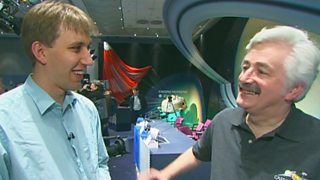
Chris Lintott celebrates 45 minutes of transmission from the Huygens probe
5. Rosetta (November 2014): It seems odd to pick an episode from last year when there is so much wonderful archive to explore, but the landing of Rosetta (a space probe) on comet Churyumov-Gerasimenko in November 2014 was one for the ages.
As well as the dramatic story of Philae (the lander module) and its bouncy touchdown on the surface, we got to know the wonderful Rosetta team who welcomed us into mission control and let us see behind the scenes of these dramatic days. We watched as the spacecraft’s engineers and scientists back down on Earth struggled to understand what was going on - and then raced to make use of its short time awake on the surface.
The best bits of the programme are when we caught up with the often sleep deprived and stressed team behind the scenes - I still find their generosity in talking to us remarkable.
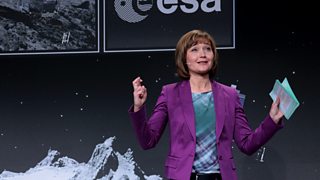
The European Space Agency's Monika Jones waits for some good news
Chris Lintott is a Professor of Astrophysics at the University of Oxford, and presents the Sky at Night.
The Planetary Flybys collection is available to watch in BBC iPlayer as part of the BBC Four Collections.
The Sky at Night's 750th episode is on tonight at 10pm on BBC Four. It will be available in BBC iPlayer for 30 days after broadcast on TV.
Comments made by writers on the BBC TV blog are their own opinions and not necessarily those of the BBC.
