
When I was approached to make a documentary about the fig leaf in sculpture, I sensed a cloud no bigger than a man's hand - or other prominent feature.
Was the subject too slight?
But it turned out that hidden within the roomy folds of this humble frond was an eye-popping story of sex, religion, censorship. Oh, and of art too, of course.
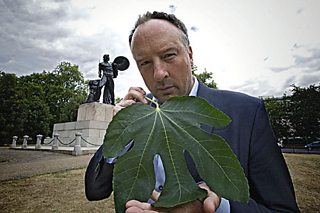
I've been looking at statues in the great cathedrals and galleries of Europe, in a bid to uncover what's behind the fig leaf, so to speak.
And I learnt that it first appeared on Adam and Eve, as the early church emphasised the link between sex and sin.
But I also discovered that the fig leaf has flourished - and wilted - according to the prevailing morality of the day.
In Florence, I was astonished to find that Michelangelo's David was pelted with rocks when it was first unveiled.
The most famous statue in the world shocked Florentines with its nakedness and it was covered by not one fig leaf but an entire shrub of them.
The sculptors of ancient Greece and Rome, whom Michelangelo adored, were entirely relaxed about public nudity. Not so the Vatican of the Renaissance.
The only time the Church encouraged bare flesh was to reinforce the eternal message that the wages of sin are death.
On the carved façade of Orvieto Cathedral, for example, the lost and the damned writhe in hell, without so much as a stitch on.
You might imagine that Queen Victoria took a similar line on the naked form. In fact, historians now think she was much more amused in that department than we give her credit for. But only in private.
In a little-visited vault under the Victoria and Albert Museum in London, I gazed agog at an outsize fig leaf made especially for the monarch.
Not for the royal person herself, you understand, but to shield her eyes from the full glory of a replica of Michelangelo's David, which she used to inspect in the galleries above.
In a square elsewhere in the capital, a statue of Priapus, the god of fertility, is complete in every detail - apart from the all-important one of his defining feature.
That lies 350 miles away, in a drawer in Paisley, where it was reluctantly stashed by its creator, the sculptor Sandy Stoddart.
As Sandy showed me around his studio, the manhood of Priapus was the elephant in the room, if that's the phrase I want.
Yes, contemporary artists can - and do - present sculptures of naked figures in exhibitions now if they wish.
But, as Sandy told me, he could face prosecution if he left Priapus as he'd intended, fully endowed and ready for action.
If only he'd clothed him in a fig leaf instead, I couldn't help thinking.
Nature's jockstrap remains an impressively elastic device, two millennia after it was first twanged into place. And it's not stretching things too far to say that it can still be a snug fit for 21st century sculpture.
Stephen Smith is the presenter of Fig Leaf: The Biggest Cover-Up In History.
Fig Leaf: The Biggest Cover-Up In History is on BBC Four at 9pm on Thursday, 10 February, and is part of Focus On Sculpture, a season of programmes on BBC Four.
Comments made by writers on the BBC TV blog are their own opinions and not necessarily those of the BBC.

