Last Night of the Proms: the best seat in the house?

Phil Hall
BBC Symphony Orchestra
OK, I admit it.
I was a young, foolish, impressionable 16-year-old who spent a week sleeping rough on a street in South Kensington just so I could hang over the rail at the front of the arena on the Last Night of the Proms in 1982.
Just don't tell anyone.
But my abiding memory of that concert was that next time I didn't want to stand up for three and a half hours.
I wanted a seat.
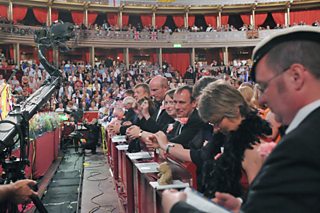
Audience members waiting for the music to start at the BBC Proms
Not any seat. Not a seat in the auditorium: I wanted one on the stage.
Fortunately fate conspired to make that a reality and ten years later I stepped out onto probably the world's most viewed stage (the concert is broadcast worldwide) with a palpable sense of arrival.
Twenty years on and sitting on the front desk of the viola section, some of the novelty has inevitably worn off but the party atmosphere in the hall for the second half hits me between the eyes every time (while the viola section's party poppers hit the back of my head!).
Controversial though some of the antics of the Last Night of the Proms are, (a former controller of the Proms tried to ban the off-putting klaxons and whistles) let us not forget that as well as a celebration it is still a concert.
The 74th consecutive concert in the world's biggest music festival.
A long concert to boot that needs just as much preparation as the eleven others the BBC Symphony Orchestra has done this season.
We still have the pressure of microphones, cameras in your face (literally) and numerous solos to perform to the millions listening and watching.
After a long, hot summer sweating in the Albert Hall it's no wonder that sometimes there can be a few grey faces in the orchestra!
It's been interesting comparing the different conductors who have accepted the 'poisoned chalice' various Proms controllers have offered them over the years.
I'm too young to recall Malcolm Sargent so for my money I'd say Andrew Davis was positively born for the task.
This year we had the youngest ever maestro to take on the challenge since Henry Wood himself: step forward English National Opera's Music Director Edward Gardner.
Plus he's also a Brit, which some people think is important.
I don't think it is particularly; the Vienna Philharmonic play their waltzes just as well if the conductor is Indian, American, French or Japanese.
We can similarly manage an Elgar march and Parry's Jerusalem.
In fact, Ed let slip in rehearsals that he has never conducted Pomp and Circumstance or Jerusalem before.
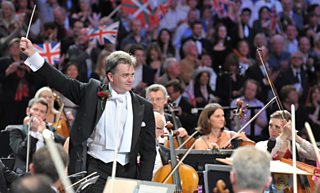
Edward Gardner conducting at the Last Night of the Proms
I got to the hall at 10am on Saturday only to find Roger Wright watching the England rugby team three points down to Argentina in the artist's bar.
I silently hope that's not a bad omen... we had a quick chat and he seemed remarkably fresh considering he'd attended all the Proms and had to deal with the inevitable last minute artist cancellations.
Ed Gardner too looked pretty relaxed. Just as well as this was just about the most frantic general rehearsal there is, what with three hours to rehearse two and a half hours worth of music.
But he kept his cool - and even finished five minutes early.
More importantly he was splendid on the night itself: cutting a dash on the podium, his easy manner was always going to be a hit with the crowd (I mean, audience).
Not a bad speech either. I'd wager this won't have been his last Last Night, although he still has quite a few years to do until he catches up with some of us...
Phil Hall is the BBC Symphony Orchestra's sub-principal viola player. He is a regular contributor to the BBC Radio 3 Blog.
Part one of The Last Night of the Proms was broadcast on Saturday 10th Sept at 7.30pm on BBC Two and BBC HD.
Part two of The Last Night of the Proms was broadcast on Saturday 10th Sept at 9.10pm on BBC One.
Watch a video of Conductor Edward Gardner and the orchestra preparing for The Last Night of the Proms on the About the BBC Blog.

