Birdsong: Interview with the director

Fiona Wickham
Editor, BBC TV blog
Sebastian Faulks' World War I novel Birdsong is about "the violence of a love affair, and exquisite love in war", says screenwriter Abi Morgan, who has adapted the modern classic for BBC One.
Director Philip Martin told the BBC TV blog about the experience of making the two-part drama.
What drew you to this script?
Abi Morgan's brilliant idea was to intercut between past and present, so that the story switches between pre-war France and WWI itself - to create a great tension. Balancing the love story (the past) with the war story (the present) was the challenge.
What kind of notes did Sebastian Faulks make on the script?
Sebastian was a great collaborator and joined us on location in Budapest. He gave us space to do our thing - but was there to help if we needed it. We all carried battered copies of the novel in our back pockets and I think everyone in the cast and crew spent the whole time trying to find ways to do justice to this epic story.
What does the title mean?
Birdsong doesn't quite stand for a peaceful, natural sound marking the ending of conflict - but actually the indifference of the natural world to the activity of humans. There's a great introduction to the paperback edition from Sebastian, where he talks about the meaning of Birdsong and how he wrote the book. It's fascinating to read, especially as it seems he wrote the book really fast - in a kind of trance.
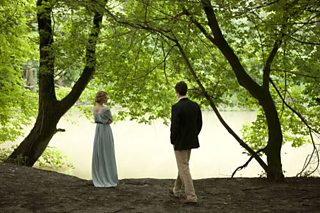
Isabelle Azaire (Clémence Poésy) and Stephen Wraysford (Eddie Redmayne)
This BBC version of Birdsong is described as "painterly" by Ben Stephenson (BBC controller for drama commissioning) - is that how you visualised it?
I wanted pre-war France to feel like a dream: crystal clear yet mysterious. The director of photography, Julian Court and I found a touchstone in a quote from the pre-RaphaeliteEdward Burne-Jones, who said a painting should be "a beautiful, romantic dream of something that never was, never will be - in a light better than any light that ever shone - in a land no-one can define or remember, only desire... ".
What were your thoughts on tackling the erotic tone in parts of the book?
It's difficult in any area to translate something from a book to a film - they're both different. But it's particularly tricky with sex. Eddie Redmayne, Clémence Poésy and I spent long hours talking about it and we tried to be very clear about exactly what was going to happen in each moment - so that the build-up of sexual tension was done in a very precise and detailed way. What we tried to do was to make the experience of the audience watching match the intensity of the experience of reading the book.
There are two horrifying deaths in episode one - typical of WWI - how did you decide how gory to be in showing those deaths?
I suppose you try to make the deaths as powerful as possible, without making the audience switch off. The war was brutal and inhuman, with new technological ways of killing, like gas - so it feels important to reflect that fact... but to do so in a way that isn't self-defeating.
Did the actors visit war graves or the sites of conflict?
Both Eddie Redmayne and Joe Mawle visited the battlefields - and went into a newly discovered chalk tunnel in La Boiselle, with Peter Barton, a WWI historical consultant. I think they were some of the first people to be back inside the tunnel since the war itself. They found a poem, written on the chalk wall of the tunnel by a soldier almost 100 years earlier, which was incredibly moving. I also found the 1916 film of the Battle of the Somme extremely useful for research. Even in black and white, you could feel how hot and dusty it was and get a sense of the strange, upbeat energy of the soldiers - which was unlike anything I'd seen before.
Stephen (Eddie Redmayne) rejoins his men at the front
Were the sets built or on location?
For the war story, we built sets just outside Budapest. I felt the audience's experience of the trenches should be 360, so we searched for a piece of ground which gave us uninterrupted views of the horizon. Production designer Grant Montgomery used hundreds of dead trees, quarried chalk and reclaimed timber to create an extraordinary world. For the French story, set in pre-war Amiens, we filmed on location in Budapest. This was perhaps the trickiest bit, as there's no tradition of the kind of architecture we were looking for.
Can you tell us a little about the uniforms?
We couldn't find enough uniforms in London - and so decided to make them in Poland. Charlotte Walter the costume designer tracked down a company using looms that made exactly the same cloth the original uniforms, and under the watchful eye of the curator of costumes at the Imperial War Museum, Martin Boswell.
Where do you find the replica guns?
We brought some working guns over from London - which gets complicated and requires lots of paperwork, as everyone seems to think you're about to stage a coup! We also had some terrific Lee-Enfield replicas made in Budapest.
How does an actor safely smash a glass on set without getting hurt in the way that Laurent Lafitte (playing René Azaire) does in episode one?
The glass is made out of spun sugar, so it can smash without being dangerous.
What was your worst moment in production?
There was a day when were due to film a lyrical summer picnic sequence when - predictably - after days of sunshine, the Budapest monsoon began. But the day also contained one of my favourite moments, when Stephen and Isabelle's ankles touch on the boat trip. It's all about body language and eyes and faces... like a wildlife film but with humans in it.
Philip Martin is the director of Birdsong.
Birdsong continues on BBC One and BBC One HD on Sunday, 29 January at 9pm. Episode one is available to watch and download in iPlayer until Sunday, 5 February.
Fiona Wickham is the editor of the BBC TV blog.
Comments made by writers on the BBC TV blog are their own opinions and not necessarily those of the BBC.

