Tonight, as Egypt - Children Of The Revolution airs - filmed over a year through Egypt's revolution and tumultuous aftermath - two of the three young people we followed, Gigi and Ahmed, are back on the streets still fighting for the regime to "really" fall.
The third, Tahir, an Islamist tortured in Mubarak's prisons is enjoying his party's first term in an uncertain parliament.
What does it feel like to live through a revolution? That's what this film wanted to answer, by taking us away from the streets and protests and into the real lives of three young people who each wanted the revolution - but for very different reasons.
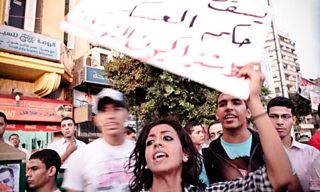
Gigi joins the protest in Tahrir Square, 2011
The crew that worked on the programme across the year included a journalist, Inigo Gilmore, a Cairene ad-man turned revolutionary, Ayman Shabrawy and me, an Egyptian from Brum.
Inigo started to film with Gigi and Ahmed when he met them on the encampment on Tahrir Square's roundabout during those first electric 18 days in 2011 which ended with the dramatic resignation of Hosni Mubarak.
He had filmed with a view to following the story wherever it might lead - and we all knew that 18 days wasn't going to be the end of it.
As for me, I wasn't in Egypt when the revolution started. Born to Egyptian parents in Birmingham, my family and I were glued to the coverage of our people ousting the very regime my parents had fled.
When I stepped down off the plane in Cairo, in the ecstatic haze of the revolution's morning after, it was to follow up with Gigi and Ahmed on Inigo's request to look for a third character amongst the Islamists.
This would be a challenge as the Islamists had been quiet on the revolution itself but we knew that they were going to become major players in whatever happened next.
At the time it was incredible to be part of such optimism. The country was revolution crazy - one leading pizza store was even advertising 'democratic pizza' - where you could choose your own toppings. However, it didn't last.
Filming in Egypt was extremely difficult. Egyptian state television stoked up fears of foreign forces at work to destroy the country.
With Libya at war and Syria brutalised, there was a real anxiety that Egypt could end up with the fate of either.
Distinguished by my British-sounding Arabic and wielding a camera and tripod, the team was mobbed several times by people convinced that we were, at worse Israeli spies filming state secrets, and at best, foreigners up to no good.
So it wasn't altogether a pleasant ride. But who said revolutions are easy?
Most of the time we had no idea what would happen next. Initially, what looked like a lull was the calm before the storm.
Ahmed struggles to find work
At Tahrir Square, the revolutionaries constantly told me that the army would invade at any moment. Sometimes weeks would pass like that.
We spent the year waiting, wanting to be there when it happened but also wanting to be away from the protests, inside living rooms, listening to the real conversations on the other side of town.
At times, living through a revolution seems very ordinary - like Ahmed going to his barber the day after the fall of Mubarak.
For me this year has been extraordinarily difficult - trying to film in a country where many people were scared of finding fault with the military, the last bastion of national pride and security.
Where we were perceived to have an anti-military agenda we faced even more harassment, accused of being conspirators.
The Maspero massacre that features prominently in the film, where army tanks ran over protestors in October 2011, was a very dangerous moment in Egypt. The nation was splitting and our film was trying to straddle the divide.
Despite the negative events there is something overwhelmingly powerful about what I saw in Egypt this year - after 30 years of silence there is no way to turn to clock back - the price will be more deaths, but the prize is freedom.
May Abdalla is the director of Egypt - Children Of The Revolution.
Egypt - Children Of The Revolution is on BBC Two and BBC HD at 7pm on Friday, 3 February. For further programme times please see the upcoming broadcasts page.
Comments made by writers on the BBC TV blog are their own opinions and not necessarily those of the BBC.

